Homeschooling can open the door to deep connections, joyful learning, and creative opportunities. Just ask Nadia, a teen ballerina and entrepreneur who has been immersed in Charlotte Mason homeschooling since childhood. In this Homeschool Conversation, Nadia shares how her education sparked a lifelong love of Shakespeare, prepared her for college-level classes through the power of narration, and even gave her the confidence to launch her own business, Bluebirds and Blackberries Studio, where she creates Shakespeare resources for families. Whether you’re looking for practical tips to make Shakespeare fun and approachable, encouragement for homeschooling high school, or advice for young entrepreneurs, this episode is full of insight and inspiration to bring beauty and joy to your homeschool.
{This post contains paid links. Please see disclaimer.}
- A Charlotte Mason Childhood and the Love of Learning
- Building Connections Through Literature and History
- Homeschooling, Narration, and College Preparation
- Discovering Shakespeare as a Friend, Not a Chore
- Bluebirds and Blackberries Studio: Creativity Meets Entrepreneurship
- Books, Breaks, and Best Homeschool Tips
- Key Takeaways:
- You may also enjoy:
- Find Nadia Online
- Check out all the other interviews in my Homeschool Conversations series!

A Charlotte Mason Childhood and the Love of Learning
Nadia, a ballerina and entrepreneur, has been immersed in Charlotte Mason education since early childhood. As the oldest of four, she’s experienced both homeschooling and a year in public school, which gave her perspective.
“Even though I had a very positive experience with my public school year, we ended up deciding that home education was a better fit for me, because I really wanted to devote more time to my ballet training.”
Central to her Charlotte Mason education is the idea that education is about building connections.
“Education is the science of relations.”
Nadia explained how this shaped her way of seeing the world:
“You can really just have so many better conversations, so much deeper thought on a subject when you are connecting it to the other things that you have seen or read about in your life.”
Building Connections Through Literature and History
From Genevieve Foster’s books to composer and artist studies, Nadia recalls how her education taught her to see interwoven patterns in history and culture.
“We used to read Genevieve Foster’s books … and they really just helped us see how everything was interconnected.”
She loved how this kind of study sparked her curiosity and helped her notice connections everywhere.
Homeschooling, Narration, and College Preparation
While Charlotte Mason education avoids traditional tests, Nadia still found she was well-prepared for college-level work. Currently enrolled in dual-enrollment classes, she credits her background with building independence and initiative.
“Our end of term assessments were really like a celebration of everything we learned.”
When transitioning into standardized tests, she found narration a surprisingly helpful tool.
“Narration really helped me with my writing skills for essays and for research papers.”

Discovering Shakespeare as a Friend, Not a Chore
Nadia’s love for Shakespeare began young, with recitation and joyful engagement.
“It just made Shakespeare feel like an old friend and not something scary or hard.”
One of her earliest memories is of a passage from A Midsummer Night’s Dream:
“One of my favorite quotes is, ‘I know a bank where the wild thyme blows.’”
Not surprisingly, that same play remains her favorite Shakespeare experience.
Bluebirds and Blackberries Studio: Creativity Meets Entrepreneurship
Nadia’s business grew from her own need to keep track of Shakespeare’s many characters.
“I have 16 plays right now that I’ve made sets for.”
Through entrepreneurship, she’s learned confidence, customer interaction, and time management.
“One of the biggest ones I learned was to be afraid to do something and to just take the leap and do it anyway.”
Her advice to other young entrepreneurs is clear:
“Just believe in yourself. You don’t have to have everything perfect.”
Books, Breaks, and Best Homeschool Tips
Recently, Nadia has been reading The Enchanted April by Elizabeth von Arnim and Agatha Christie’s 4:50 from Paddington. For struggling homeschool days, her advice is simple but profound: step away, refresh, and return ready.
Key Takeaways:
- Charlotte Mason’s “science of relations” gave Nadia a love for learning.
- Genevieve Foster’s books helped her see interconnectedness in history.
- Narration built skills for essay writing, research, and synthesis.
- Homeschooling allowed her to pursue ballet training more deeply.
- Test-taking was an adjustment, but narration and flashcards helped.
- Shakespeare became an “old friend” through joyful recitation.
- A Midsummer Night’s Dream remains her favorite play and memory.
- Bluebirds and Blackberries Studio grew from her own homeschool needs.
- Entrepreneurship taught her courage, persistence, and time management.
- Her best homeschool day reset: water, a short break, and fresh air.
You may also enjoy:
- Narration as the Art of Learning: A Conversation with Adrienne Freas
- Learn in Color: curiosity, flexibility, and entrepreneurship (with Samantha Shank)
- Exploring Shakespeare With Children: How to Play with the Bard in your Homeschool
- 6 Shakespeare Monologues Everyone Should Know
- Textbook Free History Masterclass
Find Nadia Online
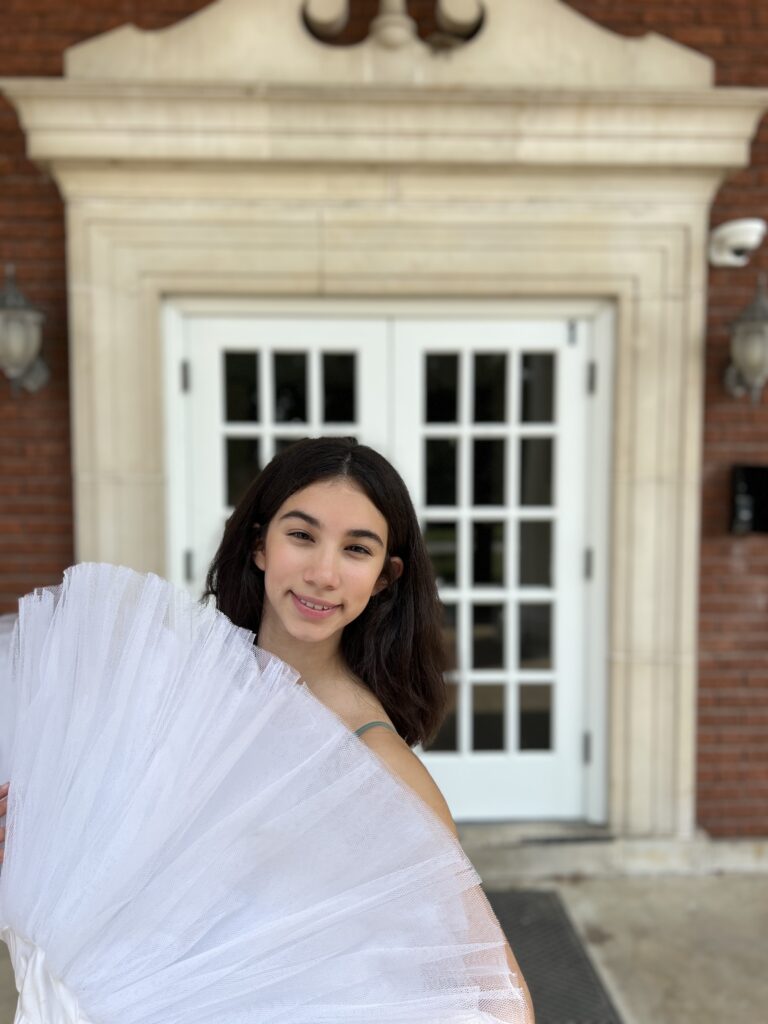
Nadia is a ballerina and entrepreneur in grade 11. Since she was 11 years old, Nadia has been helping families bring Shakespeare to life through the Shakespeare puppets, artist studies, and recitation sheets she has created to make Shakespeare lessons feel rich and vibrant. When she’s not designing resources, you can find her baking delicious treats, reading books, or training towards her dream of being a professional ballerina.
Check out all the other interviews in my Homeschool Conversations series!
Amy Sloan: Hello friends. Today I am joined by Nadia. She is a ballerina and an entrepreneur in grade 11. Since she was 11 years old, Nadia has been helping families bring Shakespeare to life through the Shakespeare puppets, artist studies, and recitation sheets she has created to make Shakespeare lessons feel rich and vibrant. When she’s not designing these resources, you can find her baking delicious treats, reading books, or training toward her dream of being a professional ballerina. Nadia, I have enjoyed following your Instagram account for a while, and I’m so excited to chat with you today. So first, here at the beginning, just tell us a little bit about yourself, your family, and your background with homeschooling.
Nadia: Sure, I’m so excited to be here. I’m a ballerina. I currently train about 22 hours each week, and I’m also an entrepreneur and the oldest of four kids. And I’ve been taught using Charlotte Mason’s educational philosophies pretty much since I can remember. So I’ve really been immersed in that method of education for a long time. And I also have a somewhat unique experience with that because I went to a public school for my ninth grade year. And so I can kind of compare and contrast the two. And I ended up, even though I had a very positive experience with my public school year, we ended up deciding that home education was a better fit for me, because I really wanted to devote more time to my ballet training. And I just felt like I’d have a richer education and learn more efficiently at home than in a public school.
Amy Sloan: Well, what have been some of, I guess, the foundational or most important parts in your experience from receiving this Charlotte Mason home education?
Nadia: I think really the concept that education is the science of relations. That’s something I felt like was really skipped over or not really given a lot of attention to when I went to public school. And I think that really makes for such a rich and well-rounded education. You can really just have so many better conversations, so much deeper thought on a subject when you are connecting it to the other things that you have seen or read about in your life. And that’s something I really love when I’m homeschooling. I can just share with my mom the connections I’ve made on a subject. And we have such wonderful conversations about it. So that’s something I really love.
Amy Sloan: Would you say that those connections, that science of relation, is something that you’ve noticed yourself and it’s something that’s sort of more organic? Or is it something that your mom kind of brings out or laid a foundation for? Or how did you kind of begin seeing those connections?
Nadia: I think we definitely had like a foundation laid out for us. We used to read these books. I think one of them was like Columbus’s World, or like it was the world of the person. It was focused on one person.
Amy Sloan: Genevieve Foster books?

Nadia: Yes, Genevieve Foster’s books. And they really just helped us like see how everything was interconnected. And it was so neat. I never explored like history or science or anything like that before. And I think that really laid the foundation of like that curiosity to find out like, oh, this is connected to something else and just find that web of things that are related to each other.
Amy Sloan: So I was actually homeschooled myself and read those books in my own student years and then have enjoyed them many times with my own children. And so for anyone listening, I will make sure to put the link to those titles in the show notes because it is so fascinating, right, to see how all these different people and events and ideas are happening all around the world. And they’re interacting with one another. And it’s not just like this isolated topic here, topic there, time period here. Real history and science and life is always connected because it’s about real people who are complicated and multidimensional.
Nadia: And I think building on that as well, like we’ll read about a piece of art or listen to a piece of music in our composer studies. And then I’ll come across the piece of art in an art gallery or something by the same artist. And I’ll just like see it and I’ll be so excited because I know this thing. I know this person who or about the person who painted it. And it’s just really neat seeing that like come to play in real life.
Amy Sloan: Well, as you’ve had the experience with, you know, a Charlotte Mason approach to education, which typically doesn’t have, you know, graded exams or worksheets and tests in the same way that maybe a traditional modern schooling might be, someone might be expecting or used to. How had that background impacted your ability to transition? For example, you had a year where you were at public school or as you’re taking potentially college level classes and things like that. Were you able to transition into a more standardized form of assessment or how did that work for you?
Nadia: Yeah, so I’m taking dual enrollment classes currently through a local college. And I think that my Charlotte Mason education really did lay a great background for even traditional test taking. And we didn’t do that a lot. I remember I was nine and like my friends were, who went to traditional school, they were all stressed about their tests. And I was so confused because I love their end of term assessments. Ours were really like a celebration of everything we learned. But going into like my university courses, I feel like really being able to teach myself and to find the connections between things and to just have a very proactive approach to my learning and not waiting for someone to come and spin feed it to me. But like going out there and taking the materials and the resources that they provide us with and using that to further my own knowledge, my own education. That’s something that I don’t know that traditional schools teach that necessarily. And that’s something that’s been really valuable for me. One thing that I did struggle with for normal, like traditional tests was studying for them because I usually just read something, I’ll narrate it and we don’t really have to memorize like long lists of dates, long lists of terms. We just kind of learn about them organically throughout our readings and like whatever we’re doing. So that was a bit of a struggle for me, but I found a few things that helped. And one of those was just making flash cards, going through like the lectures or the readings. And I would just make mini narrations on those. So like bullet points of the most important things and then just read those over again so that I would make sure everything was sticking in my brain. Yeah, so that’s been really helpful.
Amy Sloan: I think that’s such a good point that you bring up because narration, someone might think, well, is narration really going to be enough? Just saying it back. But how you’ve actually been able to use that skill, that way of reading and listening and thinking and remembering. And then kind of using that almost as a note-taking, as a note-taking tool. Because it’s given you that habit of attention, that ability to think of what’s most important here and kind of synthesizing the material.
Nadia: Oh yes, definitely. And it’s helped a lot for writing essays as well because you have to synthesize a lot in the essays for like between the different sources that you’ve taken. And I think narration really, really helped me with my writing skills for essays and for research papers just because we’re so used to doing like the synthesizing without calling it synthesizing. But that’s what we’re doing in our narrations.
Amy Sloan: I know that my own kids who have done dual enrollment, so my oldest two have graduated from our home school and my own experience as a home school graduate, I think one other thing that’s really unique about coming from a Charlotte Mason classical, this sort of unique homeschooling approach is there’s also an interest in learning. Like this is exciting, right? We’re motivated to want to know the material, to want to explore and not just check the boxes. And so that is not necessarily a content thing that you can check off a list, but that is so important as you go on into university studies or just lifelong learning to actually have an interest and a wonder and a sense of like motivation in pursuing the learning.
Nadia: For sure. That’s something that I really felt the difference in that when I went to traditional school and it really felt very much just teaching for the test. And I love to learn, I love to explore what I’m reading about. And I just really felt the difference between home education and traditional education in that sense. Yeah.
Amy Sloan: Well, one of the things that is very exciting that you love, that our family also loves, and one of the main reasons I wanted to chat with you today is because I know that you also have a love for Shakespeare. And so I’m curious how homeschooling gave you the freedom to approach your studies of Shakespeare maybe differently than you would have otherwise.
Nadia: Yes. So I think that that was something that I really saw the difference in when I went to traditional school because my mom introduced us to Shakespeare quite young, actually. We were, I think I was seven when we first started doing recitation of the Shakespeare plays. So we, she would pick a passage that was memorable or funny and we would recite it for our recitation. And then in fourth grade, I started doing the full Shakespeare plays and we started with A Midsummer Night’s Dream. And I think that’s such a perfect play to start with because it’s full of mischief and just mayhaps. And it’s really fun to start with and make Shakespeare a really memorable, enjoyable experience. And when I went to school in ninth grade, that’s when most traditional schools start Shakespeare. They started in high school and they usually start with Romeo and Juliet for whatever reason.
Amy Sloan: No, it’s one of the deep mysteries of life. Why in the world? That would be the first one.
Nadia: Right? So my English teacher, actually, we started reading the original text for two lessons and then she decided it was too hard for her class and we were going to read the Sparknotes version. I don’t know if you are familiar with the Sparknotes version, but it’s just the translation of Shakespeare into modern English. And that really takes away from the play because you’re reading the play and you’re in the original text and you’re getting this beautiful rhythm, like the richness of the words, and it’s like poetry. And when you read the modern English translation, that’s lost. And that’s really one of the reasons I love reading Shakespeare is for that richness and beauty of his words. And so it just really was a very different experience than how we had approached Shakespeare in our homeschool.
Amy Sloan: Yeah, I love to include Shakespeare in our homeschool. I have one of my favorite videos is of my fourth child, but this is when she was like maybe two years old and she was lisping her way through, I know a bank where the wild time flows. You know, she had just heard it with her older siblings reciting it right. And there’s something so beautiful when you can introduce it in a joyful way in those younger years so that by the time you get to the teen years, and maybe you do want to go into more in-depth literary studies of the text, you already are familiar with the style, the rhythm, the lyricism. And it’s like, oh yeah, of course I’m going to, I love Shakespeare. Let’s think about it more deeply, right? It takes away that intimidation factor that I think sometimes teens and adults can feel when it’s not been something that’s been a part of their regular life.
Nadia: Definitely. And I think that’s one of the reasons recitation is a great way to introduce Shakespeare because by the time we were reading the full plays, it was really like a scavenger hunt almost because we would read the play and we’d come across the passage we’d recited and we’d be like, oh, there’s our passage. And it just made Shakespeare feel like an old friend and not something scary or hard like I know it can feel for some people.
Amy Sloan: Yeah, no, I love that. It’s very fun when we will have, you know, memorized some long and recited together some longer passages. And then I’ll often have just a page of kind of key quotes from a play that we will recite together. And then if we watch a film version or see, you know, a theater adaptation, it is, it’s really fun. You have all these little hooks throughout the whole play. I’ll be like, oh, I know that one. Oh, I recognize that quote. You know, it makes it a lot more fun. I definitely agree. Well, do you have, oh, sorry, go ahead. Oh no, go ahead. I was just going to ask if you have a particular favorite Shakespeare play or quote or character, and it can be more than one. I know it’s hard to pick a favorite.
Nadia: Actually, one of my favorite quotes is that one you just mentioned, I know a bank where the wild thyme blows. That was one of the first passages that we recited. I think I was maybe seven, and I still remember it, most of it to this day. And coincidentally, my favorite play is also A Midsummer Night’s Dream, where that passage is from. We actually, I came across that play first in Ballet Shoes by Noelle Streetfield, because two of the girls in that book, they act in the play. And so when we started reading the play, I had already recited that passage. I already knew about it from that story. And so it was a really fun play, really, I think one of my most enjoyable experiences with Shakespeare. And then eventually my brother and I also started planning our own production of it, which never got past the planning stage, but it’s just a play that has a lot of sweet memories for me.
Amy Sloan: That is really fun. I enjoy many of our memories of recitation from that, although I have to say, I think my favorite comedy is still probably Much Ado About Nothing. But it’s interesting because you are remembering all those good memories, and that’s sort of one of the reasons why you love Midsummer Night’s Dream. And I think for me, Much Ado About Nothing kind of holds that same place for my own childhood and teen years. And so for me, it’s sort of the play closest to my heart. And even though there are others that are wonderful and great, I always kind of return to Much Ado. So much of that is with memories, right? Which is a good reminder for homeschool parents listening that associate these beautiful things with good memories, and it helps develop the love for the literature.
Nadia: Exactly. And I mean, we used to act it out. There’s just so many wonderful things that I remember, and I don’t really remember us struggling as much as the memories that we made while we were doing the plays.
Amy Sloan: Well, tell us a little bit about your business, Bluebirds and Blackberries Studio, because this is related to the topic of Shakespeare. What products do you offer there, and how has running the business kind of built upon and been a part of your education?
Nadia: Yeah, so this business actually started because we were having a really hard time keeping track of the characters in our Shakespeare play. And my mom had looked online for printable puppets to help us keep track of them, and she just couldn’t find anything. So I decided, oh, well, you know what? I’m going to try. I’m going to see what I can do, and I’m going to try to make these printable puppets for our play. And it just kind of grew from there. I think I have 16 plays right now that I’ve made sets for, and I make coloring sheets and watercolored sets. And they’re printable, so they’re just digital PDFs that families can print at home. And then I also have recitation sheets and artist studies that I’ve created to kind of go along and help with the Shakespeare play.
Amy Sloan: So it started just with you wanting the puppets yourself, kind of keep track of all the characters, which can be tricky sometimes in a play. And then you’ve turned it into this whole business. So how has sort of entrepreneurship and building a business been part of what you- of your own education and learning? And then what advice would you give other teens and kids who maybe are interested in pursuing entrepreneurship themselves?
Nadia: Well, I think it really built upon my education, and it gave me so many life skills as well. One of the biggest ones I learned was to be afraid to do something and to just take the leap and do it anyway. I mean, even this podcast I was a bit nervous going on to, but it’s been such a fun experience so far. Last summer, I was invited to the CMI conference to do a talk on entrepreneurship, and I was really, really nervous to go. And I almost didn’t, but my mom convinced me in the end, and I’m so glad I went. It was such a wonderful experience, and I’m so grateful that I had that opportunity and I took it. And I mean, there’s other life skills like learning how to interact with customers and even other business owners. Those are really, really valuable skills. I mean, when you’re running a business or even if you’re working for someone else, and also time management, which is something I do struggle with. I have ballet to keep track of and also school, and that doesn’t leave a whole lot of extra time for running a business. So I have to be really thoughtful about where I’m putting my time so that I can achieve the goals I want for my business.
Amy Sloan: If another teen is listening and thinking, well, maybe I want to, I have this idea, and maybe I want to start a business, would you have any advice or perspective to share?
Nadia: Oh, definitely. I think just believe in yourself. Just know that you have a wonderful idea and that you need to go for it and do it. And you don’t have to have everything perfect. You don’t have to have everything figured out to start with. I didn’t even have my own website when I started my Shakespeare Puppets. I just had this idea and I knew I wanted to try it. And I think asking other people for help is, they’re always going to want to help you. You’re a young entrepreneur. People are always willing to help and support that, even just by spreading the word or sharing about it, with their friends or donating supplies to you. You’ll never know unless you ask. That’s another thing that I learned. And then just figure out what makes you different. Figure out what makes your offering unique and really find the people that need that. And don’t get discouraged. It’s so easy to get discouraged. You just need to be persistent and remember that you had this idea for a reason. God gave you this idea for a reason and you need to pursue it to give the beauty and joy that your idea will give to the people who need it. And there are going to be some days that are hard. Maybe you haven’t made a sale yet. Maybe you just feel like no one is seeing what you have to offer. And you need to remember that there are people who are supporting you. There are people who want you to succeed and you just need to find your people.
Amy Sloan: I think that’s such good advice because so often, whether we’re, you know, a young person or an older person, it can be intimidating to do something and worry we’re going to fail or think, well, it’s not perfect yet so I better not start. I think it was Chesterton who said something like, a thing worth doing is worth doing badly. And not in the sense of you should do a bad job on purpose or excellence doesn’t matter, but in the sense of not waiting until you have it all figured out. Not waiting until you can do it just right. Just jump in and try to do that simple thing. The simple thing that you actually do is better than the perfect thing you never start. I say that all the time because it relates to so many things in life, including, I think, starting your own business.
Nadia: I would certainly agree. That’s something that I have been working on to not make everything perfect to begin with and to just start and just to just share my ideas with the world.
Amy Sloan: Yeah, it’s kind of like when you’re writing an essay. I often will tell my kids, you can’t edit a blank page. So the first draft, just get something messy and terrible out on the page and then you can edit that and make it better. But if you just stare at the blank page, you know, there’s nowhere really to grow or change from that. I would also mention that I think maybe in season one or two, many, many years ago when I first started the podcast, I interviewed the owner of Learning Color and she was a homeschool graduate, also started an online business in her teens that is now a full-time gig for her. So I will make sure to put that link in the show notes for this episode as well in case someone listening wants to go and listen to that as well. Nadia, this has been so delightful. I am really glad that you were willing to try something new, come on a podcast, and share your experience with us both as a Charlotte Mason homeschooler and a fellow Shakespeare lover and business owner. But here at the end, I want to ask you the questions that I ask all of my guests. And so the first is just what are you reading lately?
Nadia: I actually have two books started. So one is The Enchanted April by Elizabeth Von Arnim and it was written in 1922 and I’ve just been really enjoying that one. And then also an Agatha Christie mystery. It’s called 450 from Paddington and that’s been another one that’s been a fun read.
Amy Sloan: Agatha Christie is always a good option. It’s very mysterious to me how murder mysteries are such comfort reads for me, but you know everything always turns out okay in the end. So maybe that’s what it is. And then my final question for you would be what would be your best tip for turning around a homeschool day that seems to be going all wrong?
Nadia: For me, taking a short break and just resetting my space kind of. So I’ll take like a drink of water because I’m so often dehydrated and then maybe going on like a five-minute walk, even just like stepping outside into nature. It really helps just reset your mind and you come back in and I feel so much more focused afterwards.
Amy Sloan: Yeah, very good advice. Hydrate and go outside. Probably something we should all put down, you know, put down the earbuds, go outside right now. Well Nadia, where can people find you all around the internet?
Nadia: I have my Instagram account where I share like literature and Shakespeare tips, Bluebirds and Blackberries Studio, and then my website where you can find all my Shakespeare resources. And I have a few blog posts coming out as well on helping with Shakespeare and that’s bluebirdsandblackberries.com.
Amy Sloan: Fabulous. And I will have those links in the show notes for this episode at humilityanddoxology.com. I will also make sure to link up to some of my Shakespeare resources as well because I hope everyone listening is inspired to include a little bit of Shakespeare in their homeschool this year. Grab some of Nadia’s puppets and a few simple recitations and enjoy that beauty as a family. Please take a moment wherever you are listening or watching to leave a rating and review for the podcast, to share this episode with a friend, and until next time, happy homeschooling.