
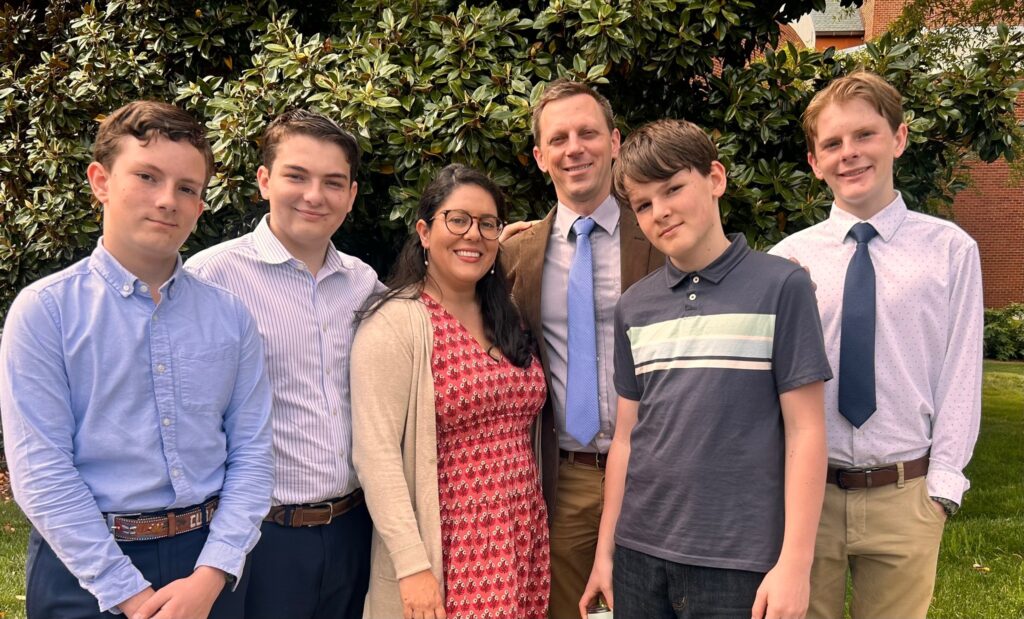
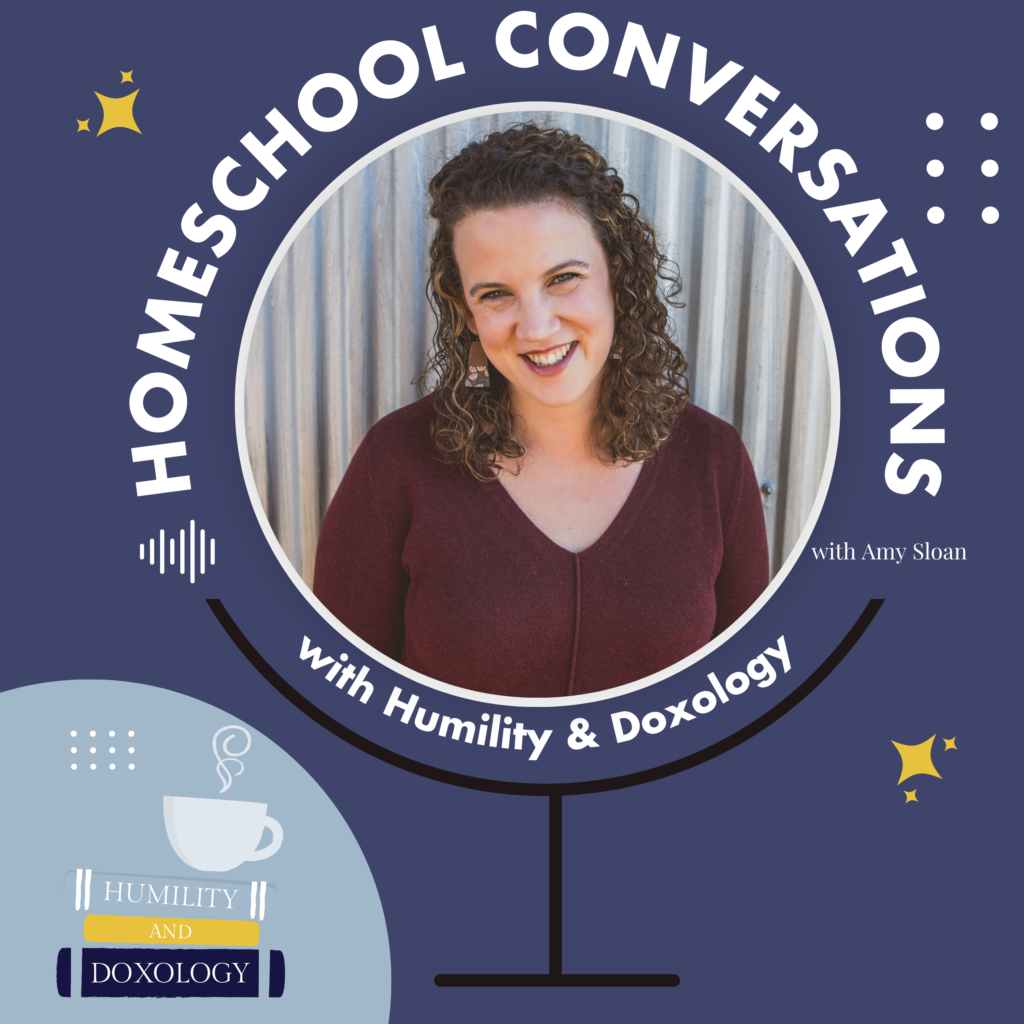
In this episode of the Homeschool Conversations podcast, I was delighted to chat once again with Elsie Iudicello, a homesteader, homemaker, and homeschool mom to four teenage sons. Our conversation was rich with wisdom, encouragement, and practical insights for homeschooling and parenting in the teen years.

{This post contains paid links. Please see disclaimer.}
- Homeschooling from the Beginning: Elsie’s Journey
- Growing with Our Children: How Homeschooling Evolves
- Parenting Teens Doesn’t Have to Be Scary
- Talking Through the Hard Things
- What Truly Matters in the Long Run
- Elsie’s Best Homeschool Reset Tip
- What Elsie is Reading Lately
- Key Takeaways
- You May Also Enjoy:
- Where to Find Elsie
- Check out all the other interviews in my Homeschool Conversations series!

Homeschooling from the Beginning: Elsie’s Journey
Elsie has been homeschooling since her firstborn (now 17) was born. With a background in public education, she had to unlearn some traditional methods to embrace the freedom and natural rhythm of homeschooling. Over the years, her philosophy has been deeply influenced by Charlotte Mason and a growing maturity in faith.
“There wasn’t really a day where we were like, we are officially homeschooling. It just felt pretty seamless.”
Growing with Our Children: How Homeschooling Evolves
As her sons have grown, Elsie has embraced the beauty of change. The transition from childhood wonder to teenage questioning is something she sees as essential, even when it looks like resistance.
“Resistance meant that they were really thinking things through for themselves.”
She emphasized the importance of giving teens space to wrestle with truth, make mistakes, and develop their own convictions.
Parenting Teens Doesn’t Have to Be Scary
Far from the fear-driven narratives many parents hear, Elsie finds parenting teens to be a joy. She celebrates the relationship she continues to build with her sons, their emerging identities, and the deep conversations they now share.
“Watching them play as teenagers makes me so happy… I got to witness the connection now in the teen years.”
Of course, the challenges exist too. Helping teens slow down, reflect, and take ownership of their actions is key. And timing matters. Many of the most impactful parenting conversations happen outside of conflict and in moments of peace.
Talking Through the Hard Things
Life has brought deep personal loss and change for Elsie’s family. She shared the importance of modeling faith in action through trials…not perfectly, but with much prayer. Whether it’s grief, cultural turmoil, or mental health struggles, Elsie encourages honest dialogue and shared prayer.
“Prayer isn’t a band-aid. It’s the rock we kneel on.”
When discussing hard topics, she often begins with one simple question: “Do you have any questions about what’s going on right now?” This helps kids process in age-appropriate ways and opens the door for meaningful conversation.
What Truly Matters in the Long Run
As she looks toward the final years of homeschooling, Elsie is deeply thankful for the priorities they’ve held: time outdoors, family connection, books, and prayer.
“I’m so glad that we were a single-income homeschool family… I could get really creative with our dates.”
She’s learned to let go of expectations about being a “fun mom” and embraced the beauty of faithfulness over performance.
“It’s not about the mom’s performance. It’s about the beauty of the things she’s laying before the kids.”
Elsie’s Best Homeschool Reset Tip
What do you do when the homeschool day goes off the rails? Elsie recommends pausing to identify the real problem. Whether it’s a heart attitude or a developmental readiness issue, the remedy changes depending on the root cause.
And often, the answer is simple: get outside, read together, and reconnect relationally.
What Elsie is Reading Lately
Elsie’s current reads are just as thoughtful and delightful as her homeschool:
- The Weight of Glory by C.S. Lewis (with her son)
- Confessing the Faith by Chad Van Dixhoorn
- Confessions by Augustine
- A stack of George MacDonald novels, including Robert Falconer
Key Takeaways
- Homeschooling is a lifelong, evolving journey, not a rigid structure; embrace growth alongside your children.
- Teens’ resistance is often a sign of growth, not rebellion. It shows they’re thinking for themselves.
- Parenting teens can be joyful and rewarding, despite cultural fearmongering.
- Space, silence, and trust matter: teens need room to fail, process, and grow.
- Big conversations should happen in peaceful moments, not just during crises.
- Hardships are opportunities for discipleship, not interruptions to avoid.
- Prayer is the foundation, not a fallback, when facing grief or complex issues.
- Time outdoors, reading, and simple one-on-one moments have long-term impact.
- You don’t need to perform to be a good mom. Faithfulness matters more than flair.
- Pause and assess what’s really wrong before trying to “fix” a hard homeschool day.
You May Also Enjoy:
- 3 Things I’ve Learned as a Mom of a Homeschool Graduate
- Homeschooling High School: Transforming Worries into Triumphs
- Parenting Teens: the Most Asked Questions and a Real Mom’s Answers
- Conversations, Relationships, and a Charlotte-Mason Education During High School (with Jami Marstall)
- Tweens, Teens, and other Homeschooling Joys and Challenges (with Jessica Jensen)
- Raising Our Expectations: Homeschooling the High School Years
- Aestheticore: Gen-Z and the Teen identity crisis
- Homesteading and Homeschooling (with Elsie Iudicello)
Where to Find Elsie
Elsie Iudicello is a homesteader, homemaker and homeschooler. She lives on a small farm with her husband, Jeff, and four teenage sons. She writes for various publications and loves learning old ways.
- Instagram: @farmhouse_schoolhouse
- Wild and Free
Check out all the other interviews in my Homeschool Conversations series!
Amy Sloan: Hello friends. Today I am joined by Elsie Iudicello. Elsie is a homesteader, homemaker, and homeschooler. She lives on a small farm with her husband Jeff and four teenage sons. She writes for various publications and loves learning old ways. She’s actually been on the podcast before, so I’ll definitely put a link to that conversation below so you can check it out. But I’m just really looking forward to chatting with you again today, Elsie. So, can you tell us a little bit about yourself and your family and your history with homeschooling? Thank you, my friend.
Elsie Iudicello: It’s really good to be here with you. Sure. We have been homeschooling from the very beginning. Whenever people ask, I always want to say 17 years because that’s how old my eldest son is. And it really does feel like we’ve been homeschooling since they were born. I feel like there was ever really a day where we’re like, we are officially homeschooling, like one day just along the way, we’re like, okay, so this is homeschooling, this is what we’re doing. And it felt like a very natural transition, even though I was very awkward in that transition because I had so much, not unfortunately, but I had been trained to be a public school teacher. So there was a lot that I had to unlearn as I was trying to homeschool my children, but that was more to do with me and less to do with how they transitioned into homeschooling. It just felt pretty seamless. So we’ve been homeschooling a long time, and I think there were a lot of natural changes. The more we read, the more we understood, the more we learned about our kids and that young adult moment, especially if you had kids when you were really little, really little, really young, where you think to yourself, oh, we’re not the same people. My children are not an extension of myself. they are entirely different persons. So those sorts of realizations, reading Charlotte Mason philosophy was definitely a big game changer for us. I think the more we matured in our spiritual walks and our faith, it certainly changed and shaped our perspective. And then of course, one of the joys of homeschooling is that you are becoming a broader person as you increase and expound on your own education. so things just tend to get deeper and richer if you are as invested in education as you’re asking your children to be. So it’s changed a lot.
Amy Sloan: Yeah, I can relate to so much of that as well. So my oldest is 20 and I was 20 when he was born. So that decade of my 20s, which is already a time when you’re changing and growing and maturing in so many ways was also when I was learning how to be a parent. And so there’s so much humiliation that goes into that process, but it’s, you know, through those years of like what you were saying, you know, learning these are not extensions of me, these are unique persons, and what does God have for us as a family? But then you’re kind of also growing and figuring things out alongside your children, and it’s a beautiful thing where they get to see that it’s okay for you to not know everything. Like, I am not their savior. We all need Jesus together, and mom doesn’t always know what she’s doing. Well, in what ways have your approaches to home education changed or deepened as your sons have grown older? Because now you have four teens?
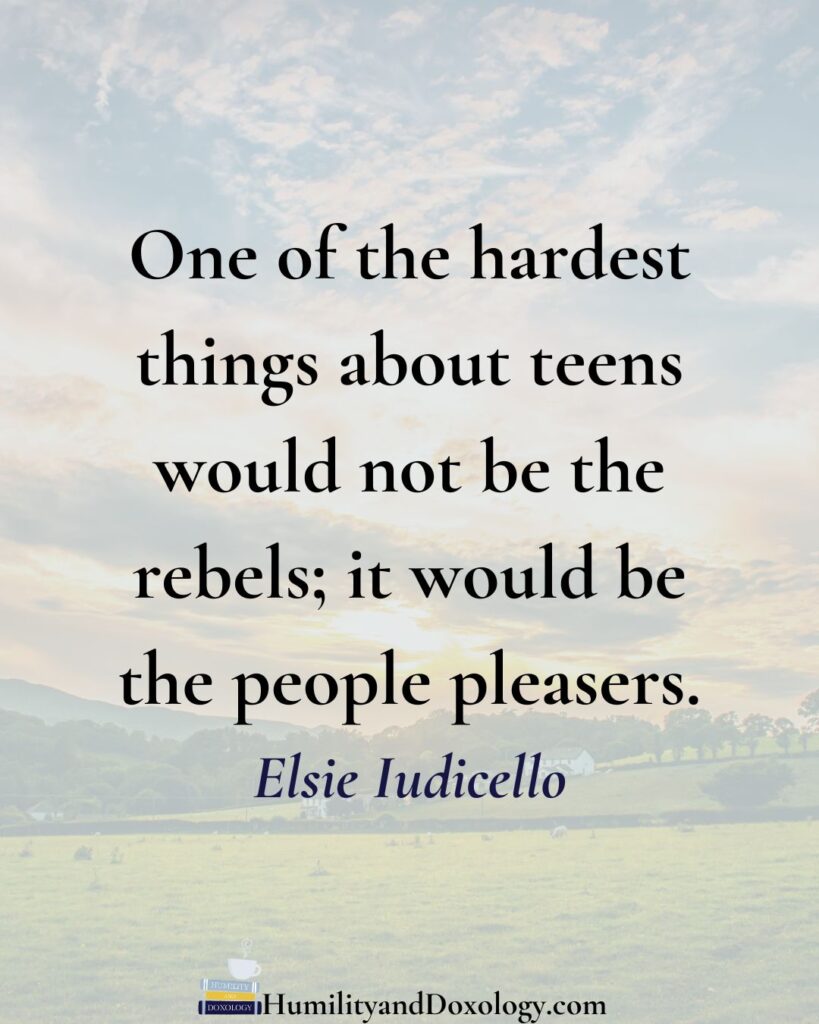
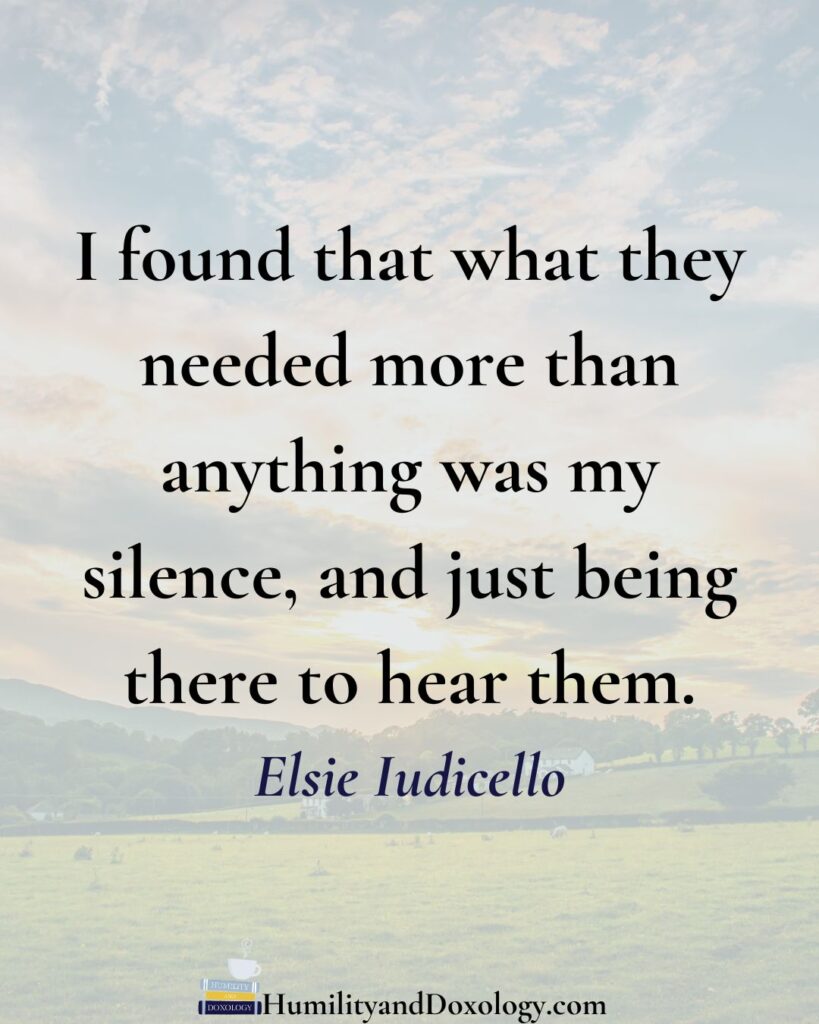
Elsie Iudicello: Yes, that’s such a good question because it’s certainly changed. I think there comes a moment, I think it’s Charlotte Mason that talks about how like a child’s joy is to continue on, right? He doesn’t want to return to the things from when he was little, he wants to continue on. And I had read from so many moms, you know, when they hit, you know, 10, 11, 12, you start hitting these like rough patches of resistance and I see that now as such a largely good thing it was such a good tool and I’ll cage that by saying not in a not them showing disrespect or being rude but any kind of resistance meant that they were really thinking things through for themselves and I realized very quickly on mostly just from listening to older moms talk that one of the hardest things about teens would not be the rebels it would be the people pleasers and that the hardest thing would be children that were so acquiescent that they did yes yes mom yes mom yes mom like to the point where you’re like are you really getting anything are you really thinking anything through or are you just trying to please me it’s such a heartbreaking thing when you when you realize that and so having that resistance from kids when they’re in middle school is gold to me because I’m like all right they’re really thinking this through. They’re trying to decide, is this faith mine? Is what I’m reading really true? How do I know that it’s true? How can I trust this? Is this good? Is this true? Is this beautiful? It’s so wonderful when you have that sort of resistance in kids because then you can help them as they’re training their will to think about these sorts of things. What are my responsibilities that, even though I hate them, I need to do them? What are things that I can passionately pursue and still make time for? How can I do that in a responsible, balanced way? How do I filter through things that I’m receiving to judge whether they are good or not? So, you know, so much of the young childhood years was wonder and exploration, and that didn’t go away when they became teenagers. It just sort of changed into an arc where they were very much responsible for processing those things, and I found that what they needed more than anything was my silence and just being there to hear them and not tell them what I think about things, but just letting them have space to process their things and then, you know, quietly guiding, asking questions, things like that. So we made a lot of room for them to make horrible mistakes and to fail spectacularly. And I feel like that was really important for them to learn how to fail well, to learn that the world wasn’t over, that they could continue on, that they could actually glean a lot of things from their mistakes and failures to help them going forward. Yeah, if someone had sent me a recording of what I’m saying now when my kids were little, I would have been like, mean, why? But it’s so necessary for them to have space and time to learn how to think on their own, to evaluate the truths that they are processing so they can stand firmly on them, and then just room to make a lot of mistakes and fail well.

Amy Sloan: Yeah. And it’s really a gift to be able to do that with them, to be able to, sometimes you’re just like, I, I, I, I, I, you know, but it’s so valuable for them to have that opportunity now because even with the failures, I mean, some of them can have significant consequences, but generally the stakes are a lot lower middle school, high school than they are once you get into big adult decisions. So it’s really a great place. And I have loved parenting teens, and not always tweens, I will say. That is not my favorite, okay? But once we get past 12 and really get into the teen years, I just have loved that season with my kids, and seeing them grow into their own people with their own unique perspectives on the world and to have them, like, still want to talk to me and for us to have this relationship, not that it’s always easy, but it’s really great. And I think a lot of times there’s this, you know, assumption that parenting teens is really scary or it’s, like, doomed to be terrible or something. But I would love to hear from another mom of teens. What are some of your favorite parts of the teen years? And then also the challenges, and how do you deal with those challenges?
Elsie Iudicello: I mean, like, we’ve sort of been dancing around it. I think the sooner that you reconcile the fact that they are their own person, right? Not the easier, but the more gentle, you know, your mothering, your parenting experience of the teen years will be because there’s just a lot more room for grace and mercy when you’re not trying to control someone and everything that they are doing. And oh, I agree with you, have loved the teen years way more than I thought. I mean, I don’t think there’s really been a stage in childhood where I’m like, that’s not for me. In general, I’ve always just enjoyed, you know, teaching, being your own kids of all ages. It’s just enjoyable. Kids are wonderful. But I was a little nervous about the teen years mostly because they get such a bad rap and all you hear from people is, you know, the teen years are terrible. They’re really not. The teen years are wonderful. I have so enjoyed watching my boys try to figure out how to bring the best of their childhood into their adulthood. Watching them navigate that and figure out like, what am I passionate about? What am I interested in? Watching them play as teenagers makes me so happy. There are a few anchors of their teenage years that I think stem from the amount of time that they spent playing outside and the kind of reading that they did as children. And I can see the evidence of those anchors in their teen years. There’s so many times where we’re, you know, talking some philosophy, theology, some deeper thing, and the examples that their minds go to are the things that they did when they were really little. And I was there for that. I got to witness that. And I got to witness the connection now in the teen years, and at some point they’re going to be adults, and Lord willing, I will be here to look at that and think, I was there. I got to see it all. I got to see when they were playing in the creek or playing at the beach. I got to see when they were a teen and they were wrestling with this big idea and thinking about their foundations. I got to be there to see in their adult years, you know, the decisions they make, the way they shape their lives, the way they recover from their mistakes. It is such a beautiful, wonderful thing. It’s hard to put into words the joy of like having your teenage son who, you know, teen boys are not terribly communicative with like texts and things like that, but to just out of the blue in their own way, you know, no emojis, no exclamation marks, nothing like that. My friends with teen girls have a very different texting relationship with their children. But just to have your teen boys send a text that’s like, Mom, have you read this book? I just finished it. It was so good. Like, have you read it? Can we talk about it? And you’re like, yes, I would love that. Like, we still love spending time together. And that means the world to me. It’s not that I need all their time, but that they’re joyfully willing to give some of it it and continue our relationship is wonderful.
Amy Sloan: Yeah, it really is priceless. And along with those beautiful moments, there are also sometimes hard challenges, right? So I think it’s really important. I wanted to start with the positive because that’s really the bigger part of it and that’s also really important because people don’t often talk about that part. But I want to be, you know, it is not always easy. So what are some of the challenges of parenting, educating those teen years, and how do you guys seek to overcome those challenges?
Elsie Iudicello: Yeah, it’s interesting how, you know, and this is true for all kids, and it extends into adulthood, that a lot of times we are very unreliable narrators in our own lives, where we just see things from a very, very skewed perspective. So something that we find ourselves doing a lot with our teens and with ourselves, like I have spent a long time trying to do this with myself often, is to kind of cycle back whenever there is a hard thing, whether it has been something sinful I have done or a mistake I have made or just something that I’ve walked into a situation, something hard where I just, I need to stop and think. It’s very hard to find time to do this because there is such a demand for immediacy in our world. They want like constant, like fastest, text me now, email me now, decide now, or this opportunity is going to pass you by, or this thing is going to steamroll you. Teaching our kids that it’s even if the world is moving at 100 million miles per hour, it is more than okay to set a boundary and say, I need time to step back and really consider this, and to take time to define what is happening. Have you sinned? Have you made a mistake? Is there a standard that you fell short of? Do you have something in this situation that you need to take ownership of? We had a really unfortunate situation in my kid’s friend group at the end of last spring where some people made really unfortunate decisions and just kept making, like, making things worse. And, you know, these weren’t bad kids. They were just choosing really poorly and it was hard to sit there and untangle all of these decisions to ask our kids, like, let’s take a bird’s eye view of this and really think and consider about what’s going on. So much of it is just helping them learn how to see clearly when we have so many things battling against us. Lots of distractions, people with very short attention spans that aren’t always willing to engage in deeper conversations or give you time to really think about things or be willing to sit and reason with you. So when it comes to hard things with teens, I think so much of it is just teaching them how to slow down and how to pull things apart. It’s not even about giving them answers or to say, well, this kid was wrong because this or you were wrong because of this, but to really untangle and say, you know, what was your responsibility here? Do you see any place where you had a misstep? What’s something that you could do in the future to, you know, make sure that this isn’t forgotten or to take ownership of this? Is there a place where you need to confess or repent of something or, you know, apologize to a brother or sister in Christ for something that you have done wrong? All of that takes time, and especially if you are parenting multiple ages or you’re in that season, you’re like, I’m a chauffeur now. I just, I live in my car. I’m just a car troll that drives people around from place to place because no one has their license yet. And you feel like you don’t have a lot of margin to be able to have those big, heavy conversations. It’s like anything else, you know, laundry’s got to go in the back burner. Something’s got to go in the back burner because those difficult conversations are such good opportunities. And then, likewise, you know, Jeff and I used to say this a lot when the kids were little that we didn’t want to do our hard parenting in horrible moments, right? We wanted to do our big parenting in good moments. When we were together, when we were having fun, like, those were the times to pour into our kids. Like, when no one was having, like, a flight or fight response, their underdeveloped, you know, portions of their brain, to sit there and really pour in those parenting things when things were good and not when they were stressed out and it’s continues to be true into the teen years you know we don’t do a lot of lecturing when there are hard things we do a lot of trying to help them understand the situation and if they still need to cool off we don’t even touch it but then we try to make sure we’re having you know good parenting family culture like time building things with them so that we can parent in those moments. And oftentimes, we do that through reading books together still, even though they’re teens. So that was a super long answer, but…
Amy Sloan: No, that was perfect. And that’s, I mean, because that’s discipleship, right? Many years ago when our church was interviewing one of our children for membership, and my pastor at the time was talking about church discipline, because one of the vows that we take in our church when you join the church is being willing to submit to the Church’s discipline. And he brought up the point that we always think of discipline being like, you did something wrong and so now we’re going to correct you. But that really, the discipline is happening every time you come and you sit under the Word of God and you hear the truth of the Gospel and you heed the warning, you know? And all of that discipleship that is a positive thing is part of the process of discipline, and that really impacted the way I thought about even parenting my children after that moment. Because as parents, you know, we think of discipline as being the thing, oh, somebody did something wrong, now we need to give the lecture, give the correction. But really, what we’re doing all the time, especially in those, maybe even especially in the positive moments, is we’re discipling, we’re building those connections and teaching. So that’s really important. I did want to bring up two things, too, on the flip side. So one, or not the flip side, but in addition, I had always heard people say, like, you know, the teens, they come and talk to you, you have to be ready to talk to them whenever they come to you, no matter how tired you are, how late at night it is. And so I, like, really tried to do that for a while. And then I realized that sometimes it was also okay for me to say, I love you.
Elsie Iudicello: “I really think this is important and I want to have this conversation with you and you’re going to have to schedule it for another time because I need to go to sleep.” So there’s sort of that also I think models for them an appropriate boundary. Mom sometimes needs her sleep and we will. This matters. You are important to me. We’re going to put a pin in this. And then also, I think it was an interesting transition, like, when you have little kids, it’s all about very immediately, like, they’re not going to remember if you try to talk to them, like, later in the afternoon about when they get their brother in the morning, like, you got to deal with it right away, right, when they’re little. But actually, one of the great things with parenting teens is now you can, like, take a break. You can say, okay, let’s wait until we have all calmed down about this. don’t have to address it in the heat of the emotion, we can take a pause and they’re able to remember and process it actually a lot better. And I think that was very, of course you’re first born, you just like mess up so much. But once I figured out like, oh, I don’t actually have to address this right away, it’s actually more helpful if we wait until we’re calm. That was a really helpful transition in my parenting. It’s also wildly helpful to know what as a parent your most sensitive areas are right so the areas where you have a really hard time responding well and knowing your partners too because I know what Jeff’s are and I know what mine are and so there’s a lot of times where we can cover for each other where I’m like oh like you have done this thing and I get offended so easily here I need to pray before we talk about it and if it’s something that you need to discuss now like I need your dad he’s not here whatever. And then it also helps, you know, just from the course of knowing your children, kids who maybe their first response is not always their best response, especially if you’re very similar to that child, then your first response is not always your best response. Like I have a kid that I can never have an eye-to-eye across the table talk with him about touchy things. It has to be a walk every time. Didn’t matter if he was four or he was eight or He was 12. Now he’s 16. I need to walk side by side with him and he needs to be physically moving in order to be able to speak his mind because if not, he will just – he will completely shut down and he won’t engage. He won’t talk. And then it does become like the hated lecture where you finish and you’re like, why did I do that? Why? That did no good. That didn’t bless anybody. Like, I don’t even – that didn’t bless anybody. That was not discipleship. was just preachiness and it wasn’t and it and it fell and it and it just fell by the wayside so I think you know knowing your touchy subjects knowing the ways that your kids receive well having boundaries for yourself like you said if you’re totally mind-numbingly exhausted and that’s part of like hey we do need to put a pin in this like we need to stop and really think through before we have a conversation and I hope that’s a gift to their future spouses if they get married that we’re even from the home talking about like not every conversation has to be a reaction right we can come to the table or go for a walk with something that we’ve really thought about ahead of time before we speak things that we cannot take back. Yeah and that really transitions into what I wanted to ask you about next, because we’re talking about these big, important conversations, right? And we know that life is often dark and difficult. There are personal trials, there’s grief and loss, and not just in our personal lives, then you have world events and cultural moments, and they can seem overwhelming and too big to even bear at times. But we know that we have some responsibility of addressing these hard topics with our kids. So what advice or suggestions would you give to other moms who are seeking to process maybe personal hardships and or complicated news items with kids and teens? I know those are kind of overlapping, but also different. So take that however you wish. I mean, the first piece of advice is to to be encouraged that you’re not gonna do it perfectly with any of those things, especially if you’re in a large family. Like Jeff told me so many times over the course of the last year when we had his brother died very tragically from diagnosis to death in 19 days. It was very unexpected. It was really brutal. We ended up rooting up and moving, losing our community. It was just, it was a really hard season in life. And Jeff kept having to say to me, are six of us. We’re not all going to be okay at the same time. Like, we’re not all going to be on the same page. There are people that are not going to be okay, and it’s not our job to control whether or not they are okay, right? So, I think that’s the first thing is just, you know, sometimes we operate from, like, this sense of guilt that, like, our kids are sad or something bad has happened, and we need to rush to make it better, not realizing that, you know, in those valleys and places of hardship is where so much beauty is wrought, so much character is formed, so much truth is revealed, giving your children the opportunity to realize when we say we rely on God, we really mean it. We’re not relying on, like, you know, shopping to make us feel better, or a vacation to make us feel better, or some shiny distraction to make us feel better. Like, we really are relying on the Lord to get us through these hard things, and there are solid biblical truths to be found in these hardships, really monumental things that form, you know, the creeds that we recite, and the prayers that we say, and the hymns that we sing. These are the experiences where we’re like, okay, like, there’s a reason these things have been spoken and sung for thousands of years because they’re true and we need them. So in terms of sharing really hard things with kids, I mean, most people know I, you know, I’ve had struggled a lot with PTSD since my third born had a really terrible accident when I was pregnant with him and was just not well for a really long time. And people are always like, what did you say to your kids? Like how did you explain that to them? And the truth is, you know, they saw a lot of it. They experienced a lot of it. There were things that they just naturally witnessed because we were in the home together and we were homeschooling. And it’s when children are really young, they generally tend to ask questions that they’re ready to hear answers to, right? So we found that it was very helpful not to just sit them down and dump a lot of stuff on them, but to sit them down and say, do you have any questions about what’s going on right now? Because then you sort of get to feel out what their perceptions are, what are the things that they’re thinking about, what their fears are, things that they’re, you know, concerned about. And then as they were older and we had personal hardships encounter, it really, the questions still stay the same. It’s like, what are your questions? What are you thinking about? You know, when they’re older, they definitely want information, they will definitely start sleuthing. Kids aren’t dumb, like they know when stuff is, you know, going down and they want to know. And so we’ve, we don’t keep things, I mean, obviously, if it’s something that is, you know, something to do with another family or something that Jeff and I are working to, we’ll guard that, just out of respect for whoever else is going through it. But if it’s just something hard that our family is going through, we share with our kids and part of that is so that we can pray together about it. Prayer is, you know, I see a lot of like sad memes now going around with people talking about like how garbage saying thoughts and prayers and whatever or how that’s just something that people like softball just because they don’t know what else to say, but in our house prayer isn’t something we say when we are nervous and don’t know what else to say. It’s not a band-aid, like it’s the rock we kneel on. It’s not something casual of like, well, we’ll just pray for them, but then we don’t. Like, if we say we’re praying, we’re really praying. Like, that is a really big deal. So sharing with kids so that we can pray, so that they can see the Lord at work, so they can see our own struggle with it, to understand that faith is not always easy. And walking through life with the Lord is sometimes a painful, really difficult thing, you know, reading through the Psalms with them. Helping them see other people’s hard things, reading stories where people go through hard things and seeing the different ways that they navigate. Yeah, we have always really dug into those things just because our family is, you know, rooted in a lot of really difficult things, and it’s the only way that I knew how to navigate all that with my kids. Yeah. And I think as we model that prayer for our children as well, that being the foundation, the first step, the second step, the last step, all the steps are bathed and rooted in prayer. We’re also showing that when we say we’re trusting the Lord, that he’s sovereign, that he is caring for us, that he is in charge, whether it be in our family or world events. If we say that and then we don’t actually talk to God about anything, right? And we spend more time worrying or thinking or discussing than we do actually praying, right? We may be saying we’re putting our trust in the Lord, but we’re not actually demonstrating that. Yeah. Yeah. It’s a big, oh, go ahead. No, go ahead. No, it’s a big, I feel like it’s also a big action step. Like people think of of prayer is not taking an action, but it’s in fact one of the biggest actions that we can take. And it’s, for me, you know, I spend a lot of time talking with my kids about the news. That’s something that we dive into, you know, with regularity. And it was different when they were little, different now that they’re teens, but I really feel like prayer is the hinge point that can take paralysis from feeling helpless into meaningful action, from turning, I guess, a sense of guilt that someone else has it so bad into gratitude for the things that you have in your own life, from choosing compassionate living instead of just desensitized living because you’re so overwhelmed with all the garbage that happens, all the sin in the world, that you’re like, I can’t even process everything so I’m completely desensitized or you know feeling like you can love versus you know growing up with really calloused heart because you feel like well everything’s bad and horrible anyway so I’m just going to be really you know callous in the way that I that I see the world and unless there’s someone with really superhuman ability that can just choose all of those things instead of you know the callousness and the paralysis and the guilt and the desensitized living, unless there’s some superhuman that is just naturally attuned to those things, for us we have found that prayer is really the thing that changes the needle on that, you know, especially when you’re praying through things like the Psalms. It really is the thing that changes the needle on that and it’s important for kids, you know, before we tackle the news, we start with prayer and we end with prayer and that’s not a legalistic thing. It’s the fuel that helps us know where to, you know, to power the car to keep it going on the right path. Like, we just, we need it. Yeah, for sure. Well, one of the things I love asking moms who have teens or young adult kids, I love, like, the perspective that kind of gives you. And so as you look, you know, you’re about to retire. You’re nearing your final years of homeschooling. And as you look back over the years, what are, what would you say you’re most glad you prioritized over the years? Like what things now are you like, oh yeah, that actually really did matter most? And then maybe are there any things that if you could go back you would say, oh young mom self, like you really don’t have to worry about that. Yeah, um, hands down. It’s being outside, hands down. It’s reading, reading, reading, reading, um, sometimes listening, listening, listening to an audiobook if I was sick or things were hard. It didn’t always have to be like the tactile sit-down book. Sometimes it was audiobooks and those were great. And that it was having purposeful one-on-one time with my kids that didn’t cost money. I’m so glad I did that. I’m so glad that I wasn’t like, oh, I have to. There was, I don’t know, maybe it was something I saw on Pinterest where it was like, you only have this many days with your kids. Make sure you’re dating your kids, make sure you’re taking them out to do all these things,” and part of me got really mad. So I was like, no, like, I still hang out with my grandparents. Like, we have, you know, if the Lord gives us long life, we have all the days that, you know, God has given us to spend time together. It’s just the relationship is going to change. And I refuse to think that I have to spend tons of money in order to have a special relationship with my child. So I’m so glad that we were dirt poor. I’m so glad that we were a single-income homeschool family where we had to save all of our pennies to be able to homeschool so that then I could get really creative with our dates. I would set little timers on my phone. Usually it was their birth, the way that I remembered it, it was their birthday date. So if I had a kid that was born on the 7th, then every month on the 7th I would try to just do one small, and sometimes it was just a cup of tea and cookies in the backyard or reading a book just to that child or saying like do you want to do something fun with mommy around the house what would you like to do and sometimes they just wanted to like demolish you know a cardboard box and build a battle scene on it and tell me everything they know about Gettysburg or whatever but it meant something to them and I’m so glad because it showed them that I was interested in them and set this precedent of like I want to hear you know the things you’re thinking about about the things that bring you joy. And I love that because now in their teen years, that’s what they’re used to. So when they have something they wanna talk about, they feel like they can come to me. I am really glad that we spent so much time with family, especially with older people. I’m so thankful that they were not just limited to peers in their age group all the time. I’m so glad that that was like, They had time with cousins and grandparents, and when we moved away and we didn’t have grandparents and cousins, that we had a church body where there was, you know, a wide age range that they got to hang out with and experience. Looking back, I feel like that was more fruitful than any workbook that I ever bought, because I’ll tell you right now, like, there’s never a time when my kid is like, remember that workbook we did when I was six? But they will say things like, remember our old neighbor Alex, who was 94, and he used to listen to me talk about tiger sharks, and he would talk to me about when he fought in the war. Yeah. I remember that, too. So those are things I’m really glad that we did.
Amy Sloan: And those are all things that have in common, like, this relational component, right? Because the soul is eternal, right? Like you were saying, like, the workbooks, I mean, sometimes they’re necessary, right? They’re necessary. the workbooks, and those are good, and they’re helpful, but those are going to pass away. But the eternal souls are going to be there forever. So thinking about our priorities and what things we want to emphasize most.
Elsie Iudicello: That’s how we order things. So I’m glad the workbook was never more important than any of the things I mentioned before. And was there a back half to the question? I’m sorry. Oh yeah.
Amy Sloan: Is there anything that you really worried about when you were a newer mom, that now you’re like, oh, it seemed so important at the time, and now you’re like, eh, that wasn’t that big a deal.
Elsie Iudicello: Yeah, it was being a fun mom, because I was a sad mom that was going through a lot of stuff, and I was wrestling with mental illness, and I think in my mind I was like, homeschool moms, you know, they have to look a certain way. It’s like, you have to be Miss Frizzle, like, 24-7. You have to be that engaging, and that exciting, at that whatever and I don’t think it took long because I realized before long like oh it’s not about the mom’s performance it’s about the beauty of the things that she’s laying before the kids like it’s not about how I’m performing it’s all of these things that we are learning about and all these ideas that we’re getting to engage with and it’s their process of how they’re receiving those things and has very little more to do with things that the Holy Spirit reveals to them than like how good I’m doing on any given day. Like my faithfulness is required, not my ability to perform or make it special or make it look a certain way. I think back to our most golden homeschool days and almost all of them were born from some kind of like inconvenient horror in the household, like an overflowing toilet or like just something awful happening that, you know, switched the day up and then that’s when like really amazing things happened because I had because I had let go like I think the Lord was gracious to destroy our indoor plumbing like six or seven times that first year that we were homeschooling and it taught and it was it was a mercy like back then it was like the worst but now I look back and I’m like oh thank you God because you taught me that lesson so early on that it wasn’t about like the little contrived lessons that I had trained for in college to give to a big you know, roomful of children, it was the natural learning that was happening at home with my family and how I needed to make room for that, for their questions and their ideas and their engagement. Yeah, I worried, I think, maybe up until the end of elementary, quietly to myself, even though I knew the truth, I knew that it was, you know, faithfulness and all these other things in the back of my mind, I would look around and be like, I’m not like these other moms, like, and I they were going through their own hard things, but in my mind, I’m like, so many of them look so happy. And I don’t always look happy. I have the joy of the Lord. That’s different. That never leaves me. But that happiness, like, I just didn’t have that the way that other young moms did. I loved my kids. I loved homeschooling. But like, happy happiness? I don’t know. It felt very very evasive to me, and looking back now, it would just be, Elsie, let that go faster. Let all those whispers leave you a lot faster. I know you already know it, but let the whispers leave you faster, because you are torturing yourself for nothing.
Amy Sloan: That is going to be such an encouragement. I know. There are going to be moms who listen and think, I thought I was the only one in comparison. I just really appreciate you sharing that. know that’s going to be an encouragement. This is why I was like, I have to have Elsie back on, because I just love everything you have to say. I could talk to you for hours, but I do want to wrap up here. But at the end, I’ll ask you the questions that I ask all my guests. And so the first is just, what are you personally reading lately?
Elsie Iudicello: Yes, so I am rereading The Weight of Glory with one of my older boys. He had to read The Abolition of Man for a camp that he went to this summer that was a very niche nerdy like Tolkien Lewis camp and then he’s like I really want to read The Weight of Glory will you read it with me because I feel like I need to it’s a we talk often with the boys about like there’s some books that need to be done in conversation kind of like the way that you know plays need to be watched not just read like there’s certain books that aren’t just alone reading experiences they’re they’re conversations and so I told him that I would read that with him. I’m going through Chad Van Dixhorn’s book called Confessing the Faith and also going through Confessions again by Augustine and those are kind of like my early morning, like I’m just taking bite sizes here and there. I’m not in a particular rush to get through them. That just comes with my Bible time and then I’m reading through a lot of George McDonald and that’s like my fun afternoon reads. I’m currently, I just started Robert Falconer. I’m very excited to, I’ve not read that one yet, so I’m really excited to engage with that. So I don’t know, some, you know, we’re, because we just moved, books are coming out of boxes, so I have a TBR in my nightstand, but I get distracted so easily when I unpack boxes. I’m I’m like, oh, hello there, I haven’t read to you in a while. And then I sit down and I start reading and my poor TBR pile, just that they’re looking at me like, really? This could all change this afternoon as I unpack more boxes. You know, I could find something and be like, squirrel, we’re reading this instead. It’s like finding an old friend. It is. How can you not sit and chat with them?
Amy Sloan: Yeah, exactly. I think it’ll be interesting. I’ll have to follow up with you in the future as you’re reading this George McDonald and then begin rereading some Lewis, how that changes the way you’re reading the Lewis, since you’re kind of a McDonald kick.
Elsie Iudicello: Yeah, it’s, I mean, they’re, I mean, we can talk about it forever, but the Inklings have always held such fascination for me, and I’ve, I’ve read, you know, a solid amount of McDonald’s, but there were so many other little ones, like, on the side that I just had not read. I think there’s, like, maybe four of them that I’ve been very curious about and have wanted to read, and so we’re doing it. We’re doing it this summer.
Amy Sloan: Very fun. All right, final question is, what would be your best tip for turning around a homeschool day that seems to be going all wrong?
Elsie Iudicello: Okay, so my best tip would be to stop and try to figure out to identify what’s going wrong because that changes the remedy, you know. If it’s an attitude thing that’s one conversation that needs to happen. If it’s a people are tired and everything is just going wrong there is no reset like being able to take a walk outside to just get fresh air to get as far away from you know the book that’s causing the problem as possible probably mostly because the book is not causing the problem it’s something else but just being able to take a walk get some fresh air there’s a lot of time where I just we need to pray like and consider like is it you know let’s say that it’s reading let’s just say that it’s your seven-year-old who is having a really hard time with like you know the long vowel sounds and you feel like you’ve been stuck on the same lesson forever you know Sonia Shaper always talks about how it’s like a knock on the door you’re knocking on the door to see if the door is gonna open and they’re ready to do it and sometimes kids are just not so sometimes turning a homeschool day around it’s just recognizing my child is not developmentally ready for this. Even though everyone is screaming that their age is the time to do it, they’re not developmentally ready. So we’re going to go back to the things that they are developmentally ready for. And, you know, if it’s raining or it’s hot, then bake some cookies and read them a book, but have some kind of little connective moment where, you know, you’re connecting on terms of relationship again, where they see you as being on their, on their team, on their side, and that you’re for them and wanting them to learn this, and that you’re not like this, you know, relentless taskmaster that is just thinking about checking items on a list. And maybe if you are in that space, maybe then you are the one that needs the break more than your kid, you know, to just reconnect with them and figure out how can we faithfully do this well without ignoring the personhood of my child, right, or steamrolling all the good work that I’m trying to do with habit training for their attitude, right, by ignoring the fact that they’re not ready for something because it’s really hard for kids to have a good attitude when they’re trying to learn something that they’re not ready to learn yet. It’s a big ask. It’s very hard. So yeah, I would say first, what’s going on is the question.
Amy Sloan: It’s like when you have a small child and everyone around you, all of their toddlers have been potty trained for years at this point and yours is the only kid still showing up in pull-ups and you just beat yourself over the head trying to get that child potty trained for years and then one day they’re just ready and then they just are. And you think, why did I waste so much time and clean up so many accidents when we could have just waited.
Elsie Iudicello: How much of that holds for so many other things, like for reading, for getting a driver’s license? Like there’s so many times where kids just, they’re not ready yet. And sometimes it’s not because they’re paralyzed or indecisive, it’s because they’re just not ready for that one thing, you know? My goodness. My fourth-born was my latest reader, which I knew would happen because he was nonverbal for a long time and you know he’s on the spectrum there’s just so many like things going on there and he uh when he finally learned how to read like I can’t get the kid to stop reading like he loves it and I think back to all those times where yeah like he was the last one in the class the last one in the whatever to do these things but being able to just you know I’m so glad that I chose to wait and skip over all of those, like, brutal, brutal days of head-butting.
Amy Sloan: Yeah. And I will say, we’ve now done college applications for two kids. None of them asked when they were potty trained or how old they were when they learned how to read, okay?
Elsie Iudicello: Nobody asks that question anymore.
Amy Sloan: It’s fine.
Elsie Iudicello: Things you wish you knew with your firstborn that you learned by the time you get to the last one.
Amy Sloan: Exactly. Oh, Elsie, where can people find you all around the internet?
Elsie Iudicello: Oh my goodness. Some days on Instagram I’m not super great at like turning what it was a content turning on to creation. I don’t I don’t really do that but I do like to share things on there once in a while. You can I do write for a Wild And Free. There’s monthly bundles there. I’ll be speaking at the Made2Homeschool Brave conference that’s coming up soon. Yeah just little corners of the internet.
Amy Sloan: And I will put those links in the show notes for this episode over at humilityanddoxology.com as well as the link to our previous conversation that I know will also be equally encouraging to moms. As you are listening, please do take a moment to leave a rating and review in your podcast app or share this episode with a friend. And until next time, happy homeschooling.