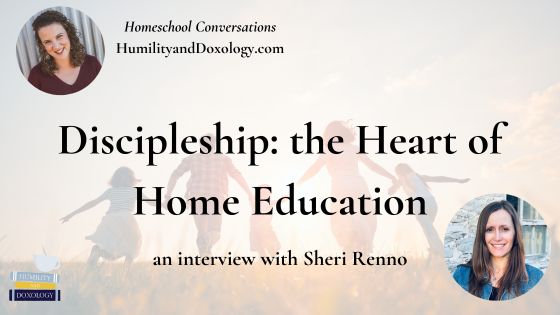
In this encouraging homeschool conversation I’m joined by veteran homeschool mom Sheri Renno to talk about faith-filled home education, relationships over academics, and persevering through the hard years. With over 15 years of homeschooling experience and ten children ranging from toddler to adult, Sheri shares practical wisdom shaped by real life, not idealized schedules.
Sheri reflects on how her approach to homeschooling has changed over time, moving from academically driven planning to a relationship-centered philosophy that values progress, peace, and long-term fruit. She shares why reading aloud became the heartbeat of her homeschool and how shared books created lasting family culture and meaningful conversations.
The conversation also explores the challenges of homeschooling, especially during seasons of exhaustion and uncertainty. Sheri speaks candidly about the early investment years when fruit felt invisible and how her husband’s encouragement played a crucial role in their perseverance.
Sheri shares her simple four-part homeschool routine, her approach to independence and checklists, and why she believes a peaceful home supports stronger learning. She also shares practical ways Christian families can disciple their children, including nightly Bible reading, weaving biblical history into academics, and modeling a sincere faith at home.
This chat is a gentle reminder that homeschooling is about way more than merely what our children know academically. Discipleship is the heart of home education.
- Homeschooling as a Calling, Not a Plan
- How Homeschooling Priorities Shift Over Time
- The Joy of Reading Together
- Persevering Through the Hard Years
- Putting Family and Relationships First
- Discipleship as the Heart of Education
- Books, Burnout, and Bad Days
- Key Takeaways
- You may also enjoy:
- Find Sheri Renno Online
- Check out all the other interviews in my Homeschool Conversations series!

{This post contains paid links. Please see disclaimer.}
Homeschooling as a Calling, Not a Plan
Sheri Renno’s homeschooling journey began not with a master plan, but with a quiet nudge of providence. Neither she nor her husband Nelson were homeschooled, yet the Lord gradually led them into a completely different way of life. Sheri recalls her first meaningful exposure to homeschooling while teaching in the public school system, where a previously homeschooled student stood out not only academically, but relationally. “He was a leader… and it actually changed the whole atmosphere of my classroom,” she explains Sheri Renno.
That early impression stayed with her. Years later, when friends from church began exploring homeschooling, Sheri and her husband stepped forward together in faith. What started as simple meetings in one another’s homes eventually grew into a long-standing co-op that continues to bless their family today.
How Homeschooling Priorities Shift Over Time
As Sheri’s children grew, so did her understanding of what truly matters in education. Early years were marked by academic rigor and careful planning, especially as her oldest approached high school. But a pivotal conversation with a friend changed everything. “What kind of memories do you think they’ll take away from it?” her friend asked, a question that arrived at just the right moment Sheri Renno.
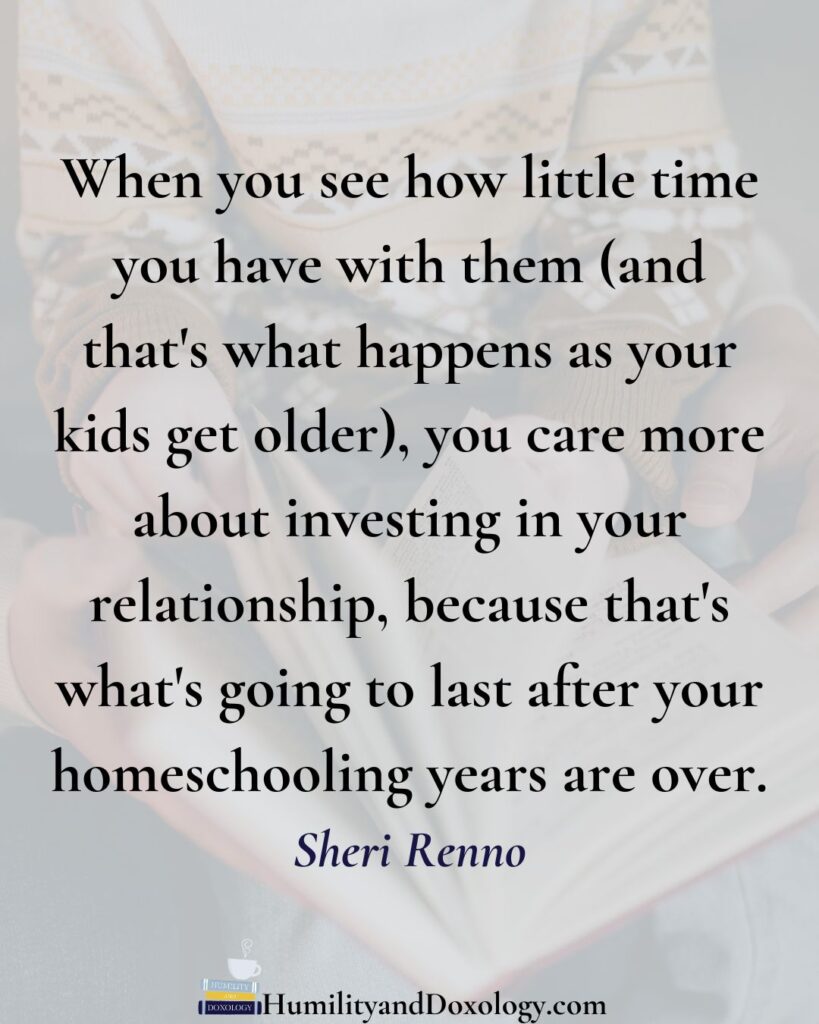
Sheri realized that while academics matter, relationships endure. “You care more about investing in your relationship, because that’s what’s gonna last after your homeschooling years are over,” she reflects Sheri Renno. This shift didn’t mean lowering standards, but rather reframing success around long-term fruit.
The Joy of Reading Together
Of all the highlights in Sheri’s homeschooling years, reading aloud stands above the rest. “Hands down, reading together with the kids,” she says without hesitation when asked for her favorite part of homeschooling. From tear-filled moments finishing Little Britches to years spent immersed in The Wingfeather Saga, books became shared worlds where meaningful conversations naturally unfolded.
“These are treasured memories,” Sheri explains, moments that shaped both hearts and relationships. Reading aloud became not just an educational practice, but a defining rhythm of family life.
Persevering Through the Hard Years
Homeschooling ten children while enduring frequent pregnancies brought real exhaustion and discouragement. Sheri speaks honestly about the early years, when investment felt constant but fruit invisible. “I physically was exhausted… and I just said, I don’t think I can do this,” she recalls.
What sustained her was her husband’s unwavering support. “I will help you… I can tell this is a really good education for our kids,” he told her during a moment of deep discouragement Sheri Renno. Sheri credits that encouragement, along with faithful consistency, as key reasons their family persevered.
Putting Family and Relationships First
Letting go of rigid planning was one of Sheri’s most transformative changes. Once driven by detailed weekly schedules, she learned those plans often made her “a harsh task master” Sheri Renno. In their place, she embraced progress over perfection.
Her current homeschool rhythm follows a simple four-part day: morning time, chores, independent work, and shared read-alouds. “The goal is progress,” she explains, helping children move steadily forward without unnecessary pressure Sheri Renno. The result is a home marked by peace, ownership, and flexibility.
Discipleship as the Heart of Education
For Sheri, discipleship is woven into daily life rather than added as a separate subject. One of the most impactful practices has been reading Scripture together each evening. “It was like a revival in our family,” she shares Sheri Renno.
She also emphasizes integrating biblical history with world history, introducing children to Christian heroes, and modeling genuine faith. “They just see everything,” Sheri explains. “They hear how we respond to stress, to criticism, to praise.” Her prayer is to be a living testimony her children can follow.
Books, Burnout, and Bad Days
When asked what she’s reading, Sheri mentions This Present Darkness and Mover of Men and Mountains, both reflecting her love for true stories and spiritual depth. And on those homeschool days that unravel completely, her advice is refreshingly simple: “Just go outside,” she says. “We just stop everything… and have fun together again.”
Key Takeaways
- Homeschooling often begins as a step of faith
- Relationships outlast academic checklists
- Reading aloud builds shared family culture
- Early years require unseen investment
- Encouragement sustains long-term perseverance
- Progress matters more than perfection
- Independence strengthens student ownership
- A peaceful home supports better learning
- Discipleship happens in everyday rhythms
- Sometimes the best reset is going outside
You may also enjoy:
- Discipleship, Identity, and Homeschool Priorities (with Kristi Stephens)
- Repentance and Discipleship in Christian Classical Education (a video interview with Dr. George Grant)
- A Family Devoted: Homeschooling with the Bible at the Center with Kimberly Steenbergen
- Getting Started with Family Worship (an interview with my husband, John Sloan)
- FREE Big Picture Homeschool Planning Guide Ebook
Find Sheri Renno Online
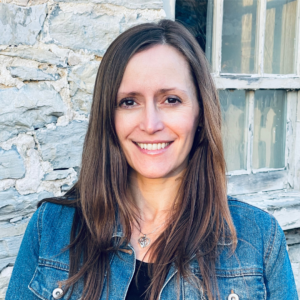
Sheri is a Christian saved by grace, wife to her high school sweetheart, and thankful mom to ten incredible kids. Drawing on fifteen years of homeschooling experience, she loves to share encouragement for everyday moms on her YouTube channel and the blog ourlifehomeschooling.com. Her passion is to cheer on other moms who are raising the next generation for the glory of God!
Check out all the other interviews in my Homeschool Conversations series!
[00:00:00] Amy Sloan: Hello friends. Today I am delighted to be joined by Sheri Reno. She is a Christian saved by grace, wife to her high school sweetheart, and thankful mom to 10 incredible kids. Drawing on 15 years of homeschooling experience, Sheri loves to share encouragement for everyday moms on her YouTube channel and on her blog Our Life Homeschooling. Her passion is to cheer on other moms who are raising the next generation for the glory of God. And so that’s you guys who are listening or watching. I had the opportunity to chat with Sheri on her podcast last year, and I’m really glad to be able to chat with you today. So that’s sort of the official bio, but Sheri, can you tell us a little bit about yourself and your family and how you got started homeschooling?
[00:00:50] Sheri Renno: Okay, yeah, my name is Sheri, and I’m married to my husband Nelson. We’ve been married for 25 years, and we met in high school in geometry class. And so neither of us are very good at geometry. That’s something we always farmed out to someone else. The kids usually did that at co-op. But yeah, together we have 10 children. Our oldest is 20, and our youngest is two. And neither of us were homeschooled, but this was something the Lord led us into. We’re so thankful to be here. But it’s definitely been a huge learning curve for us. It’s a whole different way of life, and so that was a huge adjustment for us. My first experience with someone who was homeschooled actually pretty much happened when I was a teacher in the public school system. I had a student come into my class in the middle of the school year, and he was homeschooled. His mom had just had her sixth child, and I think she probably felt a little overwhelmed, maybe didn’t have a lot of support, and put her son in school. And he was the first homeschooled person that I really had ever been familiar with. And anyway, he was exceptional in so many ways. He was very academic. Everything I passed out to the kids, he was done in like 10 minutes, and then he would sit there reading books that were way above a fourth grade level. Books like Lord of the Rings and things like that. But it wasn’t just academically that he was bent. He was just a leader in the class. I had a very average class. They just did whatever they needed to do to get by. No one was really motivated, but he was a leader, and he loved learning, and he was enthusiastic, and it actually changed the whole atmosphere of my classroom. So that was kind of my first exposure to someone who was homeschooled. Fast forward a couple years when we had our first son, and he was going into kindergarten. The Lord brought into our lives some friends from our church who were just thinking about homeschooling. And we talked, and we kind of jumped in together, and we met in each other’s homes every other week. And that ended up turning into a co-op that the Lord just really blessed that we’re still a part of today. And so yeah, we’re just, we really, this has been a great decision for our family.
[00:03:38] Amy Sloan: Yeah. I love to hear that, just how you weren’t kind of expecting or thinking about homeschooling, and then just observing that little kid, really just a small child, and that gave you that first hint of maybe there’s something else that I could consider for my kids. But I imagine over the years, you know, your oldest is 20, as my oldest is as well. I’m sure over the years, from when you started homeschooling to now, your approach, your thoughts about education have probably grown or changed a little bit over the years. So what have you seen that has grown or changed in your homeschooling?

[00:04:13] Sheri Renno: Well, I’ve definitely become more relationship-focused. In the beginning, like I mentioned, it was such a huge learning curve. I really didn’t know what to expect. And so I was very academic. I probably will always lean that way. I love learning. I love history. I’m a book person. But when our oldest son was in about seventh or eighth grade, you know, you get through elementary school, and it’s intimidating, the first, like, K through third, like, can I do this? Are my kids going to have friends? Are they going to, you know, are they going to turn out okay? And then you kind of get past elementary, and you’re like, oh, you know, we did this, and I think it’s going really well. And then when you get to high school, I think a lot of parents start back in that same place they were in elementary school. Oh, no, high school, what do we do? So, of course, I was rigorous. We were very academic. And my son, he did the work. He didn’t complain, but I don’t think he really enjoyed it. And I had a close friend. She was also a homeschooler. She just randomly asked me, do you think that when your kids are older, like, when they’re about 30, and they have kids of their own, and they’re thinking about what they’re going to do for education, do you think they’ll want to homeschool their kids? What kind of memories do you think they’ll take away from it? And this question, it really came at the right time, because it was at the time that I noticed our son was doing the work, but he just didn’t enjoy it. And it was at this point that we completely pivoted, and I saw how short the time was that we had with them. And I still, like I said, I’ll always probably be bent towards academics. That is just my nature, and it’s not like we let off of that. We still meet all the state requirements, but things like family movie nights, like going out and doing things one-on-one, just our atmosphere in our home, these kinds of things became so much more important to me. And just when you see how little time you have with them, and that’s what happens as your kids get older, you care more about investing in your relationship, because that’s what’s gonna last after your homeschooling years are over, and they do end. Yeah.
[00:06:49] Amy Sloan: You know, it’s interesting, because so much of that can relate in a slightly different way, but I can relate to what you’re saying, because I had, you know, the experience of having a graduate. So my oldest had just graduated in the spring and had started his freshman year of college when my youngest son received his cancer diagnosis. And in that, you know, in the years since then, it definitely puts into perspective, like I am a definite academic kind of person, very geared that way. Us are really my kids. We just love it. We’re kind of nerds, you know. But when circumstances mean that you aren’t able to do a lot of those things, that had always, in my mind, kind of defined what was important or special about our homeschool. And really, all those things that I had also said, that relationship mattered, and the hearts of my children, and our family culture, like that became so much more important and so much more meaningful to me over the past couple years, you know, when we couldn’t do all the same things. Like, we were literally limited in many ways, and yet that didn’t take away from the value of the education or the family life that we were prioritizing. And just really that, you know, learning both the side of, like, my older kids are growing, and my younger kids aren’t that little anymore, like seeing the fleeting time at home, and also, like, the fleetingness of life. Like, it’s precious if you have a little bit of time with your children. Like, what are you going to actually want to have spent time doing? It definitely is a perspective shift, for sure. Sheri, what have been some of your favorite parts of homeschooling?
[00:08:26] Sheri Renno: Absolutely, hands down, reading together with the kids. I have so many memories of the places we’ve been together in the books. It’s a shared experience. Just, there were a couple books that were tearjerkers. I remember when we finished Little Britches. We finished it at the time in the story that it ended, which I think was, like, around New Year’s Day, and I could not keep it together. And I think all the kids were in the same place. And I think of the WingFeather Saga books. I read one of those books every summer, so it took us four summers to get through it. And when we finished, it felt like it was the end of an era, because it had been four years, and that we had lived with the Igibys in this world. And so, there’s just so many treasured memories and conversations that come up, good conversations, where they’re really asking the hard questions, and you’re just able to open up and share with your kids. So, that will definitely be my biggest takeaway. And I’ve told the kids, when you guys are all gone, you might find me on the sofa at this same time, just ready to read to someone. If there’s, you know, maybe I’ll be reading by myself. I don’t know. That’s going to be an identity change, I think, when they’re not there, because it’s just been such a huge part of our life.
[00:10:03] Amy Sloan: Yes. Oh, my goodness. There are so many books that have made me cry, especially the books, like, I’ve read more than one time, like, to different sets of children. I think to myself, and like, you know what’s going to happen. You’re going to be prepared for this chapter. This time, you’re not going to cry. And without fail, I still cry, you know. Across Five Aprils gets me every time, you know. There’s certain books that I just, as much as I prepare myself for, I can’t help it. I can’t help it. I’ve actually told my husband, though, to your point of, I’ll just, like, be on the sofa, ready to read to someone. I’ve told him, like, when all the kids are gone, like, who’s going to recite Shakespeare and do my morning time with me? I was like, you’re going to have to just wait and do morning time with me before you start work. I don’t know how I will live my life without this beautiful part of my day.
[00:10:51] Sheri Renno: I know. I know. It’s just become so precious. And yeah, I know. There’s so many things that, in the beginning of homeschooling, were so difficult. And then, as you get to the end, and you find your way, and you learn what works for you, it becomes so enjoyable and such a part of your life. It’s hard to imagine it not being there.
[00:11:12] Amy Sloan: Yeah, it’s kind of the best job ever.
[00:11:15] Sheri Renno: It is. Yeah.
[00:11:16] Amy Sloan: And even though it is the best job ever, you know, this side of Genesis 3, there are thorns and thistles. So what have been some of the challenges of homeschooling, and how have you sought to overcome those challenges?
[00:11:33] Sheri Renno: I think the biggest challenge for me, especially as someone who was completely new to homeschooling, was all the investment work that you do in the beginning that you don’t necessarily see the fruit of. And you don’t even know, you don’t know how it’s going to turn out until it’s done, until you see, you know, that fruit. And for our family, we have 10 children. So I was pregnant, or we had an infant, almost every other year. And so that, coupled with learning how to homeschool, and what it looks like just in general, it seemed like a lot. And there were many days where, there were a couple days, my husband came home from work, and I looked at him, and I was like, I can’t do this. I physically was exhausted. Pregnancies, I was always so tired. Some women struggle with nausea. I always was exhausted. And he came home a couple times, and I just said, I don’t think I can do this. This is just, this is really hard. And I just was discouraged. This was back before there were so many resources, podcasts, YouTube channels, blogs, there wasn’t a lot out there. And for us, it was a huge step of faith. I really didn’t know a lot of people that were homeschooling. And, but by this point, when I would have a day like this, this was maybe two or three years into homeschooling, my husband had seen enough of what we did at home. And he, excuse me, he was very, just listened, you know, at first. But then once I was able to really share how I felt, he told me, you, you can’t quit. I don’t know what we’re going to do. I will help you. I will do science. I will do history. I’ll do math. What do you want me to do? I can tell this is a really good education for our kids. And this is such a great choice for our family. I want to do whatever we can to make this work. And, you know, he told me I was doing a great job, which when you’re in a, when you’re a mom and you’re in the thick of it, and you’re exhausted, when someone tells you that, that’s kind of on the outside, can see things outside of just your day to day and the dishes and the meals and the laundry. It’s really what you need. And so for any dads out there, if you can be that person for your wife, it is huge. It is incredible. And honestly, I think I credit a lot of our sticking with homeschooling, our consistency to his encouragement and support for what I was doing. So I think the biggest challenge was persevering through the hard years of investment when you don’t see the fruit. And really we overcame it just by being consistent. And this was a step of family for our, I’m sorry, a step of faith for our family in general. And the Lord has been so faithful and I’m really glad that we did stick with it all these years.
[00:14:47] Amy Sloan: Yeah. You know, you think about faith, you say that was a step of faith and faith is the substance of things hoped for, right? The conviction of things not seen. And so many of those years, especially the early years of homeschooling, you do not see where this is all going. You think I get up, I do the same thing. I am not necessarily seeing the fruit, but I, that’s one of the reasons why I love to talk to other moms like you and me who are, you know, on the other side, we’re starting to see that the fruit pay off with our older children. And it’s like, this was so hard and is so hard, but it is so worth it. So to keep persevering by God’s grace is such a gift that we can give our children. Yes. Well, you mentioned earlier on that, you know, family and relationships come first and then the academics. So can you explore that idea a little bit more and then how does that actually play out in your family rhythms and routines?
[00:15:43] Sheri Renno: Yeah. We did completely pivot and I was before, when I say it was academically focused, I did probably what a lot of homeschool moms do, and there’s nothing wrong with this, especially if it’s working for you, but I would write out everything my kids were doing every single day for the whole week for each child, exactly what pages, everything we were going to get through. And I made it all fit into a year so that I knew by the end of the year, exactly where we will be. And again, if that works for you, that’s great. I don’t want to discourage anyone, but for me, it was a harsh task master. I was always behind. And there were some days that were beautiful and everyone was playing nicely outside. But for me, this had to be done. So we would just drop everything. And I always planned more to do than was realistic. And so when I wanted to start focusing on relationships more, I kind of slowly let go of this. And I helped my kids to learn to be more independent, which I thought at the time was a step back, just having come from an education background in general. To me, I thought the teacher had to be teaching everything. And if a child is learning something on his or her own, then you’re just being a lazy mom. But what I learned was the more I helped my kids to become independent and I stepped back as more of a facilitator, they took ownership of their work and they really moved forward more quickly. So for us, we now, for me, the goal is progress. Moving the kids from where they are to the next step. So I don’t try to get a certain amount of done, a certain amount done by the end of the week, by the end of the year. We are making progress every day. And one little thing that’s been very helpful for us is our four-step school day routine. It’s very basic and this is something that we’ve kind of arrived at after, you know, this is our 16th year of homeschooling. We just kind of fit into it. So it’s something that’s tried and true. It’s not some new system I’m trying this year, but we basically have four parts to our school day. The first one is morning time. This is where we fit in all the riches, nature study, composer study, Shakespeare, Bible reading, hymn study, memory work, things like that. And then we break. The second thing is chores and getting the house clean. This is something else because I was so academically focused in the beginning that it wasn’t that we didn’t do chores. It’s just that the academics took top priority, sometimes to the detriment of our home. And I’ve really worked to be better at that because when your home is neat and orderly and kids can just keep up with basic routines, there’s so much more peace that I’ve found that we get more done academically. So secondly, just focusing on chores. Everyone has a zone and they know what’s expected in their area. And just making sure that I go back and check everything, that things are being done well. The third part to our school day is the independent work. And so this is where everyone gets out their checklist. My kids do have checklists and I have everything written down for each day that they’re supposed to do. But instead of writing down the pages I expect them to do each day of the week and printing a new one off, we go over what’s expected for them to do. You know, you should probably do two pages of language every day, unless it’s a hard lesson, and then come to me and we’ll talk about it. So when they get their checklist out, they know what to do. This is all work they can do on their own. Of course, I’m always working with the youngest child who is the budding reader and writer. I’m always working one-on-one with that child. So we always have one of them. After our independent work, we break for going outside and for lunch. And then we come back together, usually around one o’clock. I put my nappers down and that last section of our day is reading aloud together. And we all gather in the living room and just enjoy some good books.
[00:20:25] Amy Sloan: That sounds like a beautiful, a beautiful day. And it’s very similar in some ways with the way you do your checklist to how I do it with my kids too, just because I found that instead of necessarily assigning a certain page per day and planning out the whole year, if the goal is just to be faithfully consistent, some days maybe you can get a lot more done, other days not so much. But then you’re not stressed out like, oh no, we didn’t get to all our pages. It’s like, no, today we did our work on that subject. We were moving forward, like you said, making progress and having that really as the goal, as opposed to an artificial thing that really is out of your control, right? Right. Well, and so along with this, education, as you’ve been talking about with the relationships and even taking care of your home, this sort of whole person idea of education is about more than just inputting information into our children’s brains. And alongside all those things that we’ve already discussed, as Christian homeschooling parents, we have the added blessing of being able to disciple our children and really focus on their hearts. So what are some ways we can prioritize discipleship and practically implement that into our homeschool life?
[00:21:43] Sheri Renno: Well, one of the things that made the biggest difference in our family was reading the Bible together in the evenings. This was something that was new for me and my husband. I hardly even remember what prompted it or started it. It’s something we started years ago and we still do. And there’s times where it doesn’t happen, but we always come back to it. And the great thing about it was that we thought it would be good for the kids. And it was good for us. It’s been so good for us just to go through certain passages of the Bible. And, you know, sometimes in church or in different studies that you do, it’ll focus on different sections of the Bible, but to go straight through and hit some of those hard passages together and actually ask the hard questions, what does this mean? I don’t even understand this. It was like a revival in our family. And I honestly think that reading the Bible together, it’s very short. It takes like five minutes. We read a chapter. I think it has improved my kids’ reading level because they are just hearing excellent language frequently, combined with a lot of the other things that we’re doing throughout the day. This is just a practical thing that, like I said, takes so little time and is so good for the family. Another thing that we’ve done is I love to weave biblical history in with world history. When I was growing up, those were just two separate things. There’s Bible history that we learn about in church and when we’re reading the Bible, and then there’s world history, but they never come together. Or I never knew how they came together. But just weaving those together has been something that’s helpful. And the history curriculum that we use is really good about doing that. Another one is giving our kids Christian heroes. So we have, I just love reading about real Christians that I want my kids to look up to, people like Amy Carmichael. And we just finished reading about John Bunyan and George Mueller. Some of these we’ve read from the book Trial and Triumph, but we’ve also done a lot of the YWAM missionaries. And just reading about other people is so, so inspiring to me and to the kids. But I think one of the biggest parts that’s just on my heart is being a living testimony and a role model right in front of our kids. I was in a Sunday school class, this was several years ago, and someone asked the question, what has been the biggest faith builder in your life? And there were a lot of great answers, but there was one answer someone said that has stuck with me ever since then, and it was a living testimony. And it resonated with me because that is exactly what has built my faith, other than the Holy Spirit’s work through the scriptures and stuff, is just knowing someone and meeting someone that is truly surrendered to Christ. And Paul says, follow me as I follow Christ. And that’s how I want to be with our children. They just see everything. They hear how we respond to stress, to criticism, to praise. They’re there through all the parts of our day, of our Christian walk. And I just, by God’s grace, hope to be that living testimony for our children and our grandchildren and the legacy that we’re leaving behind.
[00:25:45] Amy Sloan: That is a beautiful, true encouragement and a wonderful way to end our chat that I know that that is going to be an encouragement and an exhortation to the folks who are listening today. But here at the end, Sheri, I do want to ask you the questions that I ask all of my guests. And so the first is just, what are you personally reading lately?
[00:26:08] Sheri Renno: Well, I am just in the middle of This Present Darkness by Frank Peretti. And I’ve never read this book. I mean, it came out in like the 80s or 90s. It’s a book that’s like most people have read and I haven’t read it. So it’s a book that, it’s a fictional story, but it kind of makes you aware of the spiritual battle around you and the power of prayer. So I’m enjoying that. And then I just got a new book about a businessman, R.G. Letourneau. I’m not sure if you are familiar with him. Someone recommended this book to me. He’s a Christian businessman. The book’s called Mover of Men and Mountains. And he, his passion is that a Christian businessman has just as much opportunity for service for the Lord as a pastor or a missionary. So yeah, this really interested me. I love reading true stories about real people. So I’m excited to get into this one.
[00:27:11] Amy Sloan: Yeah, that one sounds fabulous. Might be a good gift for a homeschool dad too. Yeah. Oh yeah. All right. Final question is, what would be your best tip for turning around a homeschool day that’s going all wrong? I’m sure you have some days like that too.
[00:27:28] Sheri Renno: Yeah, definitely. For me, it’s just go outside. We just stop everything, put it away. And as long as the weather’s nice, just go outside. Being out in nature just seems like a refresh, the fresh air, the sunshine, and just kind of taking that pressure off and having fun together again and not thinking about the schoolwork.
[00:27:50] Amy Sloan: Yeah. That’s good for a mom too. Don’t just send the kids outside. Moms need to go outside too. Right. Right. Yes. Well, Sheri, where can people find you all around the internet?
[00:28:03] Sheri Renno: You can find me on YouTube. I do one video a week on homeschooling encouragement for everyday moms. That’s my tagline. And then on the blog, ourlifehomeschooling.com.
[00:28:15] Amy Sloan: Fabulous. And I will have links to your YouTube channel and blog in the show notes for this episode over at humilityanddoxology.com. Thank you to everyone who has listened or watched. If you would take a moment to share this episode with a friend who could use a little bit of everyday homeschooling encouragement, that would be wonderful. Word of mouth is still one of the best ways to spread the news about the podcast. Sheri, it was a delight to chat with you. Thank you again for coming on today. Thank you.
[00:28:47] Sheri Renno: I enjoyed it.
[00:28:48] Amy Sloan: And until next time, everyone, happy homeschooling.