Sibling conflicts can be one of the most disheartening, difficult aspects of homeschooling (or even just parenting in general). What’s a mom to do when she feels like homeschooling is ruining the relationships in her home? How do we get to the heart of parenting issues in the midst of full, complicated lives? My friend Lynna Sutherland is here to share her wisdom and experience as a homeschool mom of 8!
There were so many gold nuggets in this conversation. I felt like I was getting my own personal therapy counseling session! I’ve typed up just the tip of the iceberg here in the show notes. Be sure to watch the full video for all the details, examples, and sibling parenting perspective.
**Don’t miss the special Sibling Opposition Solution Course coupon code for Humility and Doxology readers at the end of this post**
Be sure to check out all the other interviews in our Homeschool Conversations series!
Watch the video, read the show notes, and share with your friends!
Prefer to listen to your content? Subscribe to Homeschool Conversations on Apple podcasts or wherever you get your podcasts so you don’t miss a single episode!
{This post contains paid links. Please see disclaimer.}
Who is Lynna Sutherland?
Lynna is a homeschool graduate, former classroom teacher, and mother to eight always-homeschooled kiddos ages teen to toddler. She writes at Homeschooling without Training Wheels where she loves to encourage homeschool moms to embrace the freedom and flexibility of homeschooling. Lynna also hosts the Sibling Relationship Lab podcast and website where she loves to show moms how the gospel transforms sibling conflict from an obstacle to an opportunity!

Watch my interview with Lynna Sutherland
Show Notes {with video time stamps}
2nd-Generation Homeschooling {1:20}
Lynna was homeschooled for kindergarten, 11th, and 12th grade. Her younger siblings were also homeschooled off and on through their school years. Lynna’s parents always had a philosophy that their children’s education was their responsibility, no matter when or how they delegated aspects of their education.
Homeschooling seemed completely normal to Lynna because of that childhood experience, so she never had to get over an “odd” factor. She always wanted to grow up to be a classroom teacher and then a homeschool mom. And, in fact, that’s what happened!
Like many moms who plan on homeschooling, she began homeschooling perhaps a bit too early and a bit too zealously when her oldest children were young. (It’s just so exciting, right?!)
10 years later, Lynna still feels like she is continuing to learn and grow as a homeschool mom!
Perfectionism, Pride, and Performance-Driven Parenting {5:40}
Lynna’s background as a classroom teacher became somewhat of an obstacle to overcome. “In some ways we run ourselves ragged trying to replicate something that isn’t necessary,” she explained.
Lynna also realized that she came in to homeschooling with a bit of pride. After all, she had not only been homeschooled herself but even had a professional background as a teacher!
Perfectionism led to paranoia, as each decision and curriculum choice became burdened with pressure to get it “right.”
Lynna now realizes that you will end up spending money on curriculum you don’t end up using, and you can chalk it up to homeschool mom continuing education. After all, you’re figuring out what is a good fit for you and your family and your child! And you can’t do that until you’re actually trying it.
Homeschooling families don’t have the limits of an institutional setting. We can be flexible and change more quickly as necessary.
We also have to be willing to admit when we’re wrong! Sometimes that is really hard on our pride, but it is absolutely necessary.

Lynna said, “You don’t realize up front how much [homeschooling] is going to be about your own personal sanctification and humbling. But, humbling in the best possible way. God doesn’t humiliate us and leave us there. He humbles us in terms of directing our perspective as to who we are, what He expects of us, and how much of that is His own power and provision for us in the whole process, both parenting and homeschooling.”
Lynna also reminded us that it’s so easy for us to become performers, worried about the vision of homeschooling or of Christian families that we’re presenting to the world. And, of course, that leads to unfair pressure we put on our children. After all, if they act out in the store, won’t they be destroying the reputation of Christian homeschooling? That’s not a burden either we or our children ought to bear.
If our discussion about identity as homeschool moms made you think, you may also like my Homeschool Conversations episode with Missy Andrews:

Misconceptions about sibling conflict in the homeschooling family {12:50}
We know relationships are important. Some of us may even view nurturing relationships as one of our motivations for homeschooling. So sibling conflict can be even more discouraging.
“I thought this was the thing that was going to make us all close,” a mom might think. We may feel like not only is homeschooling not making our relationships lovely, sometimes we feel like we can’t even do the homeschooling part well because we’re so busy navigating sibling conflict.
“Situations…don’t cause the conflict, but they do bring them to the surface.” Lynna’s mom used to describe a cup up on a high shelf. We can’t see what’s inside it. If the shelf is jostled, whatever is inside the cup will spill out. The jostling did not create the liquid inside the cup, it merely revealed what was there to begin with.

Lynna has had moms say to her, “I feel like homeschooling is ruining our relationships.” But will being in each other’s presence more automatically make us have better relationships? No.
Lynna said, “If we’re in each other’s presence more we will see more of the things that are causing us to not love each other well and will have more opportunity to work on those things.”
We can shift our perspective and expectations. Rather than thinking we’re ruining everything when there is sibling conflict, we can see it as an opportunity for growth.

“Who had it first” and asking the right questions {18:00}
We don’t necessarily have to decide who had the toy first in the midst of a sibling conflict. We actually need to change our mindset first.
It’s not about coming up with a new set of questions, necessarily. Sometimes “who had it first” is still a good first question. Lynna brought up some of the questions God asked like “Where is your brother, Cain?” for example.
Asking factual questions is not always about just getting the facts of the situation. There’s more to it than that. What has actually changed is our mindset, the things we are looking for in the big picture of parenting, and the ultimate goals we’re working towards.
This really blows my mind. I think I sometimes think there’s some magic, super spiritual set of questions I’m supposed to know and ask in order to parent well in these sibling conflict situations. Lynna reminded me that asking the simple factual questions is not only a good first step, but it’s also only part of the equation. As a mom, my antennae are up to pick up on undercurrents, attitudes, patterns, opinions, and emotions.
Complexity of sibling conflict {22:45}
Sibling conflict is hardly ever a 100% innocent person with another person 100% in the wrong. At least, not in my home!
Lynna pointed out that we’re not just helping our children learn how to be brothers and sisters just while they’re kids at home. We’re working on a much bigger goal:
“It’s not just a matter of ‘Oh, you have to ask before you take someone’s thing,’ but, “How do you respond graciously and lovingly when someone has taken your thing without asking?” Because I promise you that will not cease happening…when you move out of the home with your siblings… This is a life skill.”
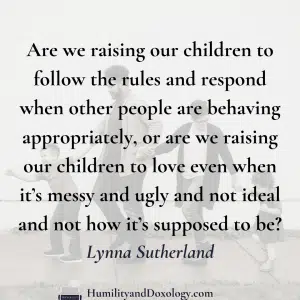
Lynna then related this to our relationships as brothers and sisters in Christ within the church. Are we just prepared to be godly and loving when everyone else is doing the things we think they ought to be doing? “Are we raising our children to follow the rules and respond when other people are behaving appropriately, or are we raising our children to love even when it’s messy and ugly and not ideal and not how it’s supposed to be?”
Lynna also reminded us that “we don’t have to address every thing at every moment.” A lot of wise parenting is noticing patterns and finding a more appropriate time to engage and deal with those issues.
I have definitely seen in my own family’s life that the heat of the moment is often the worst time to deal with big heart issues. I’ve learned to give a little space and time to process, and then deal with some of the same issues later at a more peaceful time.
This is one of the reasons why I like Lynna Sutherland’s sibling devotionals. The kids and I can discuss Biblical, wise, loving relationship issues at a time when no one feels defensive or attacked.
When to speak, when to be silent {26:51}
Not only ought we to sometimes table a discussion for later for the sake of a more important immediate family goal (like getting to church on time), but we can also do our best to set our children up for success. Sometimes this looks like setting up systems to remove potential stumbling blocks. Sometimes this looks like clearly stating a plan ahead of time that remove temptations.
“Yes, we want to deal with the heart issue. But what’s really important in the moment is that we not leave our children in a place where they’re just going to continue digging themselves deeper in a mud pit,” Lynna explained.
Taking away the toy they’re fighting over doesn’t fix the problem. But sometimes it is a way to protect them in the moment when they don’t have the wisdom or maturity to show self-control in the moment.
Nurturing loving sibling relationships {30:57}
“Moms, you have a huge, powerful opportunity to influence your children,” Lynna encouraged. When the children are all playing quietly and you’re enjoying your coffee, it’s easy to think there’s nothing you need to be doing in the parenting department. It’s only when the conflict starts that we think it’s time to start dealing with parenting issues.
But that’s just not the case!
Lynna Sutherland explained that one of the most powerful times for encouraging healthy sibling relationships actually occurs when things are peaceful! Can we help our children develop a positive narrative for their sibling relationship? As we notice a positive interaction (for example, 1 child shares a toy with a sibling), it’s important for us to bring that to the sibling’s attention.
“Whatever kind of list you’re making, you’ll always find things to add to that list,” Lynna’s mom used to say. If we can help our children develop positive things to add to the lists in their mind, we will be influencing our children in powerful ways to have close sibling bonds. It’s a way to positively spin and encourage our children’s positive bias towards their siblings. We are encouraging and training them to pick up on the “gold nuggets of relationships.”
“The flip side is true as well,” Lynna reminded. We don’t try to trick ourselves into thinking the people we love have no flaws. We need to be comfortable to have conversations with our children when one of them comes with genuine complaints about their sibling. Be willing to listen, acknowledge when things are annoying, and be a safe place to help our children think through how to positively respond to the sinners around them. (Because we will always be living around sinners, remember?!)
Sibling Opposition Solution Course {37:30}
Godly parenting is not about learning some steps, doing something to our children, and producing perfect little products. It’s often mostly about our own growth and sanctification as moms.

Lynna Sutherland has created a fantastic online sibling parenting course with short video lessons (bathroom break length!) and a connected community where you can ask questions and discuss challenges. The course includes 4 modules for a total of 18 lessons.
Each lesson in the Sibling Opposition Solution Course includes:
- Module 1: Mom’s mindset
(Own your powerful role as an influencer for change and growth in your home.) - Module 2: What to know before you begin
(Equip yourself with the insight and wisdom to understand the heart behind the hostility.) - Module 3: Foundations of reconciliation
(Master practical strategies for settling the dust after the dispute.) - Module 4: A closer look at common scenarios
(Get the straight facts on handling those common, pesky situations that happen every day.)
Here are just a few of the benefits you’ll receive from the Sibling Opposition Solution Course:
- Discover the one simple shift in your thinking that will revolutionize your approach to mediating sibling conflict
- Uncover three ways you can unknowingly blow your effectiveness as a conflict mediator … and what to do instead
- Develop a list of good questions you can ask to uncover attitudes and motives behind the conflict
- Discover the real reason we should teach our kids to apologize – it’s not what you think
- Learn five practical strategies for teaching kids to reinforce their apologies with actions
- Discover six things that true forgiveness should always include … and two things it shouldn’t!
- Find out the one fatal mistake parents make when managing the problem of tattling … and six simple things to do instead.
- Learn the five telltale signs that you’ve got a bitterness problem in your home
Find Lynna Sutherland Online
Check out all the other interviews in my Homeschool Conversations series!