When we think about a Charlotte Mason homeschool, we often picture stacks of living books, nature walks, beautiful poetry, and children narrating what they’ve learned. And those are all wonderful things! But have you considered the important role of Charlotte Mason handicrafts in your homeschool? A Charlotte Mason education encouraged our children to learn to make useful and beautiful things with their own hands.
If the word handicrafts makes you think of complicated projects, expensive supplies, or one more thing to squeeze into your already-full homeschool schedule, take heart! Teaching handicrafts to children doesn’t have to be overwhelming, and you don’t have to be an expert yourself. Today’s guest post by Dayna (longtime homeschool mom and a knitting and crochet pattern designer) from This Yellow Farmhouse shares why handicrafts matter in a Charlotte Mason education and offers practical advice for teaching handicrafts in your homeschool, one small skill at a time. You might even find that those crooked first stitches and imperfect little projects become some of your favorite homeschool memories!
- Handicrafts aren't just crafts
- Why does this matter in our homeschool?
- Handicrafts teach children to persevere
- But how do you actually teach a handicraft?
- You don't have to be an expert
- They can make something for someone they love
- Let handicrafts become part of your family life
- What Dayna's kids are knitting this fall…From beginner to independent:
- You may also enjoy:
{This post contains paid links. Please see disclaimer.}
One of my favorite parts of teaching my kids at home is watching them learn to do things that they couldn’t do before. Not just know things, but do things.
Whether it’s the first time she ties her shoes or the first time she reads a book to a younger sibling, real life learning is my favorite part of home education.
And I think it’s one reason handicrafts have such an important place in a Charlotte Mason education.
When we think about Charlotte Mason, we like to think about living books, nature study, narration, picture study, poetry, and short lessons. All of those things are wonderful and important.
But Charlotte Mason also wanted children to make things with their hands.
More than just keeping them busy, she wanted kids to work carefully and skillfully, and make useful and beautiful things. She knew that in order to have the patience and attention needed to do a job well later in life, the work started in childhood.
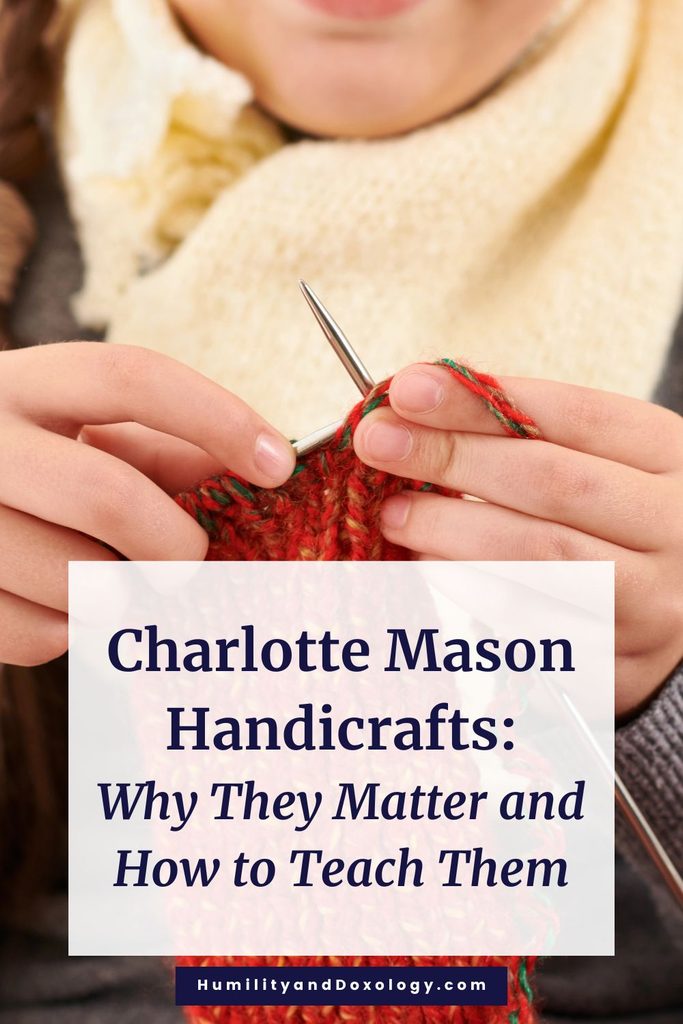
After homeschooling my own four kids, teaching knitting and crochet to children in our homeschool and community, and spending more than a decade knitting myself, I really believe that handicrafts are one of those Charlotte Mason ideas that sounds simple until you actually see what it does for a child.
Handicrafts aren’t just crafts
I love a good craft. We’ve made needle felt projects, watercolor paintings, and plenty of things with glitter and sequins. But when Charlotte Mason talks about handicrafts, she’s talking about something a little different.
A handicraft is a real skill. It’s when a child learns how to use a tool or material and gradually becomes capable of making something herself.
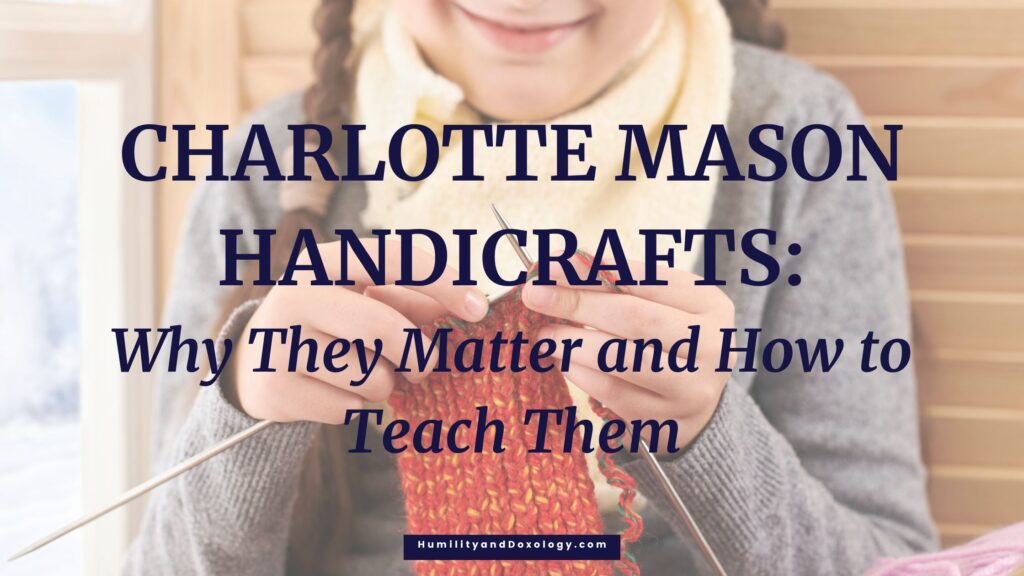
Knitting is a good example.
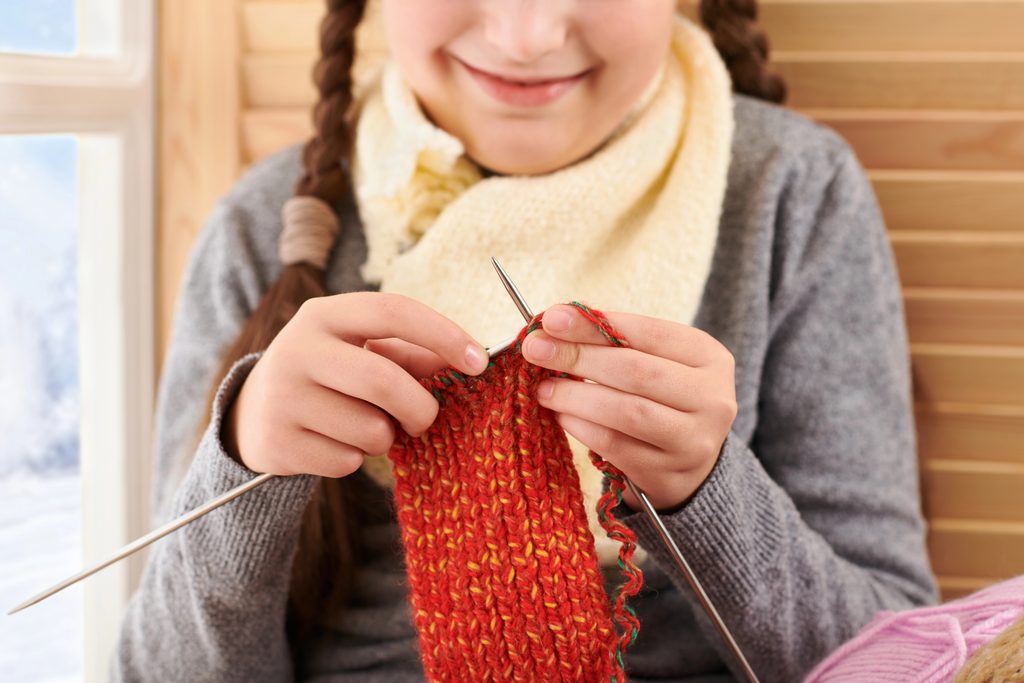
At first, knitting is hard. There are needles going in different directions and you feel like an octopus who got stuck in yarn. The first project probably isn’t going to look very impressive.
But then something happens. The children get it. Suddenly those funny little loops of yarn make sense and she can knit a row without help. Before you know it, she’s knitting several rows. And eventually she can follow a simple pattern and make something beautiful and useful.
She has now learned a skill that she can continue using for years, which is very different from gluing pom poms to a paper plate and moving on to the next craft.
Why does this matter in our homeschool?
This is so important because our kids aren’t just brains absorbing information for a test.
Kids have hands that need to learn how to work. They need to be given the chance to practice patience, attention, perseverance, and care. And they need to feel the satisfaction of making something with their own hands.
And honestly, I think all kids need to experience the frustration of not being good at something yet.
When you make a mistake and don’t realize it until three rows later, you have to undo your work. It isn’t fun, but it teaches us that making a mistake doesn’t mean you’re bad at knitting, it just means you’re learning.
Handicrafts teach children to persevere
One of the reasons I love handicrafts is that the lessons are so tangible.
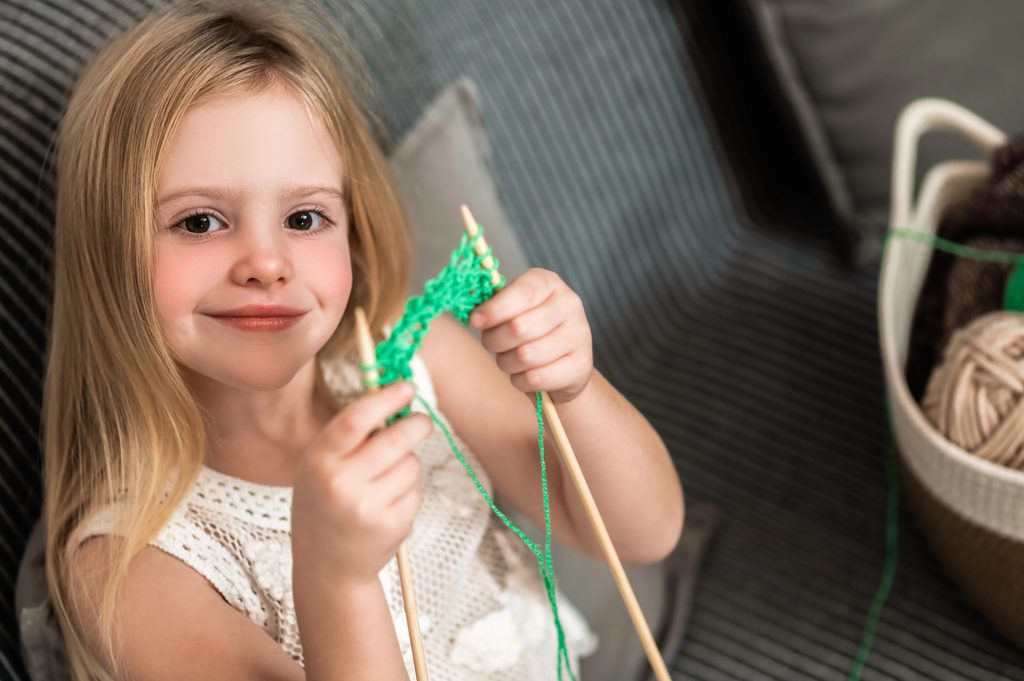
You can actually see the progress. A child who couldn’t cast on a few weeks ago is suddenly making a scarf. Or siblings who couldn’t use a crochet hook are suddenly finishing a dish cloth.
The work takes time, and that is part of the point.
We live in a world where so many things happen instantly. There’s something satisfying about sitting down with a ball of yarn and realizing that you literally can’t rush it. The scarf will take as long as it takes. The stitches have to be made one at a time. And kids get to see their efforts add up over time.
My six year old learned to knit last week, and everyday she shares a big grin and holds up how long it’s already grown. That feeling of confidence and pride comes from wrestling with a project and finishing it well.
But how do you actually teach a handicraft?
It’s one thing to understand that handicrafts are important, but it’s another to figure out what to actually teach and when you’re going to fit it into your homeschool day.
After doing this for a while, I’ve found that it helps to keep it very simple.
Pick one thing.
You don’t need to teach your child knitting, crochet, embroidery, sewing, woodworking, basket weaving, clay work, and watercolor painting all in the same year.
You can choose one. Just ask her what she’d like to learn this year. The goal isn’t to expose our children to every possible handicraft, but to help them develop a real skill.
Start small.
This is especially important with kids. Don’t begin with a hard project because it looks pretty, start with something she can actually do.
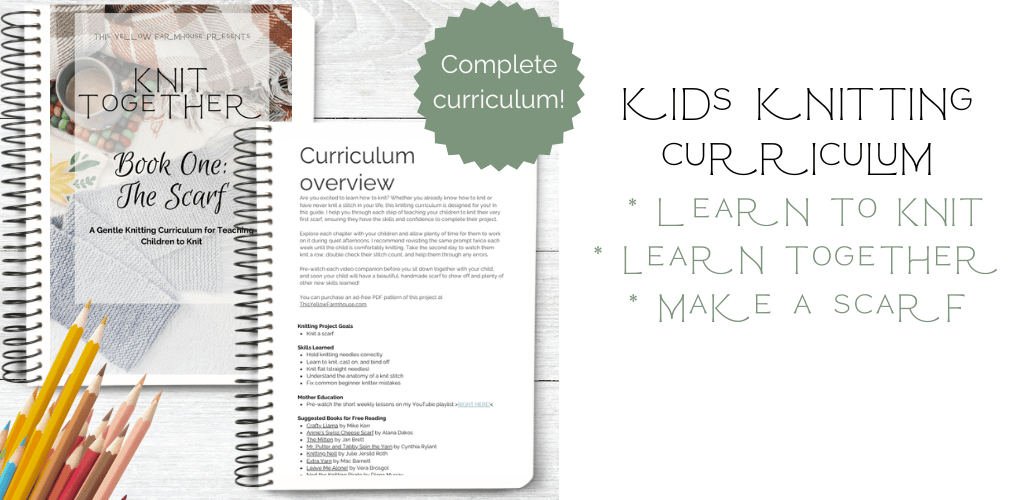
When I teach children to knit, I want their first project to be simple enough that they can experience success fairly quickly. It’s why I start kids with knitting a scarf, which I’ve shared in my knitting curriculum.
That doesn’t mean it has to be effortless. But if a child has to concentrate so hard on the mechanics that she can’t possibly enjoy making it, we’ve probably started with something that is too tough.

Charlotte Mason talked about keeping handicraft work “well within their compass,” and I think that is such a helpful rule.
Challenge them, but don’t overwhelm them.
Teach slowly.
This one is tough for moms if you already know the craft. I know how to knit, so it’s very tempting to show a child everything I know. Or they may see me knitting something complicated and ask to try it themselves.
A beginner doesn’t need to know everything you know about the craft, she just needs the next step. So we learn one thing and then we practice it, then we add another thing.
A five minute lesson that ends with a child thinking, I can do this! is so much more valuable than a thirty minute lesson that ends in tears.
Just like other school subjects, sometimes the best handicraft lesson is the one you stop before anyone gets frustrated. You can always pick it up again tomorrow.
Let them do the work.
This is probably the hardest one for me as a mom. Sometimes I can fix the problem much faster. I can knit the row for them or undo the mistake and hand it back. But if I always fix the hard parts, my child never gets the opportunity to become capable.
So as much as possible, let them struggle a little. Help them, but let their hands do the work.
The crooked scarf is part of the education.
You don’t have to be an expert
If the idea of adding handicrafts to your homeschool makes you think, That’s lovely, but I don’t know how to do any of that, I understand. And yet, I teach my kids math and science!
You don’t have to be an expert because you can learn alongside your children.
Find a good book or watch a tutorial. Ask someone who knows how or take a class.
If you learn one small skill, you can teach it to your child. I recently started learning embroidery, and because I’m practicing little by little, I can help my girls with their own projects. And we can bond over our progress and how we worked through tough stitches.
There’s actually something rather lovely about letting our kids see us learn something, too.
We don’t have to be the person in the room who knows everything. Sometimes we can say, “I don’t know how to do that yet. Let’s figure it out.”
That is a pretty good education.
They can make something for someone they love
Another reason I love handicrafts this time of year is because Christmas is coming!
Handicrafts make great Christmas gifts. Not because everyone needs to make all of their Christmas presents, and definitely not because we need to add another thing to our Christmas to do list.
But because a handmade gift gives kids the opportunity to experience something that’s really hard to teach with words: the joy of using your time and your hands for someone else.
A child can knit a washcloth for Grandma or a simple scarf for Dad. She can sew a little pouch for a sibling or crochet something for a friend.
The gift doesn’t have to be elaborate. In fact, the simpler the better when a child is just a beginner. What matters is that she gets to say, “I made this for you” and the receiver gets a handmade gift made from someone special.
Let handicrafts become part of your family life
I don’t think handicrafts need to become another big subject that we have to check off our homeschool schedule.
One of my favorite things about knitting is that once you learn the basics it can become part of everyday life.
Knitting can come along in the car and a basket of projects can sit beside the couch for morning time. We can sit together and talk while our hands are busy.
That’s exactly the kind of education I want for my kids. They’re learning to work with their hands, to push through the hard parts, and to create something useful and beautiful with their own hands.
That’s why I think handicrafts matter. They aren’t just a break from the “real” schoolwork, they are part of the schoolwork.
This fall, if you haven’t made room for handicrafts yet, you don’t need a complicated plan.
Pick one, start small, teach it slowly, and let your child do the work.
And by Christmas there might be a slightly crooked handmade gift under the tree that your child can proudly say she made herself!
I can’t think of a much sweeter way to learn.
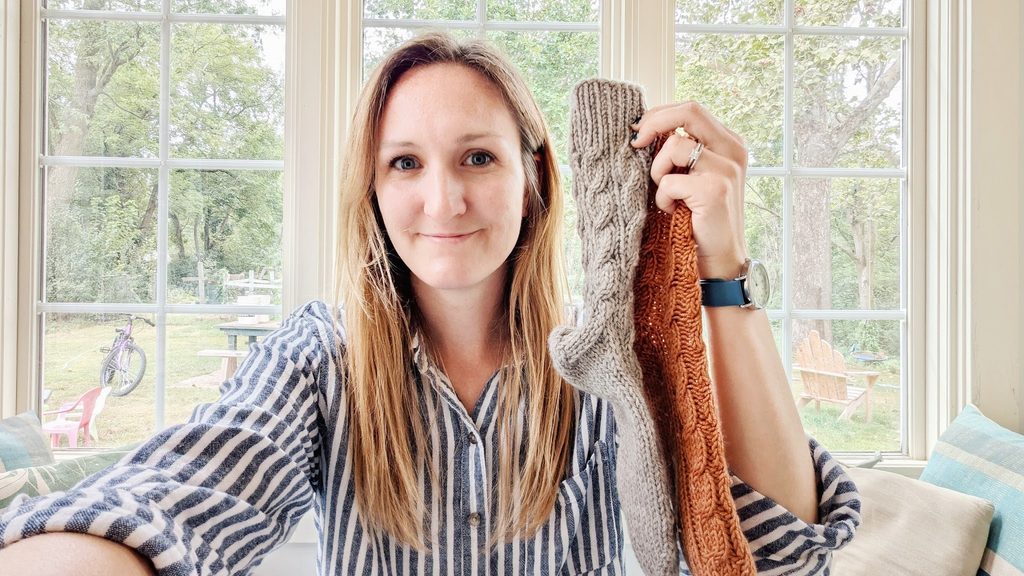
Dayna designs knitting and crochet patterns from home in their 1834 farmhouse in the woods of northern Illinois while homeschooling their four kids. She loves passing down the joy and skill of knitting and crochet to her own family, and has enjoyed encouraging and teaching other families to learn as well. You can read more on her blog and find all patterns at https://thisyellowfarmhouse.com and watch tutorials and tips on teaching kids to knit and crochet at https://youtube.com/@thisyellowfarmhouse.
What Dayna’s kids are knitting this fall…From beginner to independent:
You may also enjoy:
- From Oral Narration to Essay Writing: A Charlotte Mason Approach with Karen Glass
- Mother’s Education: Charlotte Mason for Homeschooling Moms with Beth Howard
- Scholé Every Day: Restful Learning for Homeschool Moms
- Narration as the Art of Learning: A Conversation with Adrienne Freas
- Charlotte Mason Living Education for Little Learners
- Getting Started with Charlotte Mason Homeschooling with Amy Fischer
- Recovering the Common Arts in Classical Education