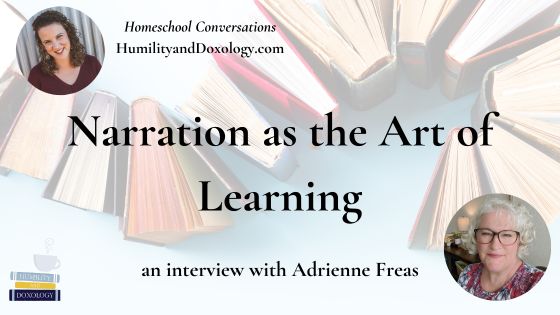
What is narration in homeschooling, and why does it matter so much in a Charlotte Mason or classical education? In this episode of Homeschool Conversations with Humility and Doxology, I talk with Adrienne Freas (homeschool veteran, grandmother, author, and classical education consultant) about the art of narration. Adrienne shares how narration goes beyond simple retelling to become a joyful, life-giving practice that builds memory, strengthens reasoning, and develops eloquent expression. Together we explore the roots of narration in the classical tradition, why it uniquely activates all three arts of the trivium, and how homeschool families can begin narration in simple, practical, and creative ways.

{This post contains paid links. Please see disclaimer.}
- Adrienne Freas’s Homeschooling Journey
- What Is Narration?
- Narration in the Classical Tradition
- Practical Ways to Begin Narration
- Transitioning from Oral to Written Narration
- What Adrienne is Reading and Her Encouragement for Homeschool Moms
- Continuing the Conversation on Narration
- Key Takeaways
- You may also enjoy:
- Find Adrienne Freas Online
- Check out all the other interviews in my Homeschool Conversations series!
Adrienne Freas’s Homeschooling Journey
Adrienne Freas began her homeschooling journey decades ago with four young children close in age. While the decision to homeschool wasn’t easy, she soon discovered the Charlotte Mason philosophy and was captivated by its emphasis on beauty, literature, music, poetry, and art. Drawing from her own childhood steeped in the arts, Adrienne recognized the importance of centering education around beauty and living ideas.
Though her family experienced both homeschool and school settings, Adrienne came to believe that the depth and richness of homeschooling provided her children with far more than even excellent schools could offer. Today, with grown children and many grandchildren, Adrienne delights in seeing the legacy of homeschooling passed to the next generation.
“Don’t give up. The richness of homeschooling far surpasses even the best schools.”
What Is Narration?
At its simplest, narration is retelling, or sharing back the story or content one has heard or read. Adrienne emphasizes, however, that narration is far more than a tool. It is an art: life-giving, creative, and multifaceted. Students can narrate by speaking, drawing, singing, acting, or even building with Legos.
“Narration is an art. Historically it is an art. An art is something you do and a tool is something you use.”
Adrienne wrote her book on narration to help parents understand that Charlotte Mason belongs firmly within the classical tradition. Narration is not just a Charlotte Mason practice. It is deeply rooted in the classical liberal arts tradition, stretching back to Plato, Aristotle, Quintilian, and Cicero.
“If you are doing a classical education, you are actually doing [Charlotte Mason]. Charlotte Mason is classical.”

Narration in the Classical Tradition
While many associate narration only with Charlotte Mason, Adrienne explains that it has long been central to classical education. Socrates and Plato emphasized oral, logocentric learning. Quintilian, the first-century Roman orator, even lamented that narration had been neglected, calling it “the most important department of rhetoric.”
Adrienne notes that narration naturally activates all three arts of the trivium:
- Grammar: gathering and imitating knowledge
- Logic: analyzing, reasoning, and internalizing ideas
- Rhetoric: expressing, applying, and creating with wisdom
“There is no other pedagogy in classical education that literally activates all three modes of the trivium. Narration is the only one.”
Every narration engages these modes of learning, making narration unique as the only practice that integrates the full trivium.
“Every narration engages grammar, logic, and rhetoric: gathering, reasoning, analyzing, and then expressing with eloquence.”

Practical Ways to Begin Narration
For homeschool families new to narration, Adrienne encourages a gentle approach:
- Use narration prompts like “Tell how…” or “Retell your favorite part…” instead of always using the word “narrate.”
- Begin with picture study to help children build mental images.
- Try short, simple texts like Aesop’s Fables.
- Encourage creative narrations such as drawing, singing, puppet shows, or Lego creations.
“It’s okay to say, tell how so-and-so did such and such a thing… these are prompts Charlotte Mason herself used in her exams.”
“Picture study is a wonderful way… then turn it over and say, tell me everything you remember.”
Importantly, Adrienne reminds parents not to feel pressured for children to narrate everything all the time. In a classroom, multiple students share narrations, but at home, parents can choose a few meaningful opportunities each day.
Transitioning from Oral to Written Narration
As students grow, narration can naturally expand into written work. Adrienne stresses that written narration should not be graded for mechanics such as spelling or punctuation. Its purpose is to express ideas, not to test grammar.
“Do not grade for punctuation and spelling because this is not a spelling lesson. It is a retelling lesson.”
Some students narrate better in writing than orally, especially reflective or introverted learners. Parents can support them with scaffolding strategies like providing a list of key words or character names to incorporate into narrations. For children who narrate at length, written narration can help them practice condensing and refining their thoughts.
“Narrating is a human thing to do. It’s never too late to start narrating.”

What Adrienne is Reading and Her Encouragement for Homeschool Moms
Currently, Adrienne is reading After Prayer by Malcolm Guite as well as spending more intentional time in the Bible. She finds joy in both the beauty of poetry and the power of Scripture.
Her encouragement for homeschooling parents is simple yet profound: don’t give up. Homeschooling provides a richness of learning and connection that far surpasses even the best schools.
Continuing the Conversation on Narration
Adrienne Freas has spent decades living, studying, and teaching the art of narration, and her insights remind us that narration is not just an academic exercise. It is a human, life-giving practice that builds memory, cultivates reason, and nurtures eloquence. Whether your children are young or older, new to narration or seasoned in the habit, there is always room to begin (or begin again) with fresh encouragement.

If this conversation has inspired you, you can learn more about Adrienne’s work, her book on narration, and her upcoming Narration Conference at beautifulteaching.com. You’ll also find her Classical Education Podcast and additional resources to help you grow in your own understanding of narration and classical learning.
If you enjoyed this conversation, don’t keep it to yourself! Share this episode with a fellow homeschool mom who may be curious, overwhelmed, or just ready to deepen her understanding of narration. And don’t forget to subscribe to Homeschool Conversations with Humility and Doxology in your favorite podcast app or on YouTube, so you never miss an encouraging and practical discussion.
Key Takeaways
- Narration is not a tool but an art form—life-giving, creative, and expressive in many mediums (oral, written, artistic, dramatic).
- Charlotte Mason’s approach to narration is deeply rooted in the long history of the classical tradition, aligning with thinkers like Plato, Aristotle, Quintilian, and Cicero.
- Narration is the only practice that fully engages all three arts of the trivium—grammar, logic, and rhetoric.
- Oral narration should come first, with written narration developing naturally “by and by,” as children gain fluency and maturity.
- Parents should avoid grading narrations for mechanics like spelling and punctuation; narration’s purpose is idea expression, not grammar drills.
- Practical prompts (e.g., “Tell how…” or “What was your favorite part?”) and creative methods (songs, drawings, Lego scenes, puppet shows) help children engage in narration joyfully.
- Picture study and short texts like Aesop’s Fables are excellent starting points, especially for children who struggle with narration.
- Narration works differently at home than in classrooms; homeschool parents should not feel pressured for their children to narrate everything all the time.
- Transitioning to written narration can be supported with keyword lists, scaffolding, and encouraging reflective or introverted children who may prefer writing.
- Adrienne encourages homeschool moms not to give up, reminding them that homeschooling provides a depth and richness of learning far greater than even excellent schools.
You may also enjoy:
- Charlotte Mason Living Education for Little Learners
- Charlotte Mason Inspired: Little Learners, Learning Challenges, and the Cultivation of Habits
- Getting Started with Charlotte Mason Homeschooling with Amy Fischer
- A Humble Place: Charlotte Mason, Picture Study, and Restful Homeschooling (with Rebecca Zipp)
- Classical Charlotte Mason Homeschooling (with Adrienne Freas)
- Patience, Wonder, Ignorance, and Joy in a Classical, Charlotte Mason education (with Karen Glass)
- Classical Education for Students with Special Needs
- Why We Pursue a Christian Classical Education in Our Homeschool
- Repentance and Discipleship in Christian Classical Education (a video interview with Dr. George Grant)
- Life-Long Learning: Charlotte Mason, Classical Education, and Read-Aloud Culture (a video interview with Kathy Weitz from Cottage Press)
- A Common Arts Education in Our Classical Homeschool (with Chris Hall)
- Classical Conversations and Couch Schooling (with Charity Miner)
Find Adrienne Freas Online
Adrienne Freas is the founder and director of the Classical Education Podcast as well as Beautiful Teaching Consulting. Adrienne has worked as the Classical Education Advisor for the K-12 Curriculum and Professional Development Project at the University of Dallas and served as the Director of Classical Methods for Responsive Education Solutions. She also served as a Curriculum and Pedagogy Specialist for Coram Deo Academies, a university collaborative model school. Adrienne has been married to her husband for over 30 years and is a retired homeschool mother of four adult children and the grandmother to 10 plus a grand puppy.

Check out all the other interviews in my Homeschool Conversations series!
Amy Sloan: Hello friends. Today I am delighted to be joined with Adrienne Freas, who is the founder and director of the Classical Education Podcast as well as Beautiful Teaching Consulting. Adrienne has worked as the Classical Education Advisor for the K-12 Curriculum and Professional Development Project at the University of Dallas and served as the Director of Classical Methods for Responsive Education Solutions. She also served as a Curriculum and Pedagogy Specialist for Coram Deo Academics, or excuse me, Coram Deo Academies, a university collaborative model school. Adrienne has been married to her husband for over 30 years and is a retired homeschool mother of four adult children and the grandmother to eight plus a grand puppy.
Adrienne Freas: Nine now, actually, and a tenth on the way.

Amy Sloan: Oh, that is so exciting. What a joy. Well, Adrienne, you’ve been here on the podcast before and I’m going to definitely put a link to that conversation in the show notes for this episode. But just as a reminder for anyone who didn’t hear our past conversation, can you tell us a little bit about yourself, your family, your background with homeschooling, Charlotte Mason, classical education?
Adrienne Freas: Sure, yeah. I, years ago, and I’m sure I talked about this in the last episode, but years ago, many, many years ago, decades ago probably, at this point I decided to homeschool my children. And, you know, that wasn’t an easy decision. It was, I knew I wanted to homeschool them, but I had four kids in five years. And so my son was starting kindergarten while a newborn was coming along. So we did put him in kindergarten. We put our kids in lower elementary school for a time. And then when we relocated to Texas, I started homeschooling all of them. So they were between the age of kindergarten and third or fourth grade when I started homeschooling all four of them. And my, I quickly discovered that Charlotte Mason was the approach I wanted. I did a lot of reading. I went to like, down here in Frisco, Texas, there was a Peach, it was called Peach Homeschool Group. I don’t remember what Peach stood for, but I don’t know if they’re still in existence, actually. But it was a wonderful homeschool group. And they had like this wonderful, every month they would kind of present a different type of homeschool. And so I educated myself on all the different types, and the Charlotte Mason approach was the one that appealed to me the most. It made the most sense to me in so many ways. The literature-based approach, the beauty approach, the music and the poetry and the pictures, you know, art. I grew up immersed in that. I was in ballet. My mom taught music out of our home. My mom, I went to college with my mom a lot. So I remember her loving art, art history classes. She was a music major. And so I just felt, I knew that that was going to be central to how I wanted to homeschool my children because I saw the connection from my childhood, even though I went to public school, I saw the connection from my childhood to the importance of beauty being a central part of that and beauty through the arts. And so I knew that I could teach everything else as long as I centered everything around the beauty of art, music, poetry, literature, all of that. And so Charlotte Mason obviously was the right choice. It was the only program that had that central focus, really. And so I bumbled my way through it, reading all of her, you know, trying to read through her volume six and having the same struggle everybody else did with her language. And eventually, I got used to her language and it was very easy to read. I can read her really easily now. It’s no problem. But it takes a lot of effort and energy. And back then we didn’t have podcasts. I didn’t even have a computer. So we didn’t have the online stuff. And I went to a computer once a week at the library for an hour because we didn’t have internet or computer. So I had to read. I had to read her. And I started a Charlotte Mason support group locally just because I needed to read her and have other women to talk to. I went to a local support group in Frisco and actually Lynn Bruce was one of the leaders of that group. It was Kim Neve and Lynn Bruce, which I was so blessed to get to know Lynn. She’s hilarious, beautiful, wise, wonderful Christian founder of Amelstein Online. And just I adored her. And she is greatly missed by many of us. And she’s still in our hearts. But then I kind of ventured out and started my own group because I wanted something a little closer to home because we had moved. Metroplex is huge here. So in doing that, then I made connections with people who were in other classical groups. And one of them was the wife of the founder of Responsive Ed. And she and her husband wanted to convert a bunch of schools to Charlotte Mason Classical. And so she invited me to come participate in that project. And that’s how I started working, which was very unexpected. I had no idea that that would ever happen to me. But she said I was the perfect person to do it. So I, my daughter was a junior in high school, my last one. So I put her at Founders Classical Academy for her junior year while I did that. And then her senior year, she came back home and homeschooled herself because she really missed the richness and the beauty of reading a lot of books. And I do want to say, I know I’m going on and on really quick. And I know you have a lot of questions, but I want to say something to the homeschool moms out there. You have my heart and I’m telling you don’t give up. There is nothing better. And I love teachers and I love schools. And I do this because this is what God called me to do. And I know that putting your children in school is often a necessity for a lot of people. And I think there’s a lot of good about going into schools. I’m kind of glad my kids have had a little bit of both. I think there’s beauty in the narration works, actually, better in a classroom. And we’ll talk about that. But it’s a struggle when you homeschool. And I have the same struggle. But I want to say to homeschool moms, don’t put your kids in school just because you think it’s that you’re not doing enough. OK, that’s never a good reason to put your kids in school. And that wasn’t a reason I put mine in school, because I will tell you that the level and amount that you can cover in a homeschool is by far tenfold more than what they would get in a public school, even the best classical school. Your children are not going to get as much richness. They’re not going to get all the books. And I love classical schools and I love all the teachers I work with. But you always have a lot of new teachers coming in. This is new to them. And for a lot of them, it’s very difficult. And so they’re not going to get the same richness as they would from a mom who actually really understands Charlotte Mason and is bumbling her way through it like I did, because you’re a mom and you love your kids and teachers are great and they love their children. I don’t want anyone to think I don’t love teachers in schools, but I down deep in my heart, I just I really love homeschooling. I still love homeschool moms. And I feel sad when homeschool moms get burned out, discouraged. And the burnout is really unnecessary because you really can just enjoy. You can enjoy your children. You can enjoy teaching them to do chores, growing in habits. You can enjoy reading books together and they’re still going to get a lot more than they would in a really good school. So I just want to say that because I know that moms need to hear that. And it’s really, really true. I go to a lot of schools. I visit a lot of classrooms and there’s a lot of good teachers and a lot of good schools. But like my daughter, she was like, I want to go back home because I can read three times the amount of books than I could in a school. And she wanted to read that many books. So that’s kind of my encouragement. So yeah. And now we have, you know, a 10th grandchild on the way. Our grandchildren are seven and under. And it’s just I love being a grandmother. I love it so much. And it takes a lot of my energy, a lot of my time. My heart is full and I’m very blessed that I have four wonderful adult children married to very, very wonderful people. And they are all great parents. So on that end, I’ve been very blessed.
Amy Sloan: Yeah. Oh, I love hearing just the background, the story, the way the Lord ended up kind of teaching you and bringing you along for this adventure and also the encouragement to homeschool moms that we all need that reminder. But I love hearing that from moms on the other side, you know, those veteran homeschool moms. They’ve gone all the way through and they can look back and say it really is all worth it.
Adrienne Freas: Oh, and my daughter, my daughter, our oldest grandchild is seven and she’s homeschooling and she’s using a most online. And yeah, so I have children who are now homeschooling their children and my other daughter’s homeschooling her almost kindergartner. And my other daughter plans to homeschool when her kids are old enough and my son and his wife plan to homeschool. So we’re really blessed that we have that legacy that we’re passing on and that they’re all embracing it.
Amy Sloan: Yeah, that’s beautiful. Well, one of the things I wanted to focus on in this, in today’s episode is really just dive deeply into the topic of narration because this is something that’s so important and it’s so fundamental. And yet moms, including myself, can still feel like overwhelmed, confused, not really like, okay, this is really important. I don’t really know what I’m supposed to do. So I was like, great, you have a new book that you’ve just written all about narration. So I was like, expert, come and help us. But let’s just start with the big picture. You know, how would you define narration? What actually is it? And then why did you decide to write your book about it? Sure.
Adrienne Freas: I mean, at its basic root level, it’s just retelling a story, retelling you hear a story and then you retell it. We do it all the time. We go to a movie, we come back and we want to tell everybody and we want to tell the spoiler even, right? So remembering all those details and coming back and retelling it. I do like Jason Barney’s definition. He has a really great definition in his book on narration. I’m going to read it here. It says, narration is a teaching practice in which students are asked to communicate back the substance of content they have learned. I think that’s a really nice starting place for narration in the way we intended for helping students to retain and build their memory. So yeah, that’s the basic definition. Okay, so why did I decide to write a book about it? Well, you know, I’m passionate about narration and I’ve been studying it for 20 years. I’ve also been studying the trivium for about 10 years and one of the things that I have kind of set forth to do in my, oh, the last five years, seven years, is really help moms to stop saying, you know, I don’t do classical, I do Charlotte Mason. Because really, if you are doing a classical education, you are actually doing it. You know, Charlotte Mason is classical and so I’ve had a real important mission to help people understand the difference between a classical education and a neoclassical education. So when they say, I don’t do classical, what they mean is neoclassical. And I know Karen Glass and Cindy Rollins have done a great podcast on this. I did a wonderful podcast with Kiernan Fiori on it and I address it in my book, my new book, because I want parents to understand the difference between the tradition of classical education and this new model of classical education that has been going on since the 1980s, right? And the reason I want them to understand the difference is because I want them to make an informed decision. Like I made informed decision. I spent a year trying to figure out how I wanted to homeschool my children and I wanted everything put before me so I could really understand what I wanted for my children. And so the neoclassical education, I don’t have a problem with it. I just want people to understand what it is, what its roots are, what does a new classical education look like versus the tradition. So the traditional form of classical education is actually very, very, very much Charlotte Mason. This liberal arts tradition, Charlotte Mason completely gives us what Plato and Aristotle and Augustine were talking about. Quintilian. He was St. Victor. John of Salisbury. You read all of these fathers of classical education and everything they’re saying is the same thing Charlotte Mason said. But the conflict, so it’s right when a mom says I don’t do classical, I do Charlotte Mason because in her mind classical is this neoclassical model and that is not compatible with Charlotte Mason. So I felt that it was important for people to understand what the tradition of the trivium is and how incredibly powerful narration is and how it actually activates all three modes of the trivium. And so when you actually understand the trivium rightly, you start to see oh Charlotte Mason is very classical because when you understand the tradition of the trivium, you see Charlotte Mason all through it. It’s the neoclassical trivium that is not aligned to Charlotte Mason. And so I think that that’s an important message to get out and I don’t think anybody’s written a book about it. So that was one reason I wrote the book. Another one was the second half of the book is on pedagogy and I have all kinds of practical things in there, especially things that teachers really want. I have, well there’s things in there for homeschoolers but also a lot of teachers need and want rubrics and how do I grade and how do I assess. And so I address that in the book like how would you take a grade or assess a narration. But I also want them to understand because there’s a huge misunderstanding in the classical education movement that narration is an assessment tool. And it is absolutely not an assessment tool and I wanted to get that point clear and it’s very important to understand this. Years and years ago one of our you know people that we there’s a person that we all follow and she’s wonderful and she has great resources out there. I know you follow her. I know lots of people follow her. And she sent out this newsletter it was probably two or three years ago to all of her people on her mailing list and she said why narration isn’t working for us. And it and I read this and I was astounded that she was calling narration a tool. And I said okay the reason narration isn’t working for her is because she’s looking at it as a tool. Narration is an art. Historically it is an art. An art is something you do and a tool is something you use. These are completely different things. An art is life-giving. A tool is not life-giving. A tool is useful. And so if you’re looking at narration as a useful tool and you say I’m I’m uh what do people say I’m I’m using narration. A lot of people say that I’m using narration. It’s in my toolbox right? No no no no. If you do that narration is going to flop because that’s not what it’s for. It’s an art. It is life-giving and it is fun. And you play with it just like you do any other art with millions of mediums. I mean you know all the homeschool moms who know you can you can sing a narration. You can draw a narration. You can do puppet show narrations. You can act out a narration. It’s because it’s an art. So it has lots of mediums in which it can perform right. And so that was another really important issue that I wanted to address because I think a huge mistake in the classical ed movement is to look at narration as a tool. And it and so I really really uh draw that point strongly in my book. And because it’s an art we would assess it the way we would art. So you think about an art teacher and how art teacher assesses. They give their students you know goals and they guide them on how to get better and better at the art which is what we want to do with narration. And if we’re going to assess them they’re going to assess them very personally, very holistically. And so I address that in my book too because I think that’s something that nobody’s ever written about and I think it’s really important. And so homeschool moms want to know that as well.
Amy Sloan: Yeah especially because I know there are some states where they may have laws where they have to have ways of kind of proving a certain ability or a certain growth or change. So that would be really helpful um even for homeschool moms who who have to show some sort of official grade for their subjects.
Adrienne Freas: Yeah but there’s a lot more in here than just I mean there’s also I have I talk about the trivium as musical modes um and how narration is a musical it’s it’s a musical activity. Um and I think that this will help a lot of homeschool moms feel encouraged um that it is really important. And there is no other pedagogy in classical education that literally activates all three modes of the trivium. Narration is the only the only um activity or practice that activates all three modes of the trivium. And if your kids are in school or you want to do seminars or Socratic discussions the kids who narrate are going to be better at participating in Socratic discussions as well.
Amy Sloan: Yeah so I think this is really interesting because a lot of people think of narration and they just automatically think Charlotte Mason. And of course you make the point and as so many do that Charlotte Mason is part of this traditional classical um framework. But what is the history of narration then specifically in that long history of the classical education tradition? And is that different in any way from maybe what people might assume uh narration is in in today’s modern world?
Adrienne Freas: Sure um well I think Jason Barney wrote a pretty good book on the history of narration. It’s really thin and really small but I kind of came about it from a different angle than he did. And I I saw some things a little differently than than he did even though he’s right. I think I’ve added another layer to to that. Um so Aristotle you know his his tutor was Plato and Socrates right? He came so Socrates Plato Aristotle right? They came right out from each other. And um Socrates was very logocentric as was Plato. So logocentric meaning word verbal oral tradition focused. So narration is a logocentric activity meaning it’s very much an oral activity first primarily even though we do transition to writing primarily like Socrates was against um writing. He he called it this technology that was going to ruin children because they weren’t gonna be able to remember anything. So narration was what they were doing. They were narrating. They were orally telling stories and they were narrating so they could keep them so that they didn’t lose their knowledge and their memory base. And so Plato then was carrying sort of that same idea and that same tradition of this logocentric focus. And and Charlotte Mason understands the logocentric focus very well because she says that the kids who can narrate we we should focus she says I don’t know where this is at but I know she says it because it’s in my book. She says we should focus on oral orally narrating over writing. There’s an obsession with writing even back in her days there was an obsession with teaching kids to write. In our country we’re teaching them to write in kindergarten. It’s kind of a little bit ridiculous. We should focus on the oral first and then she says the writing will come by and by. It will come the more they are able to orally tell they will become they will transition into being able to write. So we see that in in this logocentric model. And so what ended up happening was Aristotle kind of shifted from the logocentric model to this logic focused model. And in doing so he you know he wrote rhetoric and he really kind of shifted away from narration. He talks about it a little bit but he shifted away from it and then the West became so obsessed with Aristotle that narration sort of got lost in the trickle and it just kind of faded away. Well Quintilian tried to bring it back. He’s a first century Roman attorney statesman and orator. So he was a a teacher of rhetoric and he was asked to write a book about his pedagogy and how he implemented you know rhetoric teaching with children with boys back then they only educated boys. And it’s a great his his oration book is fantastic and it reads a lot like Charlotte Mason. If you can read Charlotte Mason you can read Quintilian. They sound very much the same. In fact I’ve posted things like who do you think this is and people are like Charlotte Mason. I’m like no it’s Quintilian. That’s awesome. Like I feel like she just she had to have read him. And he says actually that narration had been the most important department of rhetoric to the Greeks. And it was the he said it was a scandalous dereliction of duty that narration had been lost because it was the most important department of rhetoric. So right there I’m telling you narration is part of rhetoric which is one of the parts of the trivia. We’ve got grammar logic rhetoric and as I unpacked that that history that part of history of understanding that I realized that narration covers all five canons of rhetoric. So you’ve got arrangement delivery invention style and elocution the five canons of rhetoric. And when you understand what those five canons are and I have this in my book so I have a whole chart in my book explaining how it works. When you understand those five canons what you see and when you understand what narration is and what narration does narration every time a student narrates they’re covering all five canons of rhetoric. Now sometimes they might not be they might not be good at sequencing which is arrangement. So that’s where I talk about this is a rubric you can use for kids when they’re a little bit older to have them say okay which of these five canons do you think you’re good at when you narrate? Which one do you think you struggle with? How about you set a goal to get better at this? And I have real practical things of questions you can ask yourself and your student so that you can start working on those things and that will automatically transition into writing into good writing. And so I think that that focus on logic lost that logocentric beauty that Plato was trying to show us in the Republic and in his dialogues. And so I really think Quintilian did a good job trying to direct us back to that. I also in my book I actually don’t quote Charlotte Mason as much as I quote Cicero and Quintilian. So Cicero also just really really focused on the art of building memory. So I started my book out as the importance of bringing building memory palaces which is a beautiful building beautiful mental images in your mind. And that was a very medieval tradition the way they did that was through narrating. So Cicero says it is it is wrong for children to do rote memory work essentially. To recite without having an understanding of knowledge. So don’t just have them recite things that they don’t understand or that don’t have meaning. And he talks about how the things they recite should be living ideas. This is very much a Charlotte Mason thing. And so I quoted these things in my book. Like look at what Cicero was saying. Look what Quintilian was saying. They were saying the same things and what they’re basically saying is that the way we build these memory palaces is through narration and through memorizing things that are living and beautiful. And so that’s that’s my view of the history of narration and how it points us back to the tradition of living ideas of building memory palaces. And that’s those are two huge reasons why narration is very important. It cultivates our soul.
Amy Sloan: Yeah well you know I’m a big fan of focusing on beautiful living ideas in memory work. That’s a big part of our homeschool. So yes I’m like here here. But you’ve mentioned a few times that narration is I think like the only art that or the only element that uses all three arts of the trivium. So can you kind of dig into that a little bit more and why is narration such an important part of the pedagogy for classical education?
Adrienne Freas: Yeah so I have in my book on page 47 this wonderful chart. I’m just going to look at it for a second here. So I break up the trivium. Before you get to that page if you read my book is trivium is learning modes and teaching modes. So as a learning mode in the grammar phase of learning this is the art of acquiring new information. You’re gathering information as a learner. That’s what you’re doing when you’re in the grammar mode. And from the teaching perspective of grammar this is the the mode where you’re actually giving students the opportunity to imitate something. And narration is a form of mimesis of imitation. It’s not rote imitation but it is a form of imitating. You’re using some of the style of the author’s language when you are narrating. And Charlotte Mason says that she gets it right. And so one of the question I say to to you as a teacher is the trivium activity that’s happening in your mind when you’re narrating is you’re developing knowledge by imitating, gathering, noticing, wondering, naming, ordering, typing, and attending. These are all activities that happen in the grammar mode of thinking. So then the dialectic and the logic mode. And I’m just going to say dialectic and logic are two of the sides of the same coin. They work a little bit differently and I expound on that in my book. But basically it’s the art of reasoning. It’s the art of internalizing that knowledge. So you’ve been gathering the knowledge in grammar. Now you’re internalizing that knowledge. And so that pedagogy mode, that’s the learning mode. Then the teaching mode for that is reasoning or meiudics which is Socratic teaching. But it’s really using the art of reason and your mind starts to do that. So when you’re narrating you’re gathering the knowledge. You’re starting to reason and starting to put things in an order. So in that mode the activity that’s happening is you’re developing understanding, you’re reasoning, synthesizing, analyzing, internalizing, formulating questions, proofs, organizing, categorizing, mapping ideas, making relational connections, and having discourse. We know that’s what’s happening when we narrate. So we’re gathering, we’re internalizing, we’re analyzing, all of that’s happening. And then the rhetorical phase of the trivium is the art of applying wisdom and eloquence. We’re applying the knowledge now that we have been gathering. And this in the pedagogy mode is giving students plenty of time to create. So the activity that’s happening when we’re narrating in the rhetorical mode is we’re developing virtue and applying knowledge by embodying and creating a response to a lesson, expressing articulately, imitating the good, true, and beautiful, and exercising the five canons of rhetoric. So that’s why narration is so huge because it activates all those three modes of the trivium when you understand the trivium as it is as modes of thinking and modes of learning. And I’m able to prove that in the book because there’s so many quotes where like even Quintilian says that narration and logic act together. He talks about how they work together. And then John of Salisbury, I think it is, he brings grammar and rhetoric together. They activate, they’re working together. He explains how. And as you read these books that these fathers of classical education wrote, you start to see this pattern of the trivium as modes. And it is curriculum too. But really what curriculum is, is living ideas. And the trivium is a living idea. Yeah.
Amy Sloan: It’s amazing because you think of something that seems on its surface so simple, right? Narration seems, and in some ways is, it’s so simple. And yet as you start to dig into it, it’s like, wow, there’s layers upon layers. You know, I’m imagining one of those like mirrors where you see like the mirror all reflected back in it or something. It can just go deeper and deeper. Yeah. Okay. So this is so helpful to have these big picture ideas to understand what’s really going on. And now I want to kind of bring it in a little bit practical for the mom who’s like, this is all great, but what do I do on my sofa with my kid on Tuesday? Right? So how is it best to start the practice of narration, especially maybe if it hasn’t been a part of your homeschool all along and you’re trying to introduce it? Can you start this practice even with older kids if you didn’t do it when they were younger? Walk us through this sort of on a practical nitty gritty level. Yeah.
Adrienne Freas: And we’re talking mostly to homeschoolers, not teachers in the classroom, correct? Correct. Yes. So you kind of do definitely approach it differently. And I do have, I do a lot of professional development training with teachers, so I can address that a separate way. So as a former homeschool mom, one thing I want to say is don’t stress. First of all, just enjoy your children. And one of the things that I, I’m going to just find this page in my book that I found that was a struggle with my kids was when I would say, okay, I want you to narrate now. They got so tired of hearing the word narrate. So I looked back at Charlotte Mason’s, if I can find this list, it should be in here somewhere. I looked back at Charlotte Mason’s exams. They’re on the AO website. So when you look at her exams, you see all of these wonderful, basically narration prompts. So I put a list of these in my book on page 65. So instead of always saying narrate, there are things you can say, like tell how, and you can add a little bit in it. Some moms may feel like it’s a little bit leading, but that’s okay. That’s okay to say, tell how so-and-so did such and such a thing or whatever to get them started. It can be very helpful. Also another narration prompt, retell about blank, retell about your favorite part of the story, right? Or tell about, so there’s explain what you know about. These are all prompts that Charlotte Mason has on her exams. Describe the relationship between blank and blank. I mean, that’s a direct question, but it’s a start to help them narrate. And some moms I found can feel like that might be a leading and they shouldn’t do that, but Charlotte Mason actually did do that in her exams. And so it’s okay to do that. It’s okay to add, and it’s also okay if you go back to the beginning of the story, the beginning of the chapter, and read that first sentence again and say, what happened next? Right? Or just to say, what was your favorite part? Now for kids who struggle with that, and I had some who did, I would say have them do a lot of picture study narrations first, because kids today really struggle with all of the visual stimulus coming at them. And our homeschool kids are no different. Unless you really, really, really limit TV and internet, which most, a lot of homeschoolers do, and I did, but a lot, it’s almost impossible to eliminate completely anymore. But there’s so much emotion, so much visual stimulus that the kids today really struggle with being able to listen and then create that mental picture, because they’ve got so much mental pictures coming at them. They don’t know how to create that mental picture. And so picture study is a wonderful way. Then turn it over, tell me everything you remember. To get them used to starting to picture things in their mind. So I always tell people, if you’ve got kids that are really struggling with narrating, do some picture studies as a narration. You can even say, I want you to read this painting from left to right, everything that’s happening on the left, in the middle, and on the end, and then have them try to narrate that. You can also do shorter things, really like just Aesop’s Fables are wonderful for kids who struggle with narrating. And some kids just like to draw, like read a poem and have them illustrate their favorite scene from the poem. That’s a narration. And so those are some things that I encourage people to do if you have kids that are struggling with narrating. That’s a good way to get them kind of going into the practice of remembering something and then applying what they remember to something tangible. Middle school students, having them draw box cartoons with bubbles in the dialogue, you know, just a scene from the story. So some kids really love to draw. Some little kids love to sing, letting them sing their narration. Puppets, you know, these are kind of homeschool things that a lot of people already know, but I mean, perhaps there’s somebody listening that hasn’t thought of those things. But I think that to keep back in the back of your mind that every child is different, and they all are going to approach it very differently. And also, when you read Charlotte Mason, it can feel discouraging because she says the children delight in this, right? And I remember thinking, my kids are not delighting in this, right? Well, I realized what she meant. She had 200 schools. She was doing this in a classroom. And I’m going to tell you what, narration is amazing when you’ve got a bunch of kids in a classroom because one kid will tell what they remember. The teacher can interrupt and say, okay, stop. Okay, who can add to that? Somebody adds more details. Does anybody else want to add more details? They may add one or two details. So then if you’re a student who that day didn’t have to narrate because maybe five other kids narrated that day, you’re going to get narrated in another text or another day. So everybody’s getting chances to narrate, but they’re not having to narrate everything all the time. So in the homeschool, you’ve got to keep that in mind, that when Charlotte Mason said, narrate everything, these were kids in a classroom, and so not everybody was narrating everything all the time. Sometimes they were listening to all those narrations and it was benefiting them. So the kids I work with in schools, they will say they love it because when they hear the narration, they hear things that they forgot, and now they are going to not forget it. Or they hear something that they missed, but a lot of them will say they like it because it feels like it’s a second reading and they’re getting to hear the story again. And so that’s something that can be a challenge in a homeschool. And so I really want homeschool moms to realize, like, I didn’t understand the challenge I was having until I actually saw it in the classroom. Like, ah, yeah. So just kind of chill out, but don’t feel like you have to have them narrate everything all the time. And have, I mean, some of those narrations can just be, I’m cooking supper, can you come in the kitchen and tell me what you read today? From whatever, like, say they read five different books, the Ambleson online, they’re reading from seven or eight different books. I was a busy mom and I worked, and sometimes I would just call my son in the kitchen and I’d say, I want you to narrate a scene from one of the chapters from one of the books you read. I didn’t make him narrate everything.
Amy Sloan: I think that’s really helpful to hear because one, we’re remembering that this does not have to be this overwhelming thing. Like, if your child has not narrated every single thing they read or studied this week, you haven’t done something wrong. That’s really helpful. And also to expand what kind of counts as narration, you know, because some people you might see or hear someone whose child just can eloquently with great, you know, just give back in so like paragraphs of words, you know, and explain and retell. And you think, my kid can’t do that. I guess I’m just a failure at narration. But it actually makes me think about my son, Isaac. We are reading a book about King Arthur as a family, as our current family read aloud. And so I was not like asking narration questions or anything like that, but I came down this morning and with Legos, he had recreated, he had like a sword and a stone and King Arthur, then he had got all these blue Legos and he had an arm, you know, holding a sword out from the water of the lake. And I guess I didn’t think of that as narration until what you were just saying was like, oh, he was doing exactly what you’re saying. That is an example of narration. I mean, it was a rhetorical expression.
Adrienne Freas: He was rhetorically expressing some, yeah, what he had learned.
Amy Sloan: Yeah. So that’s really encouraging. And I think that also can be an encouragement if you’re just starting this with an older student, you don’t have to jump right in and be like, well, please write out a page of, you know, retellings that would not work. Right. But starting with the study, starting with the picture study, you know, using the, you know, the box cartoon, all of those are really great things that can kind of gently. And I liked your tip too. Like you don’t have to use the word narration. You gotta, sometimes you gotta be tricky with these tweens, right? And teens. So just finding ways to kind of bring the concept, but in a way that, that will be easier for them to understand and, and grab hold of. Yeah.
Adrienne Freas: And one of my favorite parts of the book too, is I created a narration fluency framework and I show beginner, intermediate and advanced. And so the different kinds of narration modes that you can progress to, what that looks like and questions you can ask yourself to see if your students are kind of moving from the beginner to the intermediate and advanced. It doesn’t matter how old you are. If you’re a new narrator, you’re a beginner narrator. It doesn’t matter. Narrating is a human thing to do. So it’s never too late to start narrating.
Amy Sloan: I love that. Well, how do we transition from the oral narration or from, you know, maybe doing our Legos or our art to written narration, especially with our older kids? And what about if you have a child who you really do want to have them begin that written narration form, but they struggle with the mechanics of penmanship or spelling?
Adrienne Freas: I don’t have a whole lot about written narration in my book, but I do have a short chapter on it. And I basically say, go read Karen Glass’s book. And that’s no Intel, right? Yes. Right. Because she’s like really the expert on written narrations. But I do have a few things to say. Definitely do not grade for punctuation and spelling because this is not a spelling lesson. It is a retelling lesson. And the students will quickly shut down if they think you’re grading them for mechanics, for grammar conventions, for spelling, for all of that. It’s the idea is that they’re just getting out on paper everything they remember. It does not matter what the mechanics look like. So that’s the first biggie. And I know Karen Glass also says that. And Charlotte Mason says that. So I think that’s one big one. But also there are some one of the things I learned from Karen Glass. She said that some kids actually just narrate better when they write than when they speak. And I’m one of those people. I struggle with oral narration, but I can write a narration a lot easier than I can speak in narration. And that’s true for some kids. So there are some kids who struggle with oral narration. If you ask them, hey, why don’t you go write a few ideas down instead of having them orally, if they’re struggling with oral narration, see if maybe they actually do better and then have them read their narration to you. Because that is something that is a real thing that can be true for some, especially. So I’m a very deep, reflective thinker. And so I need the time to sit down and reflect and put it on paper. And so if you have a kid who’s that way, who’s not much of a talker, maybe an introvert, maybe a real deep, reflective thinker, they actually may do better at written narrations than oral. Another thing for transitioning, I would say too, and this is also true for oral narration, write down some of the key words that were in the story or in passage on a whiteboard for them or a piece of paper and give it to them and say, I want to hear some of these words in your oral narration or I want to see some of these words in your written narration, character names. And if you have those spelled correctly, that’s going to actually transition to them knowing how to spell certain things. So those are a few key tips that I would say. And the student who narrates every detail verbatim perfectly and you are rolling your eyes like when is this child going to stop narrating? Because I’ve got things to do. I’ve got other kids. I’ve got a diaper to change. I’ve got dinner to cook. And this child has given me a 20 minute narration. Okay, those students, you may want to have them go write their narration and then read it and then ask them to whittle that narration down and take some of it out. They learn to do deductive writing so that then they are condensing it down to, it’s a really challenging exercise in writing and it’s actually a very good exercise. And that can help them learn how to sort of condense their narration orally as well.
Amy Sloan: I have never thought of the idea of giving, especially maybe someone who’s just beginning or who’s maybe struggling a little bit with spelling or mechanics, giving a list of keywords. That’s okay. I can give you a list of a few keywords and see if you can find a way to use those in your narration. That would be such a helpful stepping stool for a child who’s transitioning or just anyone who maybe struggles with written narration. That is a great tip.
Adrienne Freas: Yep. Yep. So those, there’s probably a few other tips I give in my book, but I don’t remember them at the moment.
Amy Sloan: And I’ll also mention, I’ve had Karen Glass on the podcast before as well. So I’ll put a link to her interview in the show notes as well. Yeah, for sure. Yeah. Well, Adrienne, this has been fantastic. I know this will be very encouraging and helpful for the moms who are listening, but before I leave you, I would like to ask you the questions I ask all my guests. And so the first is just, what are you personally reading lately?
Adrienne Freas: Yeah, I actually, I have decided that I really love Malcolm Guite. Do you know who Malcolm Guite is? Yes. He has the most wonderful YouTube channel. If your listeners have not found it, they should. And so I am reading this book called After Prayer. It is absolutely beautiful. And what it is, is it’s a chap, it’s his response to a George Herbert poem. And so he goes line by, the George Herbert poem is called Prayer. And then what Malcolm Gite does is every line of the George Herbert poem, he writes a poem based on that line. It’s really, really good. It’s very, very touching and beautiful. And I actually bought the audio book and I’m driving in the car, listening to it, just crying. I’m like, I got to buy the book. I just got to buy the book because I want to meditate on it. So that’s what I’m reading right now. And just enjoying the simplicity of not having to read something really big. It’s very small and it’s little chunks. And I really am enjoying this book. So that’s my main. Also, the other big one is I’m really focusing lately over the probably the last six months, I’m just reading my Bible more consistently and really reading and enjoying the Bible. And man, I just finished First Kings, Second Kings, well, First Samuel, Second, you know, Samuels and Kings. Oh, so I mean, I hadn’t read it in 30 years. It’s so good. Just the narrative of the life of the kings and so sad how many kings just, and he did evil in the eyes of the Lord, you know, and then every 20 kings later, and he was, you know, the Lord loved him, like, because he listened and he obeyed and he did the right thing. And so that’s been a real focus of mine lately is just trying to get back in the Bible, because I get so caught up in books and I forget, oh, you know, I should be reading the Bible. Probably the most important one. So I have invited Jason Barney to be my keynote speaker for a narration conference. It’s called Narration the Art of Learning. It’s Friday afternoon and Saturday all day, October 24th and 25th. Karen Glass will be speaking twice. I think most of her talks are on written narration. And then all of my team is going to be speaking on all different aspects of narration. I’m super excited about the fun aspects of narration. And some of them are going to be talking about the intellectual aspects, you know, Aristotelian and mimetic and how that influenced narration. And then some of us are going to be talking about some just the basic nuts and bolts of narration. We’re going to have a couple breakout workshops too, where we’re going to divide elementary, middle, and high school teachers into work rooms and have praxis sessions with narration. Everything’s recorded. It’s all online if you can’t attend, but I do, this is the big thing, I do not sell my recordings because I pay my consultants, I pay everybody on my team based on how many ticket sales I have. And so I don’t want to have to keep track of recordings that I sold. So recordings are available for nine months to everyone who has paid to register for the conference, even if they can’t attend. And it’s going to be really fun. And I have usually my conferences, like last year, it was a 50-50 split between homeschoolers and teachers. So everything I do is very much, my whole team knows this, when you’re presenting, you’re talking to homeschoolers and teachers. So your talk needs to cater to both. And so, and half of us have homeschooled.
Amy Sloan: So that’s awesome. Oh, that will be a very helpful, very, very exciting conference. I’m sure.
Adrienne Freas: Yeah. And that’s on my website. Well, beautifulteaching.com, there’s a link and a page for my narration conference. There’s also a bookstore for my book.
Amy Sloan: Yeah. And I’ll make sure to have links to that in the show notes for this episode too. Is there anywhere else around the internet that you wish people to find you?
Adrienne Freas: Oh, my podcast, but that’s also on my website. So beautifulteaching.com has everything that they would need to find me. So, and my podcast is on every major outlet like yours.
Amy Sloan: Yeah, perfect. Well, I will have links to all of those things, the podcast, the conference, your book, and your website in the show notes for this episode at humilityanddoxology.com. If you have enjoyed this episode, I would love it if you would take a moment to send it to another homeschool parent who is thinking about narration or struggling or excited to learn more about narration. Make sure you’re subscribed to the podcast in your podcast app or to the Humility and Doxology YouTube channel, if you’re watching on YouTube. And until next time, happy homeschooling.