


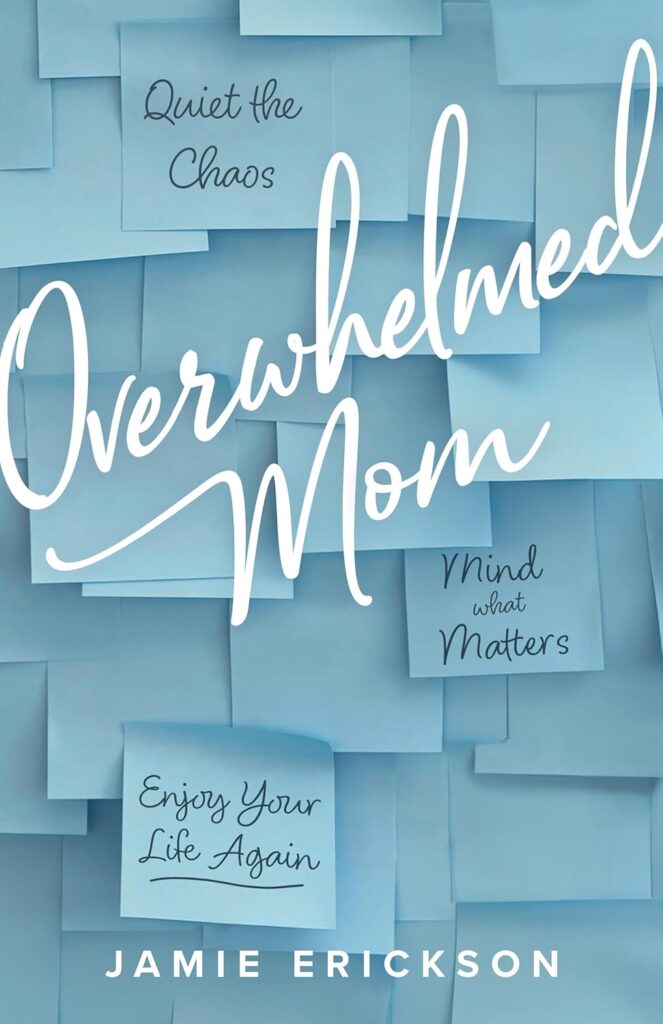
Motherhood overwhelm is something nearly every mom experiences, even in a world filled with modern conveniences. In this heartfelt and practical conversation I chat with with Jamie Erickson, homeschool mom of five, author of The Overwhelmed Mom, and host of the Mom2Mom Podcast, to explore why overwhelm feels so pervasive for twenty-first-century mothers and how we can find peace without trying to fix everything at once.
- Meet Jamie Erickson: Homeschooling, Family, and Calling
- Why Modern Moms Feel So Overwhelmed
- Tired vs. Truly Overwhelmed
- Learning to Let Go During Acute Overwhelm
- A Personal Story of Crisis and Community
- What It Really Means to ‘Live in Your Season’
- Essential Steps to Move from Burdened to Joyful
- One Small Change That Makes a Big Difference
- Reading Together and Making Time
- How the Gospel Transforms Overwhelm
- Key Takeaways
- Find Jamie online:
- You may also enjoy:
- Check out all the other interviews in my Homeschool Conversations series!

{This post contains paid links. Please see disclaimer.}
Meet Jamie Erickson: Homeschooling, Family, and Calling
Jamie Erickson shares her journey from classroom teacher to homeschool mom of five, explaining that although she once thought homeschooling was “weird,” her classroom experience ultimately “ruined me for anything but homeschooling.” After holding her first baby, she realized she wanted “a different way for me and mine,” and felt confident that God was calling their family to homeschool — not as a universal prescription, but as obedience for their family.
Why Modern Moms Feel So Overwhelmed
Despite modern conveniences, Jamie reminds us that overwhelm is not new. “Overwhelm is actually a universal, very timeless thing,” she explains, rooted in the reality of living in a fallen world. She points out that while technology promises ease, it often tempts us to take on responsibilities God never intended for us. “We don’t want to settle for what God has called good. We want to reach for better and best,” which leads us to overload our lives.

Tired vs. Truly Overwhelmed
Jamie distinguishes between everyday busyness and deeper overwhelm, identifying three types of overwhelm drawn from 1 Thessalonians 4. She explains that overwhelm can come from neglecting everyday responsibilities, from taking on work that belongs to others, or from burdens that only God can carry. As she puts it, “There are some cares and concerns of this world that… you will never be able to overcome.”
Learning to Let Go During Acute Overwhelm
Using a “bucket” analogy, Jamie encourages moms to recognize capacity limits during crisis seasons. “In order to put something new into your bucket, you’ll have to remove a few things.” Letting go, she says, should be done “guilt-free with no shame or blame,” especially when life takes an unexpected turn.
A Personal Story of Crisis and Community
Jamie shares a powerful story of receiving a devastating phone call while finishing her book — her son was critically ill and doctors didn’t know how to help him. During that season, she saw firsthand how preparation and community mattered. “There was no amount of wheels that I could turn to make that situation better,” she recalls. Yet through established routines and the faithful support of fellow believers, God provided in remarkable ways — including neighbors secretly rebuilding their deck while they were away.
What It Really Means to ‘Live in Your Season’
Jamie reframes the idea of seasons, explaining that God places boundaries lovingly, not restrictively. “Those lines weren’t ever seen as constricting… they actually were welcomed because it was keeping other things out.” Whether parenting young children or walking alongside teens and adult children, living in your season means trusting God’s timing and purpose for today.
Essential Steps to Move from Burdened to Joyful
Jamie emphasizes the power of language, urging moms to “begin to narrate a better story.” She warns that joking self-criticism becomes self-fulfilling: “You step into the story that you narrate about yourself.” From there, she encourages moms to audit pain points, build simple systems, and seek life-giving community rather than online venting.
One Small Change That Makes a Big Difference
Rather than overhauling life, Jamie encourages incremental change. “To change the entire trajectory of your shot, you actually don’t need to move your body much at all.” She suggests creating a list of five-to-ten-minute tasks to replace mindless phone scrolling with meaningful progress.
Reading Together and Making Time
For moms who feel too overwhelmed to read, Jamie offers grace-filled advice: “Set a timer for 10 minutes a day.” She reminds listeners not to let perfectionism keep them from small, steady growth.
How the Gospel Transforms Overwhelm
At the heart of the conversation is the Gospel. Jamie cautions against trying to “self-help our way out of everything that was meant to bring us to Jesus.” She explains that God often meets us most deeply in hardship, saying, “I would never want to deny you the treasures in that kind of darkness.”
Key Takeaways
- Overwhelm is timeless, not uniquely modern
- Not all busyness equals true overwhelm
- Some burdens belong only to God
- Comparison multiplies unnecessary responsibility
- Crisis seasons require releasing good things
- Faithful routines prepare us for emergencies
- Community is God’s provision, not a bonus
- Small changes can reshape daily life
- Language shapes how we experience motherhood
- The Gospel meets us in our limits
Find Jamie online:
- Website: jamieerickson.com
- Facebook: https://www.facebook.com/TheUnlikelyHomeschool/
- Instagram: https://www.instagram.com/unlikely_homeschool
- Book Overwhelmed Mom
You may also enjoy:
- Homeschool Without Overwhelm with Jenny Hedrick
- Homeschooling Without the Overwhelm (with Tiffany Jefferson)
- Balancing Home Management and Homeschooling Without Overwhelm
- Simplifying Homeschool with Christine Keys
- Homeschooling Bravely (with Jamie Erickson)
- Gentle Homeschool Reset
- Homeschooling in a Health Crisis
- Homeschooling with Confidence in Times of Crisis (with Vicki Bentley)
- Navigating Suffering: Finding Hope in the Darkness
Check out all the other interviews in my Homeschool Conversations series!

[00:00:00] Amy Sloan: Hello friends, today I am joined by Jamie Erickson, who she can be found encouraging and equipping a growing tribe of mothers all across the globe on the Mom2Mom podcast, through her blog, The Unlikely Homeschool, at national conferences, and in so many of her books. She’s been married to her college sweetheart for over 22 years, and together they’re raising and launching their five second-generation homeschooled kids along the shores of Lake Superior in Minnesota. And Jamie has been on the podcast before, I will make sure to put that link in the show notes as well, but for those who might be new to you, or getting to know you for the first time, can you tell us a little bit about yourself, your family, and how you guys got started homeschooling?
[00:00:47] Jamie Erickson: Yeah, well I was a trained teacher in the classroom, and my husband had been homeschooled since about third grade, real solidly from sixth grade on, and my mother-in-law asked if I would ever homeschool, and I had no intention of that. I thought homeschooling was weird, who even does that? But then I had my first baby, it’s about seven years into the teaching thing, and the doctor handed me that little pink bundle, and all the thoughts and memories of my classroom experience came back to me, and I think that my years in the classroom really ruined me for anything but homeschooling, because I had kind of seen the underbelly of what that looks like, and I knew that I wanted a different way for me and mine. Not that I think everybody should homeschool, but that I knew God was calling us to do it.
[00:01:39] Amy Sloan: Yeah, and I will tell you, as I’m sure you can relate to this as well, now that I have two adult children who have graduated from our homeschool, you know, my youngest is now 10, so really moving into that older kid mom zone, I love the time. I’m actually appreciating more and more as they’re getting older, the time I got to spend with them when they were younger, like such a gift, and the relationships that we have now are just incredibly deep and rich and meaningful, and every time sometimes I’m just like, I love getting to be with you guys, you know, the ones who are still at home. I’m just like, I love you, I’m so glad we get to homeschool.
[00:02:17] Jamie Erickson: Yes, and you know, it’s hard saying that out loud, knowing that there are young moms hearing that are in the thick of the mom-heavy years, where they just like want five minutes to just drink a cup of coffee that’s actually hot in peace with their own thought, but those years will come. I’m right smack dab right where you are. We’ve launched two, we still have three at home, an eighth grader, an 11th grader, and a 12th grader, so like boom, boom, boom, they’re all going to be going out the door sooner than I know, and yeah, I’m just here trying to soak in every little moment that I can, because now I realize just how fleeting the last couple years are going to be. They come so fast.
[00:03:05] Amy Sloan: Yeah, I hope it’s encouraging for the moms listening, the moms maybe who are in that overwhelmed time where they feel like everyone is calling on their attention and there’s not enough of them to go around, to know that those are really hard days. Those are hard, but for moms who have gone through those hard days and still have hard days now with older kids, like you don’t magically not have hard days anymore, but it is really worth it. I like to say it’s the best hard thing I’ve done for sure. It’s good words. But one of the things I wanted to talk to you about actually is this idea of overwhelm. Of course, this is your newest book, The Overwhelmed Mom, and as 21st century moms, you know, we have so much technology. We have our indoor plumbing and our dishwashers and our washing machines, all these things. Our grocery delivery, they bring our groceries to our porch. I love it. So many of these practical luxuries that previous generations didn’t have, and yet we can still feel so overwhelmed. So my question to you is like, do you have any ideas of why there’s still so much overwhelm in spite of what seems like so much, you know, technological or practical help? And then is there a difference between being just genuinely tired or having a long to-do list and this concept of overwhelm? Okay.
[00:04:29] Jamie Erickson: I actually think the answer to that is really layered, but just to kind of trim it down to the studs, let’s break it down. I think the reason we still feel so overwhelmed when we have pretty much every, you know, technological advancement at our fingertips is that overwhelm is actually a universal, a very timeless thing that has been plugging women all the way back since they step, you know, Eve stepped out of the garden. Sin has scarred everything that God called good and made our lives so much harder than it needs to be. And we have to remember that what Jesus promised in John, he said, in this world, you will have trouble. Not if, or you might, but that you actually will. But he also left us with encouragement. What was that encouragement? Take heart, because I have overcome the world. And in our deep overwhelm, we can remember that he has overcome. I think too, and this, this might sting a little bit if you’re listening. I think like Eve, we too are guilty for reaching for sinful superlatives. We, we don’t want to settle for what God has called good. We want to reach for better and best. And so we constantly want to add all these unnecessary things to our lives that we think are so very important, because maybe they are important. They’re just important for someone else. They’re not necessarily ours to do. And when we, we do pridefully assume like Eve, that we can be all and do all for all. But we have to remember that only God is all. I think that our overwhelm actually, you know, the second part of your question was, you know, how do you differentiate just between the, the day-to-day sort of bedlam that comes with being a mom and spending lots of plates from actual overwhelm? And I think they are two different things. I actually think there’s three different types of overwhelm, and we do well to recognize the differences between the three, because we actually have to tackle each one differently. Do you want to break those down? Oh yes, please do. Okay, so they actually come out of, and I just want to read you this verse really quickly. It comes out of 1 Thessalonians 4, 11 through 12. It shows us the three types of overwhelm, but also God, through Paul, God’s two-fold prescription for sort of digging ourselves out of really all three kinds. So let me read it to you first, and then we’ll break it down. 1 Thessalonians 4, 11 and 12. And to make it your ambition to lead a quiet life, you should mind your own business and work with your hands, just as we told you, so that your daily life may win the respective outsiders, and so that you will not be dependent on anyone. So let me just set the stage for you. Paul was writing this to a group of people that were waiting expectantly for the second coming of Christ, and they just thought he was imminent, like going to show up. And so why continue to work with their hands? They were actually, you know, quitting their jobs, being rather lazy. They also were living in like this Greco-Roman time where work was considered like a bad thing, who wants to work? So they were taking on some of that persona from the rest of the culture, and they were relying on the generosity of other believers to care for them. And so here is Paul saying, if you want a quiet life, and don’t we all want that, right? Your ears, I saw your face perk up. Wait, what? Yes, I do. And quiet here actually in the Greek means peace and calm. And what that tells me is that if they’re on the page, they actually are possible. Peace and calm are possible. And here’s how. If you want to lead a quiet life, Paul is telling us, you have to mind your own business and work with your hands. So that’s the two-prong solution to our overwhelm. Mind your own business, work with your hands. But what are those three types of overwhelm? Well, if we look at that phrase, mind your own business, when you and I read that, how do we normally read a phrase like that?
[00:08:58] Amy Sloan: You know, you might think, well, don’t gossip, pay attention to your own family, that kind of thing.
[00:09:03] Jamie Erickson: Yeah, I usually read it with a little degree of snark, like, mind your own business. You know, don’t be getting into my business. But I don’t think Paul was actually putting any of that criticism and that critique into it. If we were to read that phrase just as it is, mind your own business, it reminds me, it can remind us of the first type of overwhelm. And that’s the kind that is the everyday mayhem of life. The dishes in the sink, the making your bed, doing the laundry, paying your bills, those are all things that you and I need to mind. And sometimes our overwhelm happens when we’re not minding them, when we’ve become apathetic to our tasks of maintaining a home, maintaining order, when we’ve become complacent, dare I say it, even lazy, thinking, well, I’ll get to it tomorrow. But what happens is the cares of today then avalanche into tomorrow, and now you have double cares and you become overwhelmed. So when we are careful to actually mind our own business, being steadfast, being faithful, we won’t become as overwhelmed with just like the regular everyday brain breaking business of life, right? But if I were to read that same phrase like this, with an emphasis on a different word, mind your own business. Well, Amy, you have certain business in your life that God has called you to, and I have certain business in my life, but they might not be the same thing. And when I am looking into your life, maybe I’m going to the fishbowl internet that allows me to see a window into your world and into a million other women’s worlds, and I’m looking at all the business that everybody else is doing. What do I do? I add, and I add, and I add things to my plate, and I think that all of that is my business to mind. Well, no wonder I’m so busy. I put way too much responsibility into my bucket, right? But then if I read that phrase with a slightly more different emphasis, and I read it like this, mind your own business, that can help remind me that there is some business, there are some acute seasons in your life that you’re just not going to be able to mind. They are only God’s to mind. There are cares and concerns of this world that no matter how much you spin your wheels, no matter how many plates you have going, you will never be able to overcome that. But take heart, because God already has.
[00:11:41] Amy Sloan: Yeah, I think that’s so important. One, we have to remember our finiteness just as creatures, sometimes just like relating to Eve, right? We want to be like God. Knowing good and evil, we think, oh, I can be like God, and that can be an overwhelm where we forget who we are as a creature. Or when we compare ourselves to other moms, and my friend Don Garrett calls this the composite homeschool mom, and she created this monstrous photo with bits and pieces from all of her friends, and it’s this terrible, scary-looking image of a crazy woman. But of course, it’s because it’s not one woman. It’s all these pieces that we try to put together, and that’s not who God made us to be. And then the past couple years with my son’s cancer diagnosis and all of that, if anything, has taught me a humility in realizing all those things that we thought we had control over. That seems so important, having to realize those are out of our control. I need to rest in what God has called me to do today, these simple things, and leave those other things to the Lord. I think each of those aspects are so important, and no matter what season you’re in or how old your kids are or what’s going on in your life, you can kind of think of those different parts of life, and that can bring some clarity.
[00:12:57] Jamie Erickson: Yeah, and I think that another analogy that I like to think about when I’m thinking about my overwhelm, especially when you are in a season, Amy, like you are in right now, and obviously the care that you have for your son has to take priority and precedence. If you can look at your life like a bucket and think all of those things, all my responsibilities are sitting in this bucket, right? If I can handle and maintain and care for those mundane, everyday things with steadfastness and faithfulness, then when those outside of my control circumstances happen, the things that I actually can’t control, my son is sick with cancer, my mother-in-law just passed away, those things that I can’t actually do anything about necessarily, but they are an overwhelming, an acutely overwhelming situation. If I can see my bucket and see what’s inside of it already, and now this new thing comes along, I can tell myself, okay, my bucket already feels very full right now, and the laws of physics say you can’t just put a giant thing in a bucket with everything else and it’s all going to stay there, right? Some of it has to come out. In order to put something new into your bucket, you’ll have to remove a few things. And I think that in looking at our lives that way, it actually gives us freedom to know, okay, if I’m going to tackle this new acute season of overwhelm, I can’t just add it to everything else I’m doing right now. I actually have to be willing to let some things go guilt-free with no shame or blame, because my bucket is already full, and now I have to add this thing to it. So I think sometimes if we look at it that way, it can be freeing, and we don’t have to carry the unnecessary guilt and shame of saying no to some things that we just maybe were a yes yesterday, but they have to be a no today.
[00:14:48] Amy Sloan: Yeah, and it’s really important to know that you will have to say no to good things. You’re not just saying no to things that aren’t so great. Sometimes the best thing for us is saying no to the good things, and that can be a hard place to be, but that is where freedom comes for sure. But Jamie, can you share maybe a personal story about your own motherhood overwhelm and how you overcame it? Sure.
[00:15:12] Jamie Erickson: Well, actually, right in the middle of writing this book, right when I was at the tail end of it, I think it was due in November, this was on my birthday, so it was the middle of September, I got a call from a naval hospital in a different part of the country where my husband was serving in being trained in special operations, and this naval doctor on the other end of the line said, Jamie, we need you to come immediately. We need next of kin. Your son is not doing well, and we need you to be here. And of course, I began to spiral, and I think about all the responsibilities I currently have. I still have three kids at home, but my husband and I had to drop everything and drive across a couple states to be with our son, and he was laying in bed. He looked like a shell of himself. He had sepsis. He had fluid around his heart and his lungs. His blood was not regenerating. He was on all kinds of oxygen. He had five teams of doctors that did not know how to help him, and it was looking very grim. There was no amount of wheels that I could turn to make that situation better, but here’s two things that I saw ring true in that time. I had already spent time establishing some good routines and rhythms for the normal everyday parts of my life so that when something like this happened, those things were almost on autopilot and could be picked up and put down when I needed to. They could almost manage themselves, and so I knew that the things, the regular everyday cares of the world were being taken care of, and I didn’t have to worry about those. The other thing that I saw in absolute display was just the community of believers that we had built up in and around our lives. They completely enveloped us with prayer and text messages and telephone calls. Not only that, long story short, my son made an absolute miraculous recovery, and the doctors were dumbfounded with what occurred and couldn’t explain it through rational science. Praise God. Yes, praise the Lord. We stayed there for about a week. He wasn’t fully out of the weeds yet, but was well enough to kind of be bracketed down in his care, and so we made our way back home, and as we were pulling into our driveway, we saw two of our neighbors, two different neighbors, standing in our driveway with their cameras out filming us pull into the driveway, and I thought, well, this is real weird, and it was then that I saw, I looked over and saw that we had a brand new deck sitting at our house, and my brain fast forwarded or rewound to two days prior to getting that horrible phone call from that doctor. My husband and I were sitting in a life group sharing just a little bit about our life, what was happening that week or whatever, and he had mentioned that, you know, we were going to need to rebuild the deck. That was a high priority. He confessed to not really having the skills to do that. We didn’t really have a lot of budging room in our budget to do that, but it just needed to be done because it was becoming a hazard to people walking up to our house, and then we got that phone call, and we left, and of course, we weren’t even thinking about the deck. That was the last thing on our mind, but our friends remembered that, and they knew here was a couple that needed hands and feet care, and while they couldn’t sit with us in a hospital, you know, several states away holding our hand, they came every single day. They got our hide a key and rebuilt our deck to surprise us, and to this day, we still don’t know who it was. I only bring up that story to remind all of us that when you are in an acute season of overwhelm, one of the ways that God helps sustain and uphold you is the community, the body of believers that he places around you, and so in these seasons where maybe you’re not as overwhelmed, be investing in those people because it will surely come back tenfold, and it’s not a I’m going to do this so you do that, but you’re just living life. You’re loving on people, investing, and building up in a community, and he will return that love to you through that community in ways that you can never ask or imagine when you need it most.
[00:19:56] Amy Sloan: And I love hearing that not only had you invested in a community, but I also heard you had invested in habits as a family, like certain systems and habits and routines that were also helpful, and then the spiritual disciplines. You know, it’s hard if you have a sudden season of overwhelm, you won’t suddenly become a different, better version of yourself, right? You’ll just become yourself just more so with fewer barriers between you and the world. Yes. Good way to put it. So, you know, these are the things that we can be investing in the simpler, the quieter moments, investing in the relationships that really matter, investing in the spiritual disciplines, our relationship with the Lord, and then investing in those simple habits and routines in our homes and homeschools that will really serve us well when times do get hard. Because everyone, whether it’s a crisis or not, everyone will experience a hard day or two or three. That’s right.

[00:20:50] Jamie Erickson: Yep, yep. And if you can put those mundane tasks on autopilot, you’ll have the time, energy, and attention to give to those things that swing out of nowhere.
[00:20:59] Amy Sloan: Well, one of the things I know you talk about is you encourage moms to live in their season. And I feel like living in your season is this phrase I see a lot on the internet. And sometimes it actually rubs me a little bit of the wrong way, I’ll just tell you, because, you know, there are seasons that feel like they can last a really long time. You know, moms who just, like, have babies for a really long time, hear someone say, well, live in your season. And they’re like, I’ve been in this season for 10 years, and, you know, it doesn’t have an end. Or toddlers, or maybe there’s someone who has long-term medical care, right? These seasons that are not shorter terms. But I want to kind of hear from your perspective, what do you mean by encouraging moms to live in their season? And then how would you encourage a mom who doesn’t really see their season ending? Yeah.
[00:21:44] Jamie Erickson: Well, I think Satan always wants us to live in the two places in our lives that we cannot change. The past and the future. He wants us to pine for those glory days of when, you know, we had little ones, and they’d toddle up to our knee and look at us with such love and admiration, right? Or they want us to look, or he wants us to look to the future. If you’re a young mom, and you feel like your young kids are constraining you, and that you’re not able to give a yes to some of your passion projects, some of the things that really light you up, because right now, you’re mothering heavy, your days are mother heavy, right? And so you can look to the future and say, oh, someday when they’re not all in car seats. Someday when I don’t have to get a sitter. That’s exactly where Satan wants you to sit. But God has you right here, right now. He has your feet planted right here for a reason. And there is a scripture in Psalms, and I’m not going to try to quote it, because I’ll get it muddled up, but in the Psalms, it talks about how God has placed the lot lines of our lives in pleasant places, right? And when you look at those, the actual words, the Hebrew of those words, they’re actually a, they actually point to other words in the Torah. Back when God was dividing the land of Israel for the 12 tribes, and he was passing out, you know, like, Gad, here’s your portion. Simeon, here’s your land lot. And he was dividing it by lot lines. And so when we hear that verse in Psalms, it says, you have put down the lines in pleasant places for me. It’s hearkening back to that image of God dividing the land. And when God actually separated the land for the children of Israel, he was creating boundaries to set one tribe apart from the other. But those lines weren’t ever seen as constricting, as in like, God is hemming me in, keeping me here. They actually were welcomed because it was actually keeping other things out. So if we can see those lot lines or those boundaries of this particular season, like if you’re a young mom and you do have, you know, there was a time I had five car seats in my car, Amy, I’m sure you can relate to that too. And I had to do all the buckling. That was the season. And I will be, I would be lying if I didn’t admit there were days where I’m like, oh boy, I cannot wait to not have to buckle a single car seat. But if I can see that boundary in my life, not as it’s hemming me in, but that it’s keeping the cares and concerns of other times in my life out, I begin to see it with joy. There will be a day that young mom, you will be able to get to those passion projects. You will be able to, you know, write that book you’ve always wanted to write or create lovely music to sell on Spotify or speak in that show, that women’s ministry group, whatever it is you want to do, those things will come, but they also come with their own cares and concerns. And in God’s loving kindness for you, he’s protecting you from that right now. So you can fully enjoy right where you are. And for those of us like Amy and I that are on the other end of that spectrum, we can often be guilty of wanting to control in ways that we did when our kids were little. But my kids don’t need me to control or cajole them. They need me to sit presently with them and listen to them. They need me to trust that the same Holy Spirit that is at work and alive in me is also at work and alive in them. I don’t need to be their Holy Spirit. So that’s one way that in my season right now, I can really easily struggle with wanting to control everything about my adult children’s lives and my teenagers’ lives, just like I did before. So I don’t think it’s an easy answer. It’s not one that anybody wants to hear. And we certainly don’t want to be guilty of looking at young moms and giving out pat answers, you know, like, enjoy this season because it’ll soon be gone. Well, of course they want to enjoy it. Of course they do. Telling them that doesn’t help the situation. I think as older moms, one thing that we can do is remember back when it was that way and actually be willing to offer hands and feet practical care. Be the older mom who, like, sends a text to a younger mom. Hey, I’m at Walmart right now. Do you need anything on my, I’m going to be passing by your house. Do you need me to get you anything? What a gift that would have been years ago to me as a young mom, you know?
[00:26:52] Amy Sloan: Yeah, absolutely. I think about that now actually all the time because there were so many older moms that really did offer practical help. I remember a family that would drive their teenager to my house and, like, volunteer to do the driving and, like, not charge me for the childcare so I could take classes when I had kids that were little. So many, like, just these practical things that were so valuable and so encouraging. And so now I think, well, I’m kind of in that stage now, you know, where, like, all my kids, they can buckle themselves in the car by themselves. Like, they can take showers by themselves. They can make their own meal for that matter. Glory be. Right? And so, like, I’m at church. I’m not having to worry about where my kids are. Like, they’re taking care of themselves. So I would love to go help the mom with the toddler. Like, hey, you go visit for a little bit. I’ll take care of the toddler. Yes.
[00:27:40] Jamie Erickson: Hold that baby while she’s going through the buffet line at the church potluck and sit and hold the baby while she eats so she can actually cut her own meat with two hands.
[00:27:50] Amy Sloan: No. I have to fight the teen girls, though, for the babies. I really want to hold the babies, but the teen girls are like, no, no, this baby’s ours. We got this. Yeah. Well, what are some of the essential steps a mother can take to help her move from feeling burdened to feeling joy and enjoying her life?
[00:28:08] Jamie Erickson: Well, I think the first one, and it sounds trite, but it’s really deeply rooted in research and science and my own personal anecdotal evidence of my own life. Begin to change the way you talk about your life. Narrate a better story. If you start your day even in jest saying, oh, I’m just a hot mess today, science shows us you’re going to be a hot mess. Like, you step into the story that you narrate about yourself. And I would add on to that, be careful how you frame your husband and your children and your life with them. When you’re speaking about your husband and kids, even if they’re not in the room, you know, even if they’ll never see it because they’re not on the internet and you’re just writing something on Facebook, be very careful about that because your children aren’t an occupational hazard. They’re not robbing you of purpose and they should never be left to feel that they are. So that’s the first thing is begin to narrate a better story about your life. Proverbs 18, 21 says that death and life are in the power of the tongue. And research is only just coming out to prove that to be so exponentially true. So stop looking for blame or looking for ways to cast blame on whoever happens to be standing the closest, usually your husbands and children, and begin to narrate a better story. That’s the first step. And then, you know, I mentioned during that acute season of overwhelm in my own life, having to go to the hospital to sit with my son, there were two things that really stuck out in that time. One being that I had set up some systems in my day to let the mundane parts of my day operate well. So with that, I would say audit and edit your life wherever possible. Begin to look at every single pain point task in your day. Like when you walk into your living room, if you’re tripping over a giant pile of shoes, well, right away, you’re stepping into your house with frustration, right? So start there and determine I’m going to put together a better system right here. I’m not going to overhaul my whole house today. I’m not going to create every single system under the sun today, but I’m going to start right here and make it easier for myself to enter my house without feeling like a cat with its back up. And I’m going to fix that. And then tomorrow, I won’t be tripping into my house and I’ll have time and energy to tackle maybe another small pain point. So begin to edit and audit your life, looking for things that you can delegate to someone else, maybe your children, that you can dismiss and just say, nope, that’s not mine to do. And then the things that you actually can do. And then the second thing that I noticed during that season of overwhelm was the power of community in my life and how that was my living and active God holding me up through my friends and family caring for me. So begin to look around and find your tribe of people that you can confide in during your overwhelming seasons. I don’t think it’s wrong necessarily to say this is hard right now. I think it depends on who you’re saying it to and why you’re saying it. So when you’re narrating a good story, make sure that you tell the honest truth to the people who are actually going to pray for you, who are actually going to offer you hands and feet care, who are actually going to stop what they’re doing to help you find a solution for that thing. The internet isn’t the place to do that. Distress dumping on Facebook about your tough day is only going to get you to have people keep scrolling, right? You need to find women in your life that are going to call you to do better and love better and serve God better and pray for you and that you can also pray for them. So that is an essential step. Don’t skip that. You need to begin rallying not just allies who will let you be like a release valve to complain about your life. You need to begin rallying women who will exhort you in your life.
[00:32:23] Amy Sloan: Yeah. Well, I like that you brought up that like, what about that pile of shoes that you trip over every time you walk in the living room and it just irritates you every single time? Because that’s like a simple thing. I think we can all relate to that little tiny pain point in our homes or in our lives that probably would take us like 30 seconds to fix. But instead, we just get irritated with it every time. And I think sometimes we think there is some big thing we have to do when maybe it’s a small thing, like dealing with the shoe pile, coming up with a plan for where to put our shoes that can make a big impact. So I’m wondering if you have a small change, a suggestion to the mom who’s listening right now that she can make this week that could really make an impact maybe in her homemaking or her parenting or her homeschooling.
[00:33:10] Jamie Erickson: Yeah. You’re not going to be able to overhaul your whole life at one time. But you can, like Amy said, make a small incremental change. And I’ve used this illustration a lot, but I’m going to use it again because it was so profound to me the first time I heard it. My stepfather was an archer, a professional archer. Yep, there is such a thing as that. And he told me once, totally unrelated, he was just shooting the breeze. He says, you know, Jamie, to change the entire trajectory of your shot, you actually don’t need to move your body much at all, just like a tiny little centimeter. And it will completely reorient your arrow and change the whole shot. And it’s the same way with our lives. You don’t need to make these big, grandiose motions of change. What you need to do is just get one small pain point figured out. And once that is ironed out, nothing’s bent or broken there anymore. You can use that same amount of attention and energy you were giving to that thing and put towards some other small pain point in your life. And slowly but surely, as things begin to iron out and you have more and more time to give to the next thing and then the next thing, it’s an avalanching approach to digging yourself out of overwhelm. So let me give you one small little thing to do today. I want you to take 10 minutes today and brain dump a list of 12, 15 things that you can do in five to 10 minutes. Think of everything that you think you can do in your day. If I only have five minutes, what can I do that would be productive? Because we all have these like five or 10 minute pockets of our day where we are just sitting around. You know, we’re sitting at the dentist’s office waiting for our kid to get done getting his teeth cleaned, or we’re sitting in the pickup line, or we’re at the post office in the never ending line there, or we’re waiting for the water to boil on the stove or whatever. We have five minutes where we’re doing nothing. And what do we normally do in that time? Scroll. Yeah. Pick up our phone and scroll. Pick up our phone and scroll. But instead, if you… And let me back up. The reason that we normally pick up our phone and scroll is because we haven’t thought proactively about something else we can do in that time, right? And so we just medicate and meditate with our phone, right? But if we had an actual list written out of 12 to 15 things that we could tackle in five to 10 minute chunks that are kind of like always to dos, then when you have those five minutes a day, you can just look at your list and not even have to dispel any mental energy thinking of the next thing to do. You just look at the list, pick one thing off the list, and there you’ve done something proactive to help you with your day. And it doesn’t have to be… These are not big glory jobs. These are things you can do in five minutes. So I’m thinking of empty the dishwasher or clean out your purse. Delete a bunch of photos on your phone. Sweep the front walk. Open and categorize the mail. They’re all these brainless jobs, but for whatever reason, especially when you’re in a season of overwhelm, it’s really hard to think, what could I be doing instead besides picking up my phone?
[00:36:31] Amy Sloan: I love deleting old pictures and old emails. It’s just like, oh, I love it. I just deleted 3,000.
[00:36:39] Jamie Erickson: Yes. It’s so great. It lifts your body physically. You feel like your shoulders lift and you exhale knowing, oh, that inbox is empty. Yes, I love it. And here’s the thing. When you do pick up your phone to scroll, research shows us that every time you pick up your phone to just do some minute little thing, like maybe grab that recipe that you’re wanting to make for dinner, maybe check your email or whatever, you end up expelling 15 to 20, sometimes 30 minutes extra more than you have planned. And when you add up all that time, it ends up being 24 hours every week women spend on their phone doing things they never intended to do. So basically, you’re looking at someone else’s children for 24 hours in your week. You’re looking at somebody else’s dinner being made or the score of last night’s game from somebody else’s kid or whatever. If I could hand you, Amy, just like here’s a 24-hour chunk, Amy, to do with whatever you want to do, imagine how much you could get done in 24 hours, especially during an overwhelming season. Yeah, that’s a good mindset shift.
[00:37:48] Amy Sloan: Well, one of my readers found out I was going to be talking to you, and her name is Rose. And so she had a question for you. She said, I would like to read this book, your new book, Overwhelmed Mom, with other moms and come together for a discussion. Do you have a discussion guide for the book, was her first question. And then what advice would you have for moms that want to read your book but think they don’t have time?
[00:38:10] Jamie Erickson: Oh, well, Rose, so glad you wrote in. Hello there. Well, a couple different things. There’s many questions in that one list. There are discussion questions and further reading at the end of every chapter. So that can be done with a small group. I am a big advocate for book clubs, so I wanted to include that. But we are in talks about putting together an actual book club kit that will be coming out at the first of the year. So keep that in mind. Stay tuned for that. As far as like, this was an interesting book to write because it’s written to overwhelm moms. And a mom who feels overwhelmed, of course, she’s like, I don’t have the time to read a book. I completely get that. I guess my simplest, best advice is just to get the audio. And even if you can’t get the audio, if you get the book from the library, because the audio just isn’t in your budget right now. One of the things I love doing when I’m reading a book that, you know, is a good book, has some great tips, but I don’t really have the time to read it always is to just read, set a timer for 10 minutes a day. I’m only going to read 10 minutes and I’ll get as far as I can get. And then I’ll put a little like sticky note like that’s that’s all I could do today. But you’re slowly chewing on the content, too. You’re not being inundated by a fire hose. So if all you can do is like 10 minutes, add that to your add that to your list of 12 to 15 things to do in your five to 10 minute chunks, you’re at least getting something. Don’t let the the idol of perfection limit what you can do just incrementally every single day. You might not have the time to just sit with the book and read for hours on end. I would argue that very few of us do. So just take the 10 minutes that you that you do have.
[00:39:57] Amy Sloan: Yeah, and it really does add up. Actually, it can be really encouraging even if you don’t get the audio book. If you just look at how long an audio book is and you think, well, if I just read 10 minutes a day, even six days a week, not seven, you know, you realize, wait a minute, I’m going to get through several hours within a couple months. You know, you really can make make some good progress on your reading. Well, one of the things I always love to do, no matter what I’m talking about, is I want to bring people back to the gospel because we can have our lists and we can have our to do’s and our action steps and our action plans. But true rest comes from Christ and from the gospel. So when we’re dealing with these issues of burnout or overwhelm, how does the gospel really bring transformation in those moments?
[00:40:43] Jamie Erickson: I think when we can understand that we shouldn’t self-help our way out of everything that was meant to bring us to Jesus. Like, yes, I can give you some practical tips in this book and hopefully a lot of encouragement, but I never want to take away from the trouble in your life. And that sounds so dismissive and sounds so uncaring, but it’s really in the trouble that you are forced to sit at the feet of Jesus. You are forced to pray longer, to dive into the word more deeply, to trust in God’s care and kindness more because you’re at the end of your rope and you don’t have anything else. And I would never want to deny you the treasures in that kind of darkness, like Isaiah talks about, because it’s really in the darkness that the treasures can be found. So don’t self-help your way out of anything that was meant to bring you to the cross.
[00:41:44] Amy Sloan: Yeah, that’s a beautiful reminder. Well, here at the end, I do want to ask you the questions that I ask all of my guests. And so the first is just what are you personally reading lately?
[00:41:55] Jamie Erickson: I like that. I’m wearing my, just one more chapter sweatshirt. So I’m always reading several things, but I will mention one book I started last night. I’m not that far into it. It just came out. It’s called Life in a Lifeless World. It is a deep dive into the book of Hebrews for laymen who want to learn the book of Hebrews better. And the reason I’m reading it, and here’s a word to moms of young adult children. The man who wrote it, his name is Michael Kibbe. He’s a professor at my daughter’s university. It’s her favorite professor. And he wrote this book and she’s constantly talking about him and his classes. And as soon as it came out, she was like, mom, you have to read this book. And if your grown adult child says, mom, you have to read this book, you better put it in your cart right now. So I’m reading it and I cannot wait for all the many conversations that she and I will have about it. And it’s so far, I mean, it’s lived up to its title. It is a deep dive for a layman in the book of Hebrews. But now I want to know what you’re reading, Amy.
[00:43:02] Amy Sloan: Oh, so I just finished my millionth reread of Persuasion by Jane Austen. This is for an in-person book club. So we’ll be discussing it in a couple days. One of my favorite Austen heroes and proposals for sure. And then on audio, I’m actually not a huge audio book listener myself because I can read so much faster than I can listen to an audio book, even on 1.5 speed. But I’m listening to As You Wish by Carey Ellis, which is the sort of behind the scenes story of the making of The Princess Bride. And it’s an absolute delight because he narrates and the other actors and producers and people involved in the movie read their own parts of the story. So I think it’s definitely one you would want to listen to an audio. And already I’m just like, wow, I need to rewatch the movie now. I didn’t know that was going on here or there. And then with the kids, we are almost to the end of Men of Iron by Howard Pyle, which was a favorite of mine as a child. And it’s really a delightful story to read aloud to my kids now too. So sort of a variety.
[00:44:09] Jamie Erickson: Yes, I like that. I’m reading aloud to my boys The Finest Hour, the young adult version of it. It’s about the two tankers that went down in like 1951 right off the coast of Massachusetts in this full on Coast Guard attempt to rescue both of these boats that in the same night, same storm split in half and were sinking. It’s kind of riveting. I wanted to tell you. So here’s confession time. I’ve never read Persuasion. That’s one Austin I’ve never read. But two things. One, I put on my wish list for Christmas for my husband, who always wants to know what do you want for Christmas? A collector’s edition of Austin’s Finest. So hopefully Persuasion will be in that. And also, I just recently watched I know you’re not supposed to watch the movie first, but I watched a very clean version of it that I really enjoyed. And I think it’s a modern take on it. And I think it’s not the norm to watch a modern take on a Regency novel and have it be clean. And this one was quite clean.
[00:45:15] Amy Sloan: Okay, well, you’ll have to send me a DM after you finish reading the book. I actually really highly recommend Persuasion to people. I think you have a lot to look forward to. It’s very short. So it’s an easy win if you want to get into Austin. And then I like it because the heroine is much older than other Austin heroines, right? She’s in her late 20s, you know, still ancient for the time period. But she has, there’s a wisdom and kind of just like a chill to her that I really appreciate. And it’s just delightful. Also, one of the most romantic moments in all of literature is when Captain Wentworth gets the toddler from off her back, who will not get off her back. And he just like comes and removes the toddler. And I’m just like, that’s a real man.
[00:46:04] Jamie Erickson: That’s true love. Yeah. That’s true love. Well, you’ve sold me. I will start with Persuasion if and when I get a lovely collector’s edition of Austin’s Finest. Sounds great.
[00:46:15] Amy Sloan: Well, Jamie, where can people find you all around the internet?
[00:46:18] Jamie Erickson: Yeah, I think the easiest place is just my website, jamieerickson.com. And that’s where you can find my blog and my podcast and all my books.
[00:46:27] Amy Sloan: Fabulous. I will have that linked up in the show notes for this episode at humilityanddoxology.com. Thank you to everyone who has watched or listened today. Please do take a moment to share this episode with a friend who could use a little bit of encouragement. Maybe they’re feeling a bit overwhelmed and this would bring them a little joy and some practical tips as well. And until next time, happy homeschooling.