
Can nature study become the secret ingredient that transforms your homeschool? In this encouraging conversation, I talk with repeat-guest Eryn Lynum about how families can use nature study to teach homeschool subjects while helping children grow in wonder, wisdom, and faith.
Eryn Lynum is a second-generation homeschool mom, certified Master Naturalist, author, and host of Nat Theo: Nature Lessons Rooted in the Bible. In this episode, she shares how studying God’s creation can become more than an “extra subject.” Instead, nature study can be woven into your homeschool day as a practical, meaningful tool for teaching core academic subjects.
You’ll hear simple ideas for using nature study in:
- Math: Explore measurements, percentages, patterns, and the Fibonacci sequence through sunflowers, pinecones, jellyfish, oceans, and God’s design in creation.
- Language Arts: Use nature journaling, descriptive writing, poetry, storytelling, and classic literature inspired by the natural world.
- History: Learn through the history of science, discovery, invention, taxonomy, microscopes, flight, and how scientific understanding has developed over time.
- Art: Practice drawing, observing color and movement, and studying how nature has inspired artists, inventors, and engineers throughout history.
- Science: Discover how curiosity and close observation lead children to ask better questions and understand the wisdom built into creation.
We discuss how nature study helps children develop a biblical worldview. Rather than separating faith from learning, families can use both Scripture and creation to point children back to their Creator.
This episode also includes beautiful object lessons for family learning time:
- How pearls formed inside oysters remind us that God can bring beauty from hardship.
- How sea glass reflects redemption and transformation through difficult seasons.
- How the cuttlefish teaches children the importance of fleeing temptation quickly, just as Joseph fled sin in Genesis.
If you’ve ever wondered how to fit nature study into an already full homeschool schedule, this episode is full of practical encouragement. You do not need elaborate plans or expensive curriculum. Sometimes stepping outside, visiting a creek, observing birds, or asking good questions is enough to spark wonder-filled learning.
{This post contains paid links. Please see disclaimer.}
- What Is Natural Theology?
- How Nature Helps Kids Grow in Wonder
- Teaching Math Through Nature Study
- Using Nature for Language Arts
- History Through Nature and Science
- Art Inspired by Creation
- Gospel Lessons from Oysters, Sea Glass, and Cuttlefish
- Why Nature Study Matters
- Key Takeaways:
- You may also enjoy:
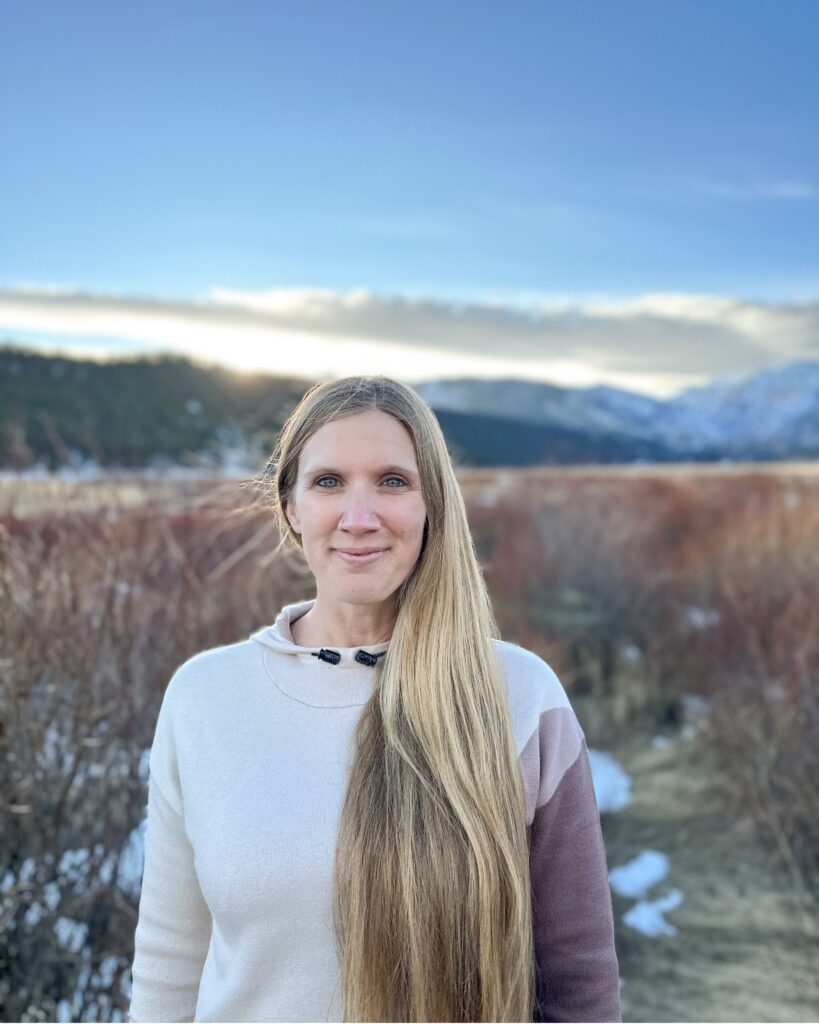
- Find Eryn Lynum online:
- Check out all the other interviews in my Homeschool Conversations series!
Many homeschool parents love the idea of nature study but wonder how to fit it into an already full schedule. I asked Eryn Lynum to discuss how nature study can become a practical way to teach academic subjects while also nurturing wonder, wisdom, and faith.
Eryn, a second-generation homeschool mom with four children, explained that her passion for nature study grew when she realized how often Jesus used creation to teach spiritual truth.
“He used all these materials that He and the Father fashioned together at creation to teach biblical truth.”
Rather than seeing nature study as an optional extra, Eryn encourages families to see it as a tool for integrating learning across many subjects.
What Is Natural Theology?
Eryn described natural theology in simple terms as learning about God through His creation. She explained that for centuries people spoke of two books from God: Scripture and nature.
“God is so generous with his revelation to us. He gave us the scriptures… and then he also gave us creation.”
Scripture remains primary because it gives us the gospel, but creation helps us see God’s wisdom, creativity, and invisible attributes more clearly.
How Nature Helps Kids Grow in Wonder
Children are naturally full of curiosity, but that sense of wonder can fade over time. Eryn believes parents can rekindle it by following their children’s interests.
“Maybe it’s insects, maybe it’s reptiles, maybe it’s birds or rocks and geology.”
She encouraged parents not to overcomplicate things. A creek, backyard, or trail can become a rich classroom. Often wonder grows best when children are free to explore.
Teaching Math Through Nature Study
Nature provides endless opportunities for math lessons. Eryn highlighted the Fibonacci sequence found in pinecones, sunflowers, galaxies, and spirals throughout creation.
She also shared how percentages become meaningful when studying Earth’s atmosphere. Oxygen levels are carefully balanced for life.
“God dialed this in just right.”
Measurements become exciting when children compare ocean depths, jellyfish tentacles, or moose antlers.
Using Nature for Language Arts
Nature study pairs beautifully with writing and literature. Eryn suggested nature journaling, descriptive writing, and imaginative prompts like writing from a flower’s perspective.
She also recommended reading literature rich with natural imagery, including Heidi, Wind in the Willows, and poetry tied to the seasons.
Themed poetry studies can deepen any unit study.
History Through Nature and Science
One surprising connection was history. Eryn explained that studying the history of science can make history come alive.
Families can learn about Carl Linnaeus and taxonomy, the discovery of microbes through microscopes, and how the Wright brothers studied birds while developing flight.
“Science began as a pursuit of God.”
Children also learn that scientific understanding grows over time rather than remaining static.
Art Inspired by Creation
Nature is also a rich source for art study. Children can sketch leaves, birds, flowers, and changing seasons while learning to notice fine details.
Eryn also shared how inventions like Velcro, wind turbines, and high-speed trains were inspired by designs already present in nature.
“It’s almost like God is the original engineer.”
Gospel Lessons from Oysters, Sea Glass, and Cuttlefish
Eryn offered memorable object lessons families can share with children.
Pearls begin as irritants inside oysters, yet become treasures over time. She compared this to how God can bring beauty from hardship.
Sea glass starts broken and discarded but becomes smooth and beautiful after years in the waves.
And the cuttlefish, which escapes danger by jetting away quickly, offers a vivid lesson about fleeing temptation.
Why Nature Study Matters
Nature study is not just about collecting facts. It helps children see God’s wisdom, cultivate humility, and respond in worship.
As I often reflect, education should lead to “humility and doxology.”
When families learn through creation, ordinary homeschool days can become rich with wonder.
Key Takeaways:
- Nature study can teach multiple homeschool subjects at once.
- Children naturally grow in wonder through outdoor exploration.
- Math concepts become meaningful through real-world creation examples.
- Nature journaling strengthens writing and observation skills.
- Literature and poetry connect beautifully with nature themes.
- The history of science makes history more engaging.
- Art skills grow through drawing and observing nature.
- Creation helps children understand God’s wisdom.
- Hard seasons can produce beauty, like pearls and sea glass.
- Nature study can lead to worship, humility, and joy.
You may also enjoy:
- The Art of Observation: Enhancing Homeschooling with Nature Study
- Nature Study in the Christian Homeschool
- Homeschool Butterfly Unit Study: an HONEST reaction
- He clasps the crag with crooked hands: Simple Science Unit Study of Eagles and Other Birds of Prey, inspired by Tennyson’s “The Eagle”
- Birds: 50+ resources for your elementary and early-middle school science and nature studies
- Weather Poems Memory Work Collection
- Climate, Faith, and Stewardship: A Conversation with Dr. Cal Beisner and Dr. David Legates
- Finding Rest in a Restless World
- Homeschool Science for Every Student
- How to Seamlessly Blend Science and History in Your Homeschool
- Natural Philosophy: Recovering a Natural Science and Christian Pedagogy (with Ravi Jain)
Find Eryn Lynum online:
Eryn Lynum is a second-generation homeschool mom of four. She holds a degree in Biblical studies and is a certified master naturalist. Eryn is the host of Nat Theo: Nature Lessons Rooted in the Bible, a podcast for kids and families. She is author of 3 books (with two new faith & science titles releasing in the fall of 2026). She and her family live in Colorado and enjoy hiking and playing in the Rocky Mountains.
Episodes mentioned today:
- Why Do Giraffes Have Spots? Lesson 105: https://player.captivate.fm/episode/57dc20eb-2e33-4b58-9765-fa726c5ba736/
- How Did God Use Math To Create Nature? Exploring The Fibonacci Sequence & Numbers – Lesson 34: https://player.captivate.fm/episode/3b67b81a-ceac-4fa1-85cf-588a32f23a30/
- Are Mushrooms Aliens? And Does Fungus Know How to Code? Lesson 11: https://player.captivate.fm/episode/b5b86cc0-358b-4136-bc79-643bd15aff9b/
- How Do Bad Germs Show Us God’s Good Grace? Lesson 18: https://player.captivate.fm/episode/1d403844-0e2d-494a-a113-5ed7e86c947b/
- How Do Birds Fly? Lesson 20: https://player.captivate.fm/episode/d39eec7d-4aca-4cba-b088-539424884c99/
- Do Cuttlefish Have a Jetpack? Lesson 98: https://player.captivate.fm/episode/fbae2a38-05cd-41cf-82fd-1e8d815c97f9/
- How Is A Pearl Made? Exploring Seashells and Mollusks – Lesson 46: https://player.captivate.fm/episode/61f83e79-70ab-4daa-a3ff-f8f3b0b2d681/
- How Is Sea Glass Made? Lesson 120: https://erynlynum.com/l120-sea-glass
Check out all the other interviews in my Homeschool Conversations series!
[00:00:00] Amy Sloan: Hello, friends. I am so delighted you are here with a guest you will probably recognize. I’m here today with Erin Lynham. She holds a degree in biblical studies and is a certified master naturalist. Erin is the host and producer of Nat Theo, Nature Lessons Rooted in the Bible. She’s the author of three books with more to come this year and is a trusted voice by families worldwide for sound biblical teaching and nature and science studies. And now, Erin, you’ve been on the podcast before twice, actually, but if you have already heard our chats before, stick around. We’re going to be diving into some new territory today, and the end is going to be especially something you can share with your kids. So, Erin, here at the beginning, please tell us a little bit about yourself, your family, and how you first got interested in nature study.
[00:00:53] Eryn Lynum: Thank you, Amy, and thanks so much for having me back on. I am a second-generation homeschool mom. My husband was also homeschooled. So, we grew up homeschooled, and we always kind of just figured that was what we would do with our own kids. And so, we have been homeschooling now while our oldest is 14, and he’s going into ninth grade in the fall. So, we’re kind of entering those high school years. So, our four kids are 14, 12, 10, and 8, and my husband and I have been married for 16 years, and we live in northern Colorado. And I became interested in nature study when I began to see the power of all these materials that God has given us in creation. You step outside, and you are surrounded by, depending on the season, insects and trees and bushes and flowers and birds and all of this life. And of course, we know all this life comes from the life giver. And I saw in the Gospels, Jesus used all these different materials in nature. He drew crowds outside, and He used all these materials that He and the Father fashioned together at creation to teach biblical truth. And so, I thought, why aren’t we doing that? And so, that’s why I became a certified Master Naturalist, is I wanted to understand those materials better to be able to, yes, teach my own kids biblical truth, but also equip parents to do the same, to turn outdoor exploration and time in nature into these faith moments that really inspire these conversations that can shift eternity.
[00:02:23] Amy Sloan: And it’s so exciting to think that we’re doing something with our children in creation that God has provided, and we’re able to teach them something about who God is and what He has done, and also make it connect, like sneaky learning. Sometimes that’s what I’ll tell my kids. They’ll be doing something. I’m like, oh, this is sneaky learning.
So, I will be getting into more of that in a little bit. But here at the beginning, I know we have talked in our previous conversations. We actually did a deep dive in our first chat about special revelation, general revelation, the differences. But I do want to make sure for anyone who’s new that you can give kind of a brief introduction, simple language. What is natural theology? For those who may have missed our previous chat.
[00:03:13] Eryn Lynum: Natural theology is really what science began as. These natural historians, philosophers, theologians looking at creation to better understand God. And they talked about, for hundreds of years, they talked about these two books of God. The book of Scripture, of course, and that’s God’s special revelation. And then the book of nature, creation, coming from Romans 1.20, that tells us that God’s invisible attributes, those things that we can’t see about God, have been plainly made clear to us through creation. And so, it’s this concept of God is so generous with his revelation to us. He gave us the scriptures, and that’s where we get the gospel. That’s primary. And then he also gave us creation, and that we can use both of these together to better understand biblical truth.

[00:03:58] Amy Sloan: So, what are some ways that we can practically use nature to help our kids grow in wonder and wisdom?
[00:04:11] Eryn Lynum: Well, let’s start with wonder. I think wonder is intuitive. Wonder is something that is woven into us. We are born with wonder, and we see that in kids. And over time, of course, it can tarnish and some kids lose interest. I know I did as I was growing up. And so, as parents, we can use nature study to really rekindle that sense of wonder and awe in our children. And I think it’s important to do that by following their interests. Maybe it’s insects, maybe it’s reptiles, maybe it’s birds or rocks and geology. Really tuning into that if your child’s interested, and using that to rekindle that sense of wonder, and to encourage and nurture that in them. To always be on the lookout, okay, where are opportunities, or how can I create opportunities to nurture that God-given wonder inside of them? And so much of that happens when we just step outside. We don’t have to have this big plan of we’re going to go do this, and we don’t have to orchestrate everything. Go to a creek and watch your children’s wonder. It is self-led, it is God-led. And then with wisdom, all of God’s creation reflects His wisdom. We see that in one of our core verses for our podcast is Psalm 104, 24, which says, how many are your works, Lord, in wisdom you have made them all. The earth is full of your creatures. And so, as we train our kids to look closely at the details of nature, to ask good questions, why does this do this? Why does that look like that? To really look at those details, they are glimpsing the wisdom and the intelligence of their creator. And I remember my third son when he was four years old, we were out hiking one day, and he turned to me, and I can’t even… He was playing with sticks. He was stacking sticks. And he says, mom, I like nature because it works well. I was like, yeah, it does work well. And our kids see that as we start looking at the details. One example in our weekly podcast, we always try to give all these examples of, okay, how do we see God’s wisdom in this creature, this plant? And one we did recently was a giraffe. And giraffes are fascinating. I mean, they’re one of those creatures that’s just so different from other creatures. And as I was researching for this episode, I was looking at the engineering really in a giraffe. You think about its tall neck, its brain can be six feet higher than its heart. And so we can wonder, how does its heart pump blood all the way up against gravity to its brain? And God gave the giraffe this super incredible heart that has a super strong ventricle that the timing is different than a normal heart. It allows it to fill with more blood between beats. And then it has this super strong pump that shoots blood up to its brain. So that’s really cool. God gave it a heart to do this. But then think about when a giraffe lowers its head, when it’s getting a drink from water on the ground, that always looks so weird. They’re straddled. It’s really bizarre and awkward. But this is how they get a drink. Well, you think about that super strong heart pumping blood into its brain. If it does it at the same velocity, the giraffe’s head would burst, that blood pressure. And you think, okay, is this bad? What is going on here? Well, what scientists found is that giraffes at the base of their skull have these little valves. They’re kind of like little doors. And when the giraffe lowers its head, those doors close to keep the blood from rushing to its head. And the blood kind of sits there and it pulls up. Its veins are actually created to expand like a balloon to hold all that blood. And then it puts its head back up and the blood goes back down and then pumps back up. All this mechanism, all this engineering. And so things like this, a giraffe, a flower, an insect, the more we look, our kids can, wow, look at the wisdom. Look at the smartness of this design.
[00:08:11] Amy Sloan: I don’t know if I’ve mentioned this to you before, but the name of my blog, Humility and Doxology, really came from something I said to my kids for years before I ever started working or creating online. Because when I would talk to them about what I wanted the end of our education to be, I was like, the end of your education, my goal for all of these things that I’m teaching and you’re learning is humility and doxology. And just hearing that incredible design of the giraffe, doesn’t that fill you with praise? How can you not hear that and not want to start singing the doxology? Praise God from whom all blessings flow. And also fills us with such humility to think, wow, this is the God we serve who is able to create such an incredible design. And so I love that example. And I love that with nature in particular, studying God’s creation, I think is one of the most beautiful ways to teach us more and more to be awed by our great and majestic God. I agree. Yeah. But one of the things I think that can be tricky for a homeschool mom thinking about this is, okay, well, that’s great. Like nature study is wonderful, but I’m a little bit concerned. I have all these requirements. Maybe there’s a mom who’s in a state that has requirements for a certain number of hours for certain subjects, or she’s like, I can barely get to just our must do’s every day. I mean, nature study just feels like one more thing. I thought it might be helpful to kind of go through and see how can we take nature study and do some of that sneaky learning we talked about and really use the nature study for teaching our typical homeschool subjects. So I’m going to give a little test for you and see if you can give us some examples. All right. So what about math? We’ll start with something easy. I think we can probably all think of some examples, but how could we teach math using nature study?
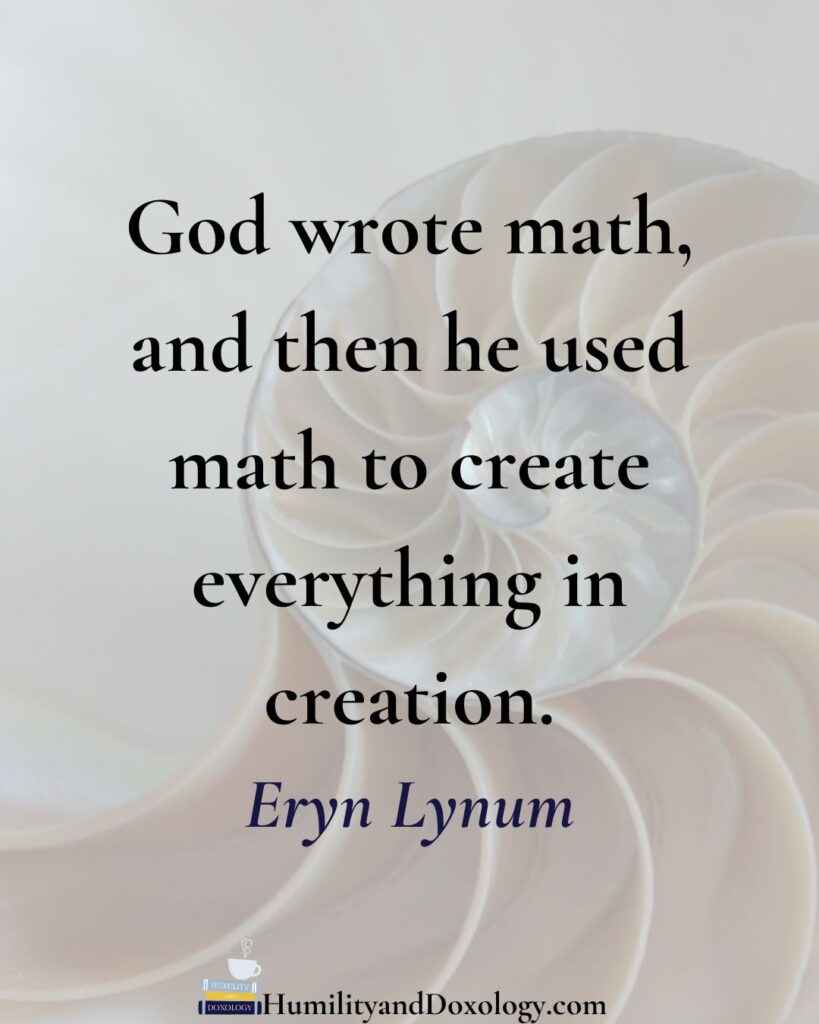
[00:10:17] Eryn Lynum: Okay. First, I love this because one of my favorite hacks, if you will, as a homeschooler is combining subjects, because who has time to teach every subject individually? And it’s not that effective. Like if we can bring these subjects together, like your sneaky learning, that our kids are getting this more well-rounded education, and it’s far more efficient. And so I love doing this with nature study. And with math, it’s kind of, I mean, there’s so many examples, but one I thought of right away is the Fibonacci sequence. And we did a whole episode on this because it’s so incredible when you look at this, this incredible math formula that creates the perfect ratio, this shape, this spiral that we see all throughout creation in a pine cone, in the center of a sunflower, in the galaxy, in the curve of a wave, or the spiral of a seahorse tail or a ram’s horn. Like when our kids can see this shape and then realize, oh, this is a signature mark of God’s, and it’s mathematical. Like God wrote math, and then he used math to create everything in creation. And for me, that helped because, okay, math is not my favorite subject. I don’t enjoy teaching it. I am not passionate about it, but it’s so important. And I want my kids to understand it. And so now we come to it in this really lens of nature. How can we see math in what God has made? And even like, think about understanding measurements. When we better understand measurements, we can more stand in awe of what God has made. Like we did an episode on the ocean’s abyss and looking at the deepest part of the ocean is almost seven miles beneath the surface of the ocean, almost seven miles. And then to think about, like we just did moose, they’re antlers, a bull moose, it’s antlers can be six feet wide, six feet spread of antlers. Or even like, I love this one thinking about the earth’s atmosphere. Earth’s atmosphere is just under 21% oxygen. And so this of course can become a lesson on percentages and fractions, but why is that important? Why is it important that our atmosphere is just under 21% oxygen? Well, for every 1% increase in oxygen, the likelihood of wildfires would be exponential. For every 1% increase, it would be about 70 times more likely that there would be a wild fire. Basically our earth would burn up and we live in Colorado. Like we’re very familiar with the threats of wildfire. And so teaching our kids like God dialed this in just right. Because on the other hand, if the oxygen was just a tiny bit lower, large animals and humans could not breathe. And so we’re teaching them about percentages and fractions. And then we’re looking at how God dialed in the atmosphere, just perfect for life on earth. And so really every math skill that we are teaching them, we can point to something in creation and say, wow, look what God made.
[00:13:20] Amy Sloan: I love that. And with the measurements, I actually just recently saw a video of a giant jellyfish that was observed off the coast of Argentina, I believe. And this jellyfish, the four tentacles that would come off of it, they’re kind of like, look like these ribbons. They can be up to 33 feet long. That’s like the size of a school bus. That’s amazing. It was absolutely gorgeous. Side note, I kind of wish I had a jellyfish as a pet, which I know is weird, but they’re so beautiful. I don’t want to touch one, but they’re so beautiful.
[00:13:53] Eryn Lynum: Yes, they really are. And the size of them, like those lion’s mane jellyfish, we had one child call into the podcast once and ask, what’s bigger, a blue whale or a lion’s mane jellyfish? And so we talked about those measurements and actually the jellyfish, when you look at its actual length, is this massive creature.
[00:14:12] Amy Sloan: That’s incredible. Okay. So that’s math. What about language arts? How can we connect that with what’s nature study?
[00:14:19] Eryn Lynum: Well, it’s a great opportunity for nature journaling and like just getting our kids outside and writing about, hey, let’s write about this flower here, but write about it in story form. Write about it from the flower’s perspective. What does it see happening around it? What does it think of this bee coming to collect pollen or the nectar from it? Like all these different prompts that we can come up with when our kids are out in nature for nature journaling, but also literature. All of this literature, whether it’s kids’ books from today or classics, so many of them incorporate beautiful depictions of nature. Have you read the book, Heidi, the classic book, Heidi? Yes, all of it. Such a beautiful book. And there’s this one scene from it that I love and always remember. And it’s where Heidi, she is enamored with all of these mountains that are surrounding her grandfather’s property. And so she goes to him one day and she says, grandfather, why do the mountains have no names? And he said to her, he said, they all have names. And if you tell me their shape, I can name them for you. And just this idea that he’s so familiar with them that someone could just say, oh, it’s shaped like this. And in one of my books, Root and Wonder, I talk about this as an Edenic familiarity. Like you think about Adam and Eve and Eden and how they were becoming familiar with everything that God had made. And so you think about, this is a beautiful picture of we should be so familiar with the things in our own backyard and surrounding our own home and just getting to know them and appreciate them because we can then give praise back to the creator. And so there’s so many books that bring this in. Like I think about the Burgess books, the Burgess animal books, disclaimer, those do like one of the main characters is mother nature. So we definitely like bring in some worldview into that. But these beautiful depictions of creation and owl moon and my side of the mountain and the green ember series and wind in the willows, a children’s garden of verses, like all these books that we can pick carefully that are bringing in the details of creation.
[00:16:27] Amy Sloan: One of the things I love to do is find poetry also that goes along with what we’re studying. Now, often I will just pick poems because I like them and I get to pick them because I’m the mom. But sometimes if there’s a particular thing we’re studying, I will look for poems that go along with that topic. Several years ago, we were studying weather. And so I found all sorts of really wonderful weather themed poems. And we included those in our morning time. A few years ago, we did some survival skills, which overlaps, I think, with nature study, obviously, because you’re surviving generally outdoors and various weathers and ecosystems. And so I found poems that went along with that as well. And that was just really delightful. And so that would be, I think, another thing if someone enjoys poetry, recitation, or memory work, or copy work, even doing those kinds of poems that coordinate with something you’re learning is a beautiful way.
[00:17:26] Eryn Lynum: Yeah. There’s a beautiful new book. Have you seen the book, A Pocket Full of Wonder?
[00:17:31] Amy Sloan: I have seen it, but I have not read it.
[00:17:34] Eryn Lynum: It’s newer. And that’s one thing the author does is every chapter is a different nature topic. And she brings in an activity and scripture and sometimes like a hymn and then always poetry. I think you would really enjoy it. Because like one day when it was snowing, I went and got it and we read the snow poem. And it’s just kind of an easy button for like, hey, where is there a poem about leaves changing colors or the wind or something like that?
[00:17:55] Amy Sloan: Oh, I love that. We have a book. I think I don’t have it in front of me. It’s either called A Song for the Seasons or A Poem for the Seasons. I will try to find it and put it in the show notes if you’re listening. But we used to check it out often from the library. And eventually, I just bought a copy for one of my children so that, you know, for my children, really for me. And it has a poem for every day of the year. And so they’re very thematic of the season and things that you might see at different times of the year. So that’s really fun.
[00:18:24] Eryn Lynum: Oh, that’s so fun.
[00:18:25] Amy Sloan: Okay. Now this one, I was like, surely, I’m going to stump her with this one. How in the world could we maybe think about history and nature study?
[00:18:33] Eryn Lynum: This is actually my favorite because I have long struggled with history. I just, I wasn’t interested in it for many, many years, going back to when I was a homeschool student and now as a homeschool mom. And I’ve struggled, like, how can I enjoy history? And then I began researching the history of science and the history of nature discovery. And so this is something we actually do often in the podcast is we bring in different elements of the history of science. And so, we have an episode on fungus and mushrooms and what are mushrooms? Are they aliens? Are they plants? Are they animals? And in that, we bring in the story of Carl Linnaeus and taxonomy. And then in microbiology, we go into the discovery of microbes and how this whole vast, almost like a whole nother world of living things that we can’t see. God created them back at creation. And yet for all these years, they were unknown until people began looking through a microscope to see them. And just this whole new world came alive of, wow, God has made so much more than we ever, ever realized. And then in our episode on how birds fly, we go into the Wright brothers and the history of flight and how they were inspired by God’s engineering, whether they would say that or not in birds. And so, of course, when you think about this, if you’re going to go into the history of science, you’re going to have opportunity to talk about worldview. And we should not be afraid of that. We, as Christian homeschooling parents, we should be going into this conversation with our children and our kids, what they can see. What I learned as an adult, when I finally started researching this is that science began as a pursuit of God. Like I said earlier, these natural philosophers and historians looking at creation to better understand God. And they’ll also see, our kids will also see that so many of the sciences, including biology, the science of life, are new sciences. The science is not settled. So even when we hear things that are presented as fact, we can tell our kids, well, this is not solid fact. We can still dig into these. We can think critically. We can question the narrative. And this is still a conversation. We need to keep it as a conversation and look at God’s word and look at evidence and really develop a solid biblical worldview.
[00:20:55] Amy Sloan: That’s one of the things that my kids have enjoyed and I think has been really brought out to them over the past couple of years. My younger kids have used the Berean Builders science curriculum, and it’s actually set up chronologically. So rather than the textbook on a certain topic, like chemistry or physics, it’s chronological science. It’s fascinating. You should look into it if you’re not familiar.
[00:21:21] Eryn Lynum: That sounds amazing. Yeah, that’s like what I research on my own and to have it spelled out in a format for students, that sounds fantastic.
[00:21:28] Amy Sloan: It’s fantastic. I’ve interviewed the author. I’ll talk to you after. I don’t want to get on a tangent too much here. I will put that episode with Dr. Weil in the show notes as well. But yeah, one of the things that I love about it is you really do see even, so we started with antiquity. So like the Greek ancient, ancient, early, early scientists who were just observing and kind of coming up with ideas. And you really see how, okay, they see this one thing and they kind of got it, but now we realize this is totally not right. But you see this growth and progression of ideas and that science isn’t fixed. It’s not something that was just decided once, discovered once, and that was perfect and we move on. But it’s a process which continues to grow and change even now.
[00:22:09] Eryn Lynum: Yeah. Yeah. And when our kids start seeing that, when they start seeing like, okay, well, this new technology just revealed this, which brings into question this idea from, as an example, Darwin from all these years ago. They can see exactly that, that there are these ideas presented as fact that new knowledge, new technology can bring back into question.
[00:22:32] Amy Sloan: Yeah. Okay. Well, how about nature study and art? This is probably a fun one and probably familiar to anyone who does any kind of nature journaling already.
[00:22:42] Eryn Lynum: Absolutely. Yeah. And just bringing in that nature journaling again, but we can really challenge our kids in this to try and match the colors as closely as they can of that flower or that leaf in front of them or the veins on the leaf or the shape of the bird. And can you capture motion? Is the flower swaying in the wind? Are the bird’s feathers ruffling because it’s cold out? And trying to really encourage them in capturing those details because as they see those details, again, they’re going to see the wisdom and the wonder of God. And then also studying how nature has influenced art throughout time. And I love the story of Lilius Trotter. Are you familiar with her?
[00:23:23] Amy Sloan: Yes. I actually saw a documentary on her life a few years ago. It’s amazing.
[00:23:27] Eryn Lynum: It’s so good. It’s so good. And what I love is that Lilius Trotter, she was this incredible artist. She gave up the opportunity to become one of the greatest artists ever because she kept doing her art, but she really felt called to the mission field. And when she’s on furlough, she’s resting. She’s in this hard season. She really needs to rest. She has a lot of health conditions. And she is walking through the woods one day and she sees this dandelion. And the lighting was just right. You think about a humble dandelion that we normally call a weed, but the light was filtering into the forest just right to where the dandelion looked like it was glowing. And she ended up writing this little, I mean, I would call it a poem from it. And it became a tract. It was published as a tract. And it was about this dandelion and this light and how the dandelion looked like it was turning toward the light. Well, another writer, a songwriter, Helen Lamel, she gets hold of this tract and she turns this inspiration from a dandelion into the hymn, Turn Your Eyes Upon Jesus. And it all came from this woman walking through the woods. And you think about all the inspiration, like there’s this whole field. It’s not even called a Christian field, but I think it’s a very faith-based field called bio-inspiration. And they want bio-living things inspiration to be inspired. And it’s this whole field of inventions and research and technology that is inspired by designs in nature. Like even like wind turbines, they’re designed after the arc of a whale’s pectoral fin. And Velcro was designed after this man was walking with his dog in the woods and came back and those little burrs were sticking to his dog. And he was like looking at the hooks and the burrs and he’s like, I could make something out of this. Or like the speed train in Japan that was built to get rid of these sonic boom noises that it was creating was fashioned after a kingfisher’s beak, this bird that can dive into the water without causing a massive splash. Like all of these examples of inventions and technologies and problems being solved as people look at nature. And so how might nature inspire our own children in their art, as well as things like inventions and technology?
[00:25:40] Amy Sloan: Yeah, that’s fascinating. I’ve seen some stories with my kids about new micro robots, like tiny things that are all designed after all these fascinating things found in nature already. Wow, it’s almost like God is the original engineer. He’s the original designer, right?
[00:25:57] Eryn Lynum: Exactly. I was just digging into robots designed after ostriches because ostriches are the fastest two-footed animal that runs across. They’re incredibly fast. And so all these engineers started looking at what is it about ostriches and looking at their tendons and how they act like springs and the cushions on their feet that absorb the impact. And they’ve come up with these incredible robots fashioned after the ostrich.
[00:26:19] Amy Sloan: That’s amazing. Although within ostrich, I always think of the old Susanne Robinson movie. I remember seeing that growing up. I just always wanted to ride an ostrich.
[00:26:29] Eryn Lynum: Yes. It’s a whole thing. There’s races. It’s a whole thing.
[00:26:33] Amy Sloan: Well, are there any subjects or topics that we haven’t covered that you’re like, but wait, there’s more?
[00:26:38] Eryn Lynum: Well, I think first and foremost, I always think of just teaching the Bible and the biblical worldview. And there’s so much in nature. And like we were talking about at the beginning, God has given us both scriptures and nature and science. And so let’s teach them together. And really that’s just the heartbeat and the aim of all of my work with my own kids and in our organization. We can nurture faith through nature study. Let’s not just teach nature study as this own thing. Let’s return it to its proper place as theology and make sure that we are connecting every lesson back to our creator.
[00:27:20] Amy Sloan: That’s a beautiful reminder. Well, if you haven’t been listening with your kids already, you might want to pause and like rewind and let them hear some of these wonderful stories that Erin has already been sharing around creation, but go ahead and pause it now. Go grab the kids because the next couple of questions are sort of specifically for them and for the family to enjoy together. So Erin, here’s my question for you. How can sea glass or an oyster encourage us that God grows us through hard times?
[00:28:02] Eryn Lynum: Okay. Let’s focus on the oyster first. Do you know how a pearl is formed? I believe there is some bit of grit that gets in and causes irritation and it covers it, but you tell me more. Yeah. Yeah. No, you’re exactly right. So a mollusk such at like a bivalve mollusk, such as an oyster or a clam, if they get some kind of irritant in their shell, it can be a piece of grit like sand. It can also be like a parasite and they can’t get it out. And it’s bothersome. Think about if you have like a popcorn kernel stuck in your tooth and you feel it, but you cannot get it out. Like that’s what the oyster is going through and they can’t get it out. And so what they do instead is they cover it. And over years they are layering this material called nacre, or sometimes it’s called mother of pearl over this irritant so that it’s not gritty and sand like hard anymore. Instead it’s this smooth surface. And that’s how a pearl is formed. And you think about this incredible thing of value, like pearls can be worth hundreds of dollars, some thousands, even millions, like these massive pearls that have been found. This beautiful thing that was formed from a problem that God wants to do in the same in our lives. And in that episode that we share this analogy, I share about, I have a rare autoimmune condition called Addison’s disease, and I was diagnosed at 14 years old. Big problem. Like this thing is potentially fatal, very life disruptive. And so at a very young age, I’m going through this hard, how do I deal with this? How do I live out God’s plan for my life with this disease? And I’ve lived with it for years now. And God has again and again and again, just shown me I’m working in this. I am bringing beauty from the struggle. And we share the story about Paul in there and the thorn in his side, whatever theologians have all these different ideas about what the thorn might’ve been, but God brought so much good from Paul’s life. And even when we have a problem, we can be reminded God wants to bring great value from that. And it’s very similar with sea glass. Sea glass is interesting because you think like, is it natural? Like it’s glass. Is it natural? But glass is made from sand. And so it’s this beautiful whole cycle that glass is made from sand. You think about like glass bottles that were on ships that shipwrecked, that’s where most sea glass comes from. And then it spends years tumbling in the ocean, breaking and getting worn down by the chemicals in the seawater and by things like sand and just all this motion and tumbling, like this natural rock tumbler. And then it ends up on a beach. Like it can take like 20 to 40 years for sea glass to form. And it’s smooth and it’s foggy from what it’s been through. And it’s like this gem, this treasure. Our family loves going and looking for sea glass on the beach. And again, you think about all this, this hardship. Of course, it’s sea glass. It’s not feeling the hardship, but you think about just like that, God wants to use the hard times in our lives when we feel like we are just tumbling and tumbling and eroding at times. And all of these hard circumstances that God wants to bring beauty out of those. And there’s so many examples like that in nature, that God is writing our stories. Like every piece of sea glass has a story of where it came from, of what it was, and just the same, even through the hard things, God is writing our stories and He is a magnificent author.
[00:31:12] Amy Sloan: So in North Carolina, where I am, on our beaches, sort of the mid-Atlantic beaches, we don’t unfortunately get sea glass. But I remember traveling as a child once to California and once to Maine to visit friends. And I could find sea glass both places there. And it was always so exciting, especially if I would find blue sea glass, because that was the most rare. And I actually have a pair of earrings that I made myself taking some of the sea glass that I found. But that’s such a beautiful picture of something that was broken, honestly. It was once useful and now it’s broken and you’d think it’s wasted. And yet in the Lord, those things are not wasted. They become beautiful in a new way. Yeah. Yeah. Redeemed. That’s amazing. Well, how about a cuttlefish? What can a cuttlefish teach us about fleeing from sin?
[00:32:05] Eryn Lynum: Cuttlefish are one of my favorite animals. They are these bizarre ocean creatures. And despite their name, they’re not cuddly and they’re not even fish. They are a mollusk, specifically a cephalopod. I don’t know if people should have a favorite category of animal. I do. And it is the cephalopods, because it’s your octopus, your cuttlefish, squid, and nautilus. Crazy cool creatures. So the cuttlefish, it has a skirt-like fin that runs along the side of its body that just kind of flows as it swims and it can swim in place. And it’s a super graceful, usually slow-moving creature. It’s just beautiful. At the Seattle Aquarium a couple of years ago, I spent probably far too long just sitting in front of the little cuttlefish aquarium, just watching them because they swim beautifully and so gracefully like ballerinas in the water. And yet when they need to escape danger, God has equipped them with a siphon, a lot like an octopus, that it can shoot a jet of water out of this siphon to quickly flee danger. And so we use this to teach kids, we need to be ready to flee the dangers of sin. And we talk about the story of Joseph in the Bible. And when he had temptation and the opportunity to escape, he didn’t have to flee the sin right in front of him. And instead, he quite literally, in Genesis 39, ran away from that temptation, like a cuttlefish using its siphon to get away from that danger. And we share 1 Corinthians 10, 13, but you can trust God who will not permit you to be tempted more than you can stand. But when you are tempted, He will also give you a way to escape so that you will be able to stand it. And this beautiful picture of a cuttlefish fleeing from danger, and it can teach our kids, hey, when we are approached with temptation, we get out of there.
[00:34:03] Amy Sloan: I love that. Yes. And I always have loved that story of Joseph where, as it’s describing it in Genesis, it says he leaves his coat behind. He wasn’t going to stop to get his coat. He was like, I’ll leave it behind. I got to get out of here. Yes, absolutely. Well, Erin, this has been fantastic. And I am sure that everyone who is listening and hopefully their children now is inspired to learn more about God’s creation and all of the stories that you share in your podcast for kids and families. But here at the end, I will ask you a question that I ask all my guests, and that is just what are you personally reading lately?
[00:34:38] Eryn Lynum: All right. In the scriptures, I’m parked in Ephesians right now. I am reading Darwin’s Sandcastle by Gordon Wilson. I’ve read it before. Loved it. I’m reading it again to prepare for a presentation I’m giving this summer. So I’m going through that one a second time. And then this weekend, I’ll be restarting A New Natural Philosophy, which I think you pointed me to that book. Is that correct? I think so, by Robbie Jane. Yes, I loved that book so much. Thank you. It really reframed my whole philosophy around education with my own kids and on our podcast and in my writing. And so I’m going to restart and go through that one again, starting this weekend.
[00:35:21] Amy Sloan: I just got goosebumps. Do you know that my love language is like book suggestions? I love connecting people with just the right book.
[00:35:27] Eryn Lynum: That makes me so happy. Totally. And I had never heard of it before. And it was my favorite book I read that year. I think it was two years ago. And yeah, I’ve been wanting and wanting to restart it.
[00:35:40] Amy Sloan: So I’m very excited to dive back in. Wonderful. And for those who are listening or watching, I interviewed the author, Robbie Jane, a few seasons, several seasons back now at this point. So I will put Robbie’s interview in the show notes as well. Hopefully, I’ll remember all the things I’ve said I’ll put in the show notes. If I forget, send me an email. You have to search the transcript for show notes.
[00:35:58] Eryn Lynum: Exactly. Exactly. Okay
[00:36:05] Amy Sloan: Well, since you have come on two times before, actually, my two kind of go-to questions that I ask my guests here at the end, you’ve answered both of them. But I can’t let you get away without answering two final questions. So I decided to make one just for you. And so the question is, if you could meet any scientist, living or dead, and chat with them, who would it be?
[00:36:23] Eryn Lynum: Okay. I love this question. It would definitely be Kepler, who was a scientist from the 1500s to 1600s. He was a mathematician and an astronomer. His work has deeply impacted just my view of both science and math and faith, really. He used his science to point others to the creator God. He was a firm believer. And one thing I love about him, as I share this story in Rooted in Wonder, that he worked closely with Galileo, because Galileo had this huge problem that he wasn’t the first to invent the telescope, but he was the first one with the main idea of the telescope. And so he’s trying to get everyone like, look through this thing. Look at the cosmos. I’m seeing things that no one has ever seen before. And all his contemporaries laughed at him and mocked him. They were so firmly holding to Aristotle’s description of the universe that they wouldn’t even look through his telescope. And so Galileo went to Kepler and asked for help. And it was Kepler who was able to convince these other scientists, look through this, see the cosmos. And again, he used all of this to really point everyone’s attention to the creator. And one of my quotes that I love from Kepler is he wrote, thus God himself was too kind to remain idle and began to play the game of signatures, signing his likeness into the world.
[00:37:53] Amy Sloan: Wow. That just gave me goosebumps. That’s amazing. I have not heard that quote. Erin, this has been wonderful. Thank you again for chatting with me. Once again, it is always a delight to talk to you. Where can people find you all around the internet?
[00:38:06] Eryn Lynum: Thank you, Amy. And thank you. So I just love getting to like deep dive into weird creatures like the cuttlefish. Thank you. So our podcast for kids and families is Nat Theo, N-A-T, space T-H-E-O, and that’s Nature Lessons Rooted in the Bible. And that’s available on all the podcast platforms, as well as on YouTube. And we include visuals and videos on YouTube, or right on our website, which is my name, erinleinum.com, E-R-Y-N-L-Y-N-U-M.com, and all my books and other work are available there as well.
[00:38:38] Amy Sloan: Fabulous. And I will have those links in the show notes for this episode over at humilityanddoxology.com. And I’ll also link to my previous chats with Erin, because I’m sure now you’re like, I want more from Erin. Let me hear more. And I would love it if you would take a moment to share this episode with another homeschool family that you think would enjoy these discussions that we have had. Take a moment to leave a rating and review in your podcast app. And until next time, happy homeschooling.