In this episode of Homeschool Conversations with Humility and Doxology, I talked with Greg Wilbur, founder and president of New College Franklin and award-winning composer, about the Quadrivium, beauty, harmony, and the role of music in Christian education.

{This post contains paid links. Please see disclaimer.}

Wilbur shared how he grew up “in a musical home,” where his mother taught piano and led church music for over 50 years and his father pastored. His early dream was to “serve in the church,” a path that eventually intertwined with teaching and the founding of New College Franklin. “All those things kind of flowed in together from one thing to the next,” he reflected, describing his vision to unite the Trivium and Quadrivium—the seven liberal arts—in the context of worship and beauty.
Surrounded by Beauty: A Collector’s Delight
When asked about his famous “collections,” Wilbur laughed that his office looked “as if the cathedral exploded.” Filled with carvings, religious art, and architectural Lego sets, each object is a tangible memory. “It is a delight,” he said. “I can look out and see things and be reminded of trips or conversations or experiences.”
Hymns for the Church and Beyond
Wilbur began writing hymns while studying music in college. His first hymnal publication came “probably now at least 20 years” ago. He’s since had “about 20 hymnals” include his songs, and he emphasizes that his music was written “primarily for our church… for our congregation to sing, not necessarily a soloist.” That local, incarnational focus remains central to his art.

Recovering the Quadrivium
When most people think of classical education, Wilbur noted, they think only of the Trivium. But “the three and the four were meant to work together.” The Quadrivium (arithmetic, geometry, music, and astronomy) is more than mere academics: it reveals “number and relationship.”
He explained, “Music… is also the most difficult [art] because our siloing of music as a fine art or as something emotionally driven seems disconnected from arithmetic, geometry, and astronomy.” Yet in its true sense, “music is a reflection of order,” uniting the cosmos, morality, and beauty.
“There’s a moral, ethical, formative content to the Quadrivium. It’s utilizing number, it’s based on number, but it leads to philosophical and theological discussion.”
The Objectivity of Music
Can music be objective? Wilbur answered with characteristic thoughtfulness. “It’s really hard to offend somebody with an isosceles triangle,” he quipped, “but you start talking about music and suddenly you’ve stepped on all sorts of toes.”
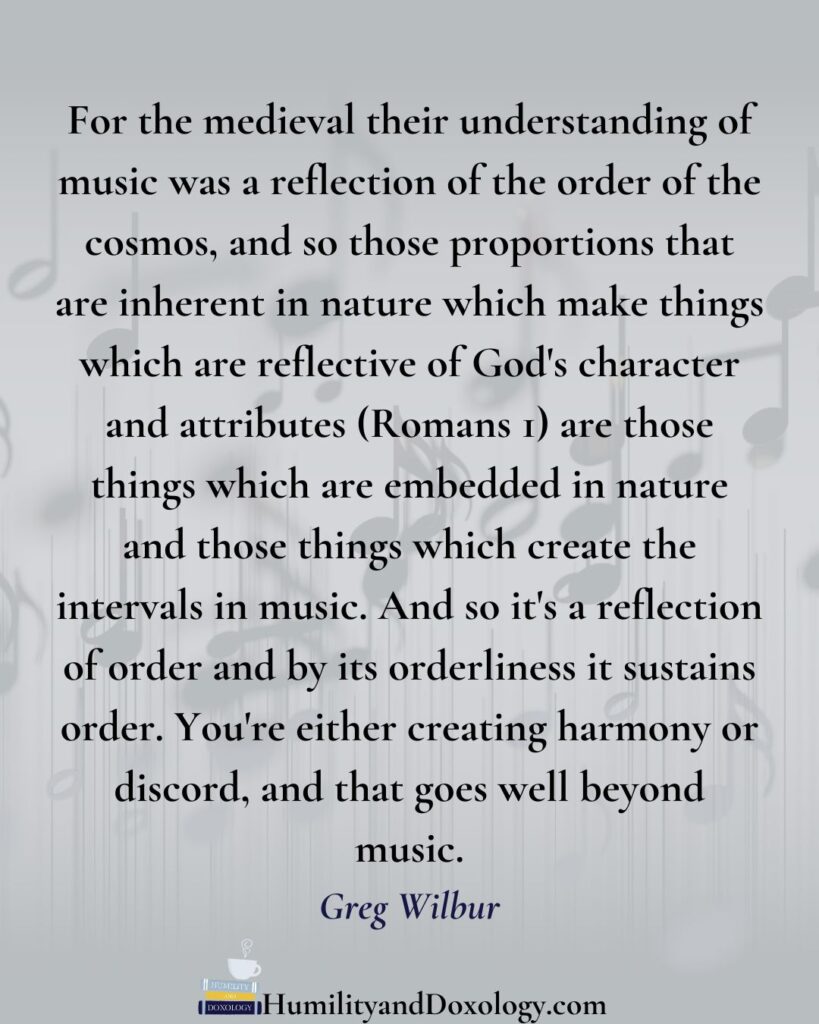
Music, he said, is not merely emotional but ethical and metaphysical. “You’re either creating harmony or discord, and that goes well beyond music… The word harmonious literally means fitting together.”
“Harmony is how you hold things together in tension—justice and mercy, peace and order—all reflecting God’s character.”
Seeing and Living Harmony
Harmony, Wilbur explained, is more than stacked notes: it is relational. “It’s the movement of this note to the next note.” Living in harmony means living “according to the way God created the world to work.” He connected this to Paul’s command to “live in harmony with one another,” saying, “There’s an ethical quality to what it means to live in a harmoniousness.”
Music, the Body, and the Cosmos
Wilbur lamented how the Enlightenment separated music from the spiritual: “It becomes much more about entertainment.” True musical education, he argued, must recover music’s formative power.
He also described the difference between live and recorded sound:
“When you listen live, you’re getting sound waves passing through your body. That’s a very different experience… an embodied and incarnated moment.”
Ordering Our Affections
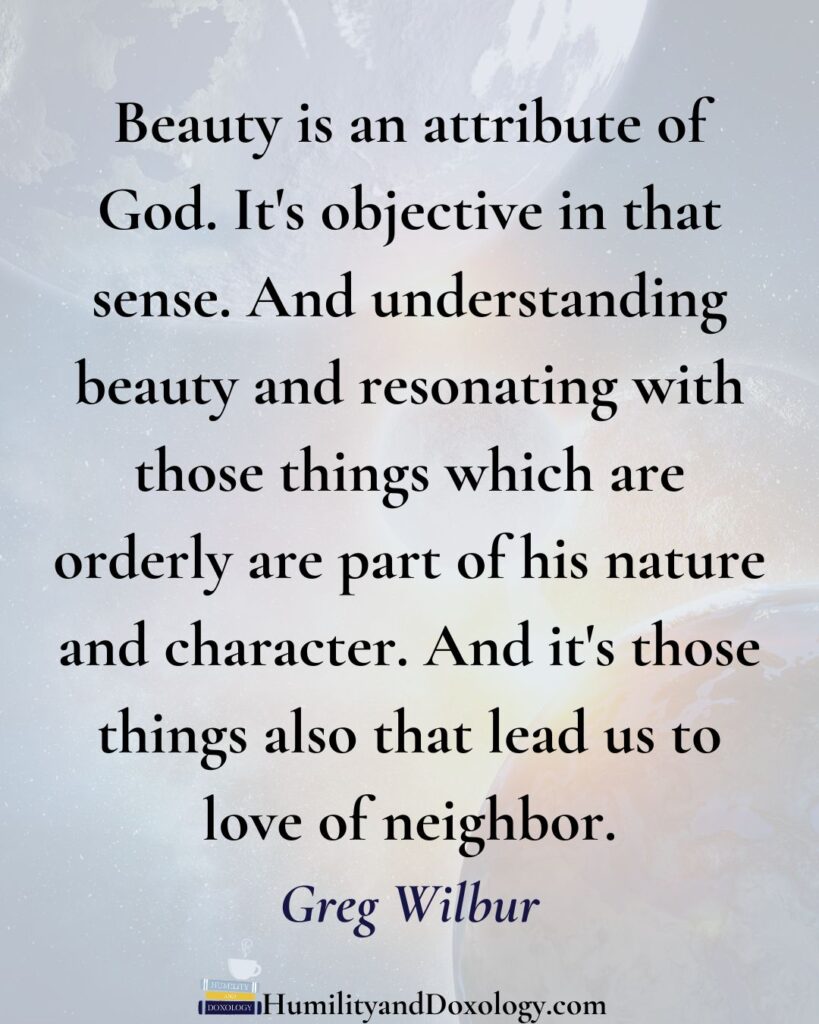
Wilbur encouraged families to cultivate musical taste intentionally: “One of the most important spiritual disciplines… is just pay attention.” Beauty, he said, “is an attribute of God,” and training our ears and hearts helps us love both God and neighbor.
He advised parents not to fear what they don’t know: “You know intuitively when a piece rises and falls… you can talk about how it’s shaped and moved.”
Turning a Bad Day Around
Wilbur’s advice for redeeming a rough educational day? Simple: play music.
“That has a way of resetting emotions… and just turning things into a different direction.”
After all, he joked, “It’s hard to be in conflict with people when you’re dancing with them.”
Key Takeaways
- The Quadrivium completes the classical vision of education when joined with the Trivium.
- Music reveals order and harmony reflecting God’s character.
- The ethical and theological dimensions of music form souls, not just tastes.
- Harmony means “fitting together”, holding justice and mercy in tension.
- True education is a mode of thinking, not a checklist of books.
- Live music provides an embodied experience unmatched by recordings.
- Beauty is objective and rooted in God’s nature.
- Parents can begin by simply listening attentively with their children.
- Replacing habits with better ones reshapes affections and loves.
- When learning goes awry, play music—it restores order and joy.
You may also enjoy:
- Narration as the Art of Learning: A Conversation with Adrienne Freas
- Faith, Story, and a Literary Life with Dr. Carolyn Weber
- Wisdom, Truth, and Cultural Discernment with Dr. Carl Trueman
- Classical Education, Homeschooling, and the CLT
- Words, Words, Words: Why (and How) to Teach Writing
- Classical Education for Students with Special Needs
- Reading for the Love of God with Dr. Jessica Hooten Wilson
- Natural Philosophy: Recovering a Natural Science and Christian Pedagogy (with Ravi Jain)
- A Common Arts Education in Our Classical Homeschool (with Chris Hall)
- Classical Charlotte Mason Homeschooling (with Adrienne Freas)
- Order, Harmony, and the Medieval Imagination (with Kelly Cumbee)
- Why We Pursue a Christian Classical Education in Our Homeschool
- Curiosity and Surrender: Classical Education, Poetry, and a Longing for Light (with Jennifer Souza)
- Patience, Wonder, Ignorance, and Joy in a Classical, Charlotte Mason education (with Karen Glass)
- Reading and Teaching the Great Books (with Kristen Rudd)
- Repentance and Discipleship in Christian Classical Education (a video interview with Dr. George Grant)
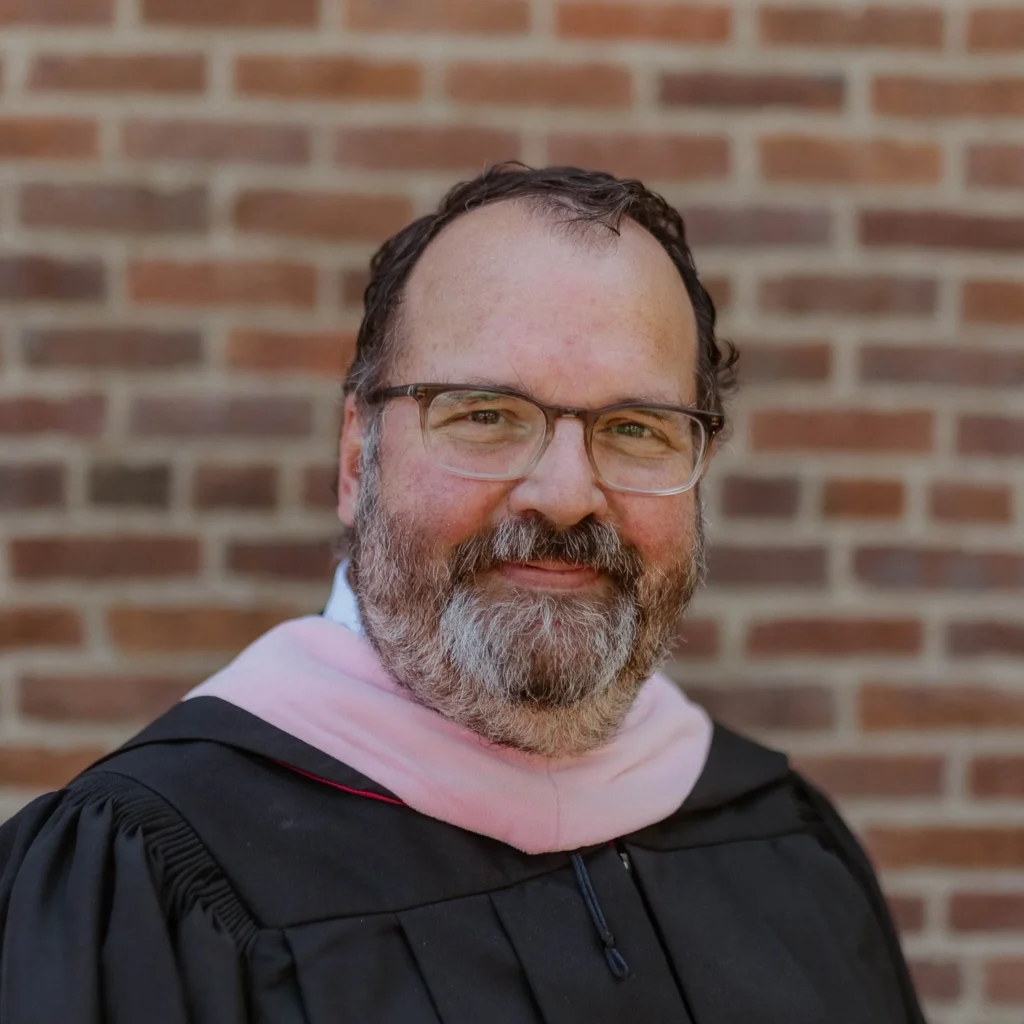
Gregory Wilbur is founder of New College Franklin—a Christian college that concentrates on the classics and the seven liberal arts with a discussion-based approach and spiritual formation. In addition to teaching and developing curriculum, his current academic focus is advancing the disciplines of the Quadrivium by bringing together leading voices in its renewal. He is an award-winning composer and has released multiple albums of hymns and Psalms for congregational singing.
Check out all the other interviews in my Homeschool Conversations series!
Amy Sloan: Hello friends, today I am so delighted to be joined by Gregory Wilbur. He is the founder of New College Franklin, a Christian college that concentrates on the classics and the seven liberal arts with a discussion-based approach and spiritual formation. In addition to teaching and developing curriculum, his current academic focus is advancing the disciplines of the Quadrivium by bringing together leading voices in its renewal. He is an award-winning composer and has released multiple albums of hymns and psalms for congregational singing. I’m so delighted to be chatting with you today here as we get started. Just tell us a little bit about yourself, your family, and your background with kind of classical education in general, music specifically, And then I’ll also say that my friend Lucy, who is a student at New College Franklin, said I needed to make sure to ask you about all of your collections. So maybe you can tell me about that too.
Greg Wilbur: Great. Well, I’m so delighted to be here. Thank you for having me. I grew up in a musical home, and so I came by that honestly. My mother taught piano lessons. She was an organ major. She led music at our church for 50 plus years. My dad was the pastor, so very much involved in that growing up, went on to study music in college with the idea of wanting to serve in the church, and that was my initial desire and ambition. That took a while to get to that point, and along the way I started teaching at a classical school about 30 years ago at this point. And as is what happens at a lot of small schools, you wind up teaching things you hadn’t necessarily planned on teaching or that you maybe necessarily hadn’t studied yourself so thoroughly, but that began for me a whole education and the idea of the arts and beauty and music’s place in that, especially with my interest where how that applies to issues of worship. And so all that became kind of the foundation of all those studies and the years that I taught in that situation, and about 10 years at the school and then started a homeschool co-op for a few years and then eventually homeschooled our own child and then started the college and had the opportunity from ground up to implement the seven liberts, trivium and quadrivium in the context of a college setting along with the great books, the great questions of theology and practice. So all those things kind of flowed in together from one thing to the next. And along the way, I also started working full-time church and got to be able to do that as well and have done that now for a number of years.
Amy Sloan: I love to hear just sort of the gradual growth and understanding, you know, and I can imagine probably many listeners can relate to that. You know, you go into one thing and suddenly you’re like, oh wow, I guess no one’s here teaching this, but then as we’re teaching something we learn and grow and get excited and that deepens our own understanding as well. So tell us a little bit about some of the maybe unique collections you have around your house.
Greg Wilbur: I was going to say too about, you know, learning and growing. I do, I shudder and I’m a bit embarrassed by probably the things that I talked about and taught and spoke about in the early years of my formation. So it is nice to be able to continue to grow as we teach, as we study, as we learn and deepen our own understanding. My brother once described my office as if the cathedral exploded because I have little bits of things from whether religious art or replicas of roof bosses or carvings from from choir stalls and I have a fair collection of lego from architectural pieces and so forth and I’m one who likes to memorialize trips and significant occasions in life with something tangible and those tend to wind up on my shelf in my office because my wife at various points have said we have too many things at home either this goes or you know so they wind up here so I’m you know looking around now at all the things so so yeah it’s very eclectic. There’s hardly any inch that’s not covered by something. It is a delight, because I can look out and see things and be reminded of trips or conversations or experiences.
Amy Sloan: It really reminds us of the stories and the people. I no longer really like to get doodads or things on trips, but what I love to do if we’re on a trip is go to a bookstore, especially like a a used bookstore or something like that and find some old book and then I’ll write in it, you know, I got it at this, you know, this place and this city and this year and then it’s always fun because, like, decades later I’ll open up the book and I’ll have completely forgotten, oh, I got this book, you know, in York, England, I remember that trip, you know, and that’s really, it’s a fun, a fun kind of little gift to your future self, too, because it comes with the memory, not just the book itself.
Greg Wilbur: Why, I envy those people, too, who have a foresight to, write in the front of their book every time they read it, not, you know, the date, but also kind of where they were in life at that point or what they got out of it that time through. So as you reread a book, you can actually kind of see that history of your encounter with that particular text. But like I said, I haven’t had that foresight, but I like the idea of that.
Amy Sloan: Oh, I like that too. I’ll have to tell my kids. I feel like it’s too late for me to start that now, but that sounds like something my kids would really enjoy. Well, one of the questions I wanted to ask, you know, you mentioned your work in the church and your work with worship. So when was your first hymn arrangement actually published in a hymnal, and was there a reason why you chose that particular hymn?
Greg Wilbur: Boy, that’s a good question. I mean, I started writing when I was really little, not anything that would be good for anybody else to hear, but I just was working on creative things. When I was in college, I wound up getting a master’s in composition and serving at a church. So I began writing for a small choir at the church and some hymn and psalm settings. So I was kind of doing that all along. It was, and writing some choral pieces. But the, I don’t think I’ve ever actually promoted any of my music towards hymnals. it’s been people contacting me and so that’s been probably now at least 20 years for the first one and I just got an email recently from a New Zealand denomination who wants to republish a hymnal that they’d published one of my hymns in like 2013 but I think it’s about 20 hymnals at this point in which I have various songs but then along the way I was able to do my own recordings and release things, music that are written primarily for our church. And so it’s very much focused on our local setting, our congregation, the sermon series, or whatever we have musical needs written for the congregation to sing, not necessarily a soloist. I usually record it that way, but it’s written for our church, and then some of that has found life in various recordings.
Amy Sloan: Well, that’s really neat to be able to have the congregation, it relating to the sermon as well. Just the word and the music really working together, not as separate things, but as coming together to support each other. That’s neat. Yeah. Well, one of the things I’m super excited to talk to you about is this idea of classical education and the quadrivium in particular. I know it’s something you have devoted a lot of time and thought to. When people think about classical education, especially folks outside the tradition, I’ll be like, oh, yeah, it’s that, like, grammar, logic, rhetoric thing. Or sometimes even within the classical tradition, it’s really focused on the trivium. And we forget about the quadrivium. So if you can, for those who are listening, maybe give kind of a brief introduction as what the quadrivium is, why it matters, and if it’s still relevant to us today.
Greg Wilbur: Yes. Well, I think, you know, we talk about the seven liberal arts because ideally the three and the four were meant to work together. And I think in some ways just having an individual focus on the trivium without the quadrivium kind of sends that off to maybe a slightly different direction than was intended by all seven together. And so, you know, some people think about, you know, the language arts versus the mathematical arts or the qualitative versus the quantitative. I don’t like that delineation because there is a qualitative aspect to number as well as quantitative, and that’s part of what the quadrivian uncovers. So historically speaking, or as it kind of got condensed in, especially through the medieval period, it’s arithmetic, geometry, music, and astronomy, but not as we think of arithmetic, not as we probably were taught geometry, but a more robust understanding of number, the idea of number, number and relationship, geometry using Euclid or other sources that aren’t using specific numbers. We’re actually talking about the idea of ratio and proportion, which is great when you work through Euclid. You’re working on a particular proposition and the application of that fits on your page, but the proportions of that could expand to the size of a cathedral. It’s not you’re dealing with specific numbers, you’re dealing with the idea of how those things relate. But then music, I think, music, I may have to circle back around on this one because that’s the one that’s also the most difficult, I think, because we are, our understanding and our siloing of music as a fine art or as something that’s more emotionally driven seems really disconnected from, from arithmetic, geometry, and astronomy. And I, there’s, there are reasons for that. So part of that is recovery of how does music fit into to this idea of number and number in relationship to one another. Augustine, in his book on music, talks a lot about that. That’s a lot of the sense of proportion that he even within his definition of what music is. And then astronomy as well, the relationship between the spheres. The interesting thing I think is that with early Greek education, you talk about gymnastics and music. Those two get talked about. Gymnastics was not just physical exertion, but it was also a training of the appetites and included fasting as well. It was a holistic idea of how do you bring discipline to the body. Training in music or the muses was actually a training in the affections. You think of the muses were the nine daughters of memory, and so that was the enculturation of a student’s life. these are our songs, these are our dances, these are our epic poems, these are our love poems, these are our plays, these are the star myths because astronomy and music are both part of of the muses in the earthly education as well as quadrivium. So music and astronomy and the quadrivium is different than music and star myths and mythologies that we think of in terms of that earlier level. But I think unfortunately and like especially with regards to music our understanding of music tends to be a music appreciation, music history, music theory, all very good things, but those would have been more foundational and not what would have been studied with regards to quadrivial studies. And so having that kind of different mindset, I think, is helpful to put that in there. And then, you know, then the, what does it mean to, are these still relevant? How do we recover these? You know, an example I’ve used a number of years is Augustine was beautifully classically educated, but he never read Shakespeare, or Dante, or Thomas Aquinas, or himself. All the things that we add on to what it means for us to have our children educated in a classical way just didn’t exist. They were after his time. What does it mean to take the principles and ideas of what the quadrivium was for and then move that through the things that we’ve learned in the past 1500 years. But I think there is a distinctive difference between STEM or what we think of in terms of math and science and what the quadrivium is for. There’s a moral, ethical, formative content to the quadrivium. It’s utilizing number, it’s based on a number, but it leads to philosophical and theological discussion as well as the practical outworkings. And so in some ways, I mean, I’ve heard people say things like, well, the quadrillion has been replaced by, you know, algebra, geometry, you know, that sequence of classes, when in fact, I think those are two very different things. And it’s not necessarily a replacement of those things, it interfaces with those things, but it is after something different. And so, I think there’s not necessarily a replacement of, but actually alongside of, which return to quadrivial studies as well as the math and the sciences that we often teach.

Amy Sloan: I think that’s really helpful to hear, because I do think there can be this misunderstanding of like, we have a trivium, we have a quadrivium, they’re two separate things. Instead of understanding, No, these were considered the seven liberal arts. They’re working together and focused on soul formation, really, the mind and wisdom. One might even say humility and doxology. But I’ve thought about this a lot, actually, in the past couple years as our family has gone through, you know, medical crisis, things that impact the realities of the content you’re able to include in your day. And I have been really struck by how there can be a misunderstanding in classical education world that like, like you were saying, it’s like, well, have you done this list of these books? Have you read these things? Have you memorized these facts? And like that defines a classical education. And what if you can’t do those things? Can you still classically be educating your children? Is there something beyond that, deeper than just a book list or some sort of concepts we want to impart and pour into our kids’ brains somehow? There’s something much deeper and richer that we are focused on.
Greg Wilbur: It’s more of a mode of thinking than it is the book list. And the actuality, it is through those things that you get towards that mode, but it’s it’s not necessarily checking the boxes on things. And I think that begins to help us think a little more expansively of what education is and what we’re looking for, of what we desire in our children. I mean, I think we recently finished up our school year in the spring and several students commented at the end of the year type of things, how one of the things that they appreciated about some of the classes that I taught. And I’m not saying this. I’m saying this only as a point, but that the classes that they took with me helped them see the world differently. And that’s less about content than it is about having a new, a new vision for things. I think, for example, you know, the divide, that sense of divide between the trivium and the quadrivium. Where does poetry fit in? poetry is actually a musical art, it actually fits in the quadrivium because it’s relationship of meter. And so when Augustine talks about music, he starts by talking about rhythm, he starts talking about poetic meter. And so what we would typically think of, well, of course, it’s language arts, poetry shows up, you know, that’s part of the trivium, we’ll fit it in, you know, as rhetoric or, you know, creative writing something, more historically speaking, poetry would have been sung and it would have been seen as a relationship between the lengths of sound.
Amy Sloan: That’s fascinating. My daughter actually was just yesterday telling me she had read an article, I believe it was by Anthony Esolen, on a particular hymn and she was talking to me about the chalice meter, which we were not familiar with before, but, you know, we are used to seeing like a hymn written out in stanza form with the music and the words, but when it’s actually written out in the metrical form, it kind of forms this shape, and that was really fascinating. I had never thought about that in relation to poetry or meter, and now I’m like, okay, wait a minute, I need to stop our conversation and go off on this. I need to contemplate more this idea of poetry as part of the quadrivium, but I’ll have to think about that offline and then come back and have a second conversation.
Greg Wilbur: This is a book, and I can’t think of the author’s name, but his thesis is that George Herbert derived his poetic structure and form from Augustine’s book on music.
Amy Sloan: Wow. Okay, I have like another thing to study now. This is so exciting. But this is actually kind of interesting because I wanted to ask, you mentioned this briefly, you know, music is often we think about like music appreciation, you talked about how we think of that more sort of those early years or this emotional experience, but music has an objective reality, right? So how can music be objective when maybe in contemporary culture we think of it as based on emotions?
Greg Wilbur: See, that’s the type of question that is a really great question that I refuse to answer my students for a whole year while we go through the course because and here’s the reason why now I will answer it but it’s really hard to offend somebody with an isosceles triangle but you start talking about music and suddenly you’ve stepped on all sorts of toes and we have a defense mechanism because so much of our identity self-identity has been wrapped up in the music that we like and so when you start talking about well if I start talking about something that is objective about music then the next thing is I’m going to say that the music that you listen to is bad you know you know that’s coming right you know we’re all we all feel that judgment coming right uh and so it’s it’s uh I prepared that conversation over a long period of time but the heart of that is is um is uh Augustine’s understanding of music it talks about it’s the knowledge of modulating or motion doing that well and so there’s an ethical aspect to it and you know for the medieval their understanding of music was a reflection of the order of the cosmos and so those proportions that are inherent in nature which make things which are reflective of God’s character and attributes, Romans 1, are those things which are embedded in nature and those things which create the intervals in music. And so it’s a reflection of order and by its orderliness sustains order and because it’s either you’re either creating harmony or discord and that goes well beyond music. I mean you can apply that to a relationship? Are you seeking harmony in relationship or is it discordant? What’s life like in the home? What’s life like in culture? There’s an ethical quality to what does it mean to live in a harmoniousness. And so the idea of harmony extends well beyond music. I mean, that’s its most obvious application. But the word harmonious literally means fitting together. And so how do you fit things together in tension? It’s not about balance. That’s much more of a, you know, shave off a little bit here or there and keep things in balance. You know, harmony is much more like, you know, you’re drawing a string taut. And when it’s stretched out, you can pluck it and you can make a beautiful tone. But if it’s loose, you know, if it’s not in tension, then it doesn’t create music. And so there’s that aspect of how do you hold these disparate things together? So if God is all justice and he’s all merciful, you don’t balance those out by shaving off some of his justice to seem more merciful or the other way around. He is totally, fully both of those things. The harmony is how you hold those things in tension. And that’s a theological question that, you know, that we wrestle with at times. But you see the discord that comes in the Garden of Eden, you see the peace, the shalom, shalom, rightness of things, justice, harmony are all entwined in the same kind of idea, that the peace that comes from the blood of the cross. And so there’s a restoration of harmony on the individual level through salvation of the blood of the cross. So that idea, that metaphor is very useful not just as a semantic exercise but really as how we relate to one another. I mean like if you’re having a good conversation with somebody you said like we really resonated, you know. We use these terminologies all the time like when your car needs fixing you take it in for a tune-up, you know, you’re retuning your car so that all the things work in conjunction with one another, they fit together in a way that is orderly.
Amy Sloan: That is really fascinating and yet one more example of how some of these tensions or difficulties really find their resolution or find their order in the character of God himself, which is one of the reasons why I personally believe that Christian classical education is very important because we can only truly understand these things as we see the truth and it really coming from who God is himself, which then works itself out into the created order. But I think it’s also interesting because when we hear the word harmony, you know, we think, oh, alto, tenor, bass, right, you know, these things we hear, but you were making that word have a much deeper and richer meaning. So let’s talk a little bit more about harmony. Is there a way to see harmony? Like, how is harmony more than something we just hear with our ears?
Greg Wilbur: Well, you know, Paul, the Apostle Paul, uses harmony a number of times, live in harmony with one another. So he uses that kind of terminology, even in that kind of context of the ethical aspect. Boethius, in his book on music, talks about cosmic music, music of the heart, the soul, and instrumental music or heard music or ethical music. So there’s, you know, there’s all those different levels of how those aspects of harmony work. But, you know, remembering also that when the Greeks were talking about harmony or even in the early days of the church, what they meant by harmony is the movement of this note to the next note. They’re not talking about notes on top of one another, and so it’s the aspect of what’s the relationship of this tone to this tone, and then the following tone. And so it’s much more of a linear idea than it is a horizontal idea. That comes along in terms of musical development, but to recognize too that harmony is not just notes stacked on one another, but also the relationship one to the next. And so that has further implications too of how you recognize, because that involves issues of memory, it involves issues of hearing and of playing back or singing or participation in. And Augustine talks about how all these things then point to the divine numbers, those things which are reflective of who God is, which also with Augustine too is, you know, the idea of rightly ordered loves, it’s the formative aspect of those things which are well-ordered or reflective of order that bring us into harmony or into order with God and with his creation. I mean there’s a way to think about even the Ten Commandments as this is the rule book, this is the guidebook of not just thou shalt nots, but the positive aspects of what does it mean to live harmoniously in the way in which God created the world to work and if you don’t live if you live discordantly with the way God created the world to work then in sin then there are consequences to that but if you live according to the way in which he you’re trying to create your own alternative reality but if you live in the reality of what God has made you live harmoniously with creation and with God and with other people.
Amy Sloan: So it’s really more an issue of, like you were saying, living in accordance with reality, whether that be in relationship vertically with God or horizontally with those around us, with our neighbors. I’m thinking of, insofar as it depends on you, live at peace with all men. there’s that sense of harmony is kind of what I hear you talking about. It’s more that peace, peace with God and peace with our neighbors. Right.
Greg Wilbur: And that’s obviously reflected in the music that we hear. You know, we recognize that there are certain types of music that are more appropriate for different situations. You know, that whether we’re in, no pun intended, in tune with our own, you know, connection with the music or not. I mean, some music is more appropriate in other places. Like, you’re not going to play, a marching band’s not going to play a lullaby marching down the street, you know. You’re not going to play, you know, hip-hop or rap to get your child to go to sleep, you know. But you are going to play high-adrenaline music at a sporting event so that you get the crowd, you know, revved up and pepped up and ready to cheer on, you know. you’re you’re emotionally you’re literally emotionally manipulating them uh sometimes physiologically because like in some instances they change they increase the um the tempo of the songs that they play so that you’re actually um in sync heart rate wise with the music that’s playing that gets your adrenaline going so that you’re more participatory and so there’s a there’s a way in which our bodies lend itself to those types of situations i had a student years and years ago who there was certain music that he played when he was angry because he knew that it would feed his anger he wasn’t trying to get out of it he actually wanted to kind of feed that it’s like wallow in it right but he knew that you know there’s you know if you want to set a particular mood you know for for dinner or a difficult situation whenever there’s there’s particular particular types of music that you’ll play one of one of the readings that we did one of the classes I taught recently says that part of the beauty of sorrowful songs is it actually reconciles in beauty the difficulties of life. And it actually resolves those in a particular way. I mean there’s a reason why when we’re melancholic or things are difficult we tend towards things which are, you know, maybe explore more mournful aspects of life, and especially the Psalms, you know, understanding the difficulties of life that David and the other psalmists talk about, and having that expressed in music. But it becomes, you know, cathartic in a way, in that it actually resolves what is discordant about life, it resolves it harmoniously in the context of music. So there’s ways in which we resonate with that in it that we listen along and are participatory.
Amy Sloan: It makes sense because we’re not Gnostics, right? Like we don’t just think, oh, we’re these, like, talking about these ideas and these, like, harmonies, you know, this music thing that’s just sort of out there. God made us to be embodied souls, right? So it makes sense that it relates to our bodies as well as our minds.
Greg Wilbur: And see, and that is, thank you for bringing it up because that is the big divide too that happens in the development of music history and when you think about to the time of Bach you know he died in in 1750 into the Baroque period most of the music especially that we study in music appreciation types of situations are it’s music that is written for the concert stage not the church is written for a secular setting and is instrumental and not vocal. And so there’s a significant shift with the Enlightenment thinking that music becomes much more about entertainment. And it separates from the spiritual, you know, it becomes much more on the plane of the physical and not the metaphysical, and the spiritual is separated out of that. And so it becomes much more about what’s popular, what the crowd wants, you get the romantic period, you get the rise of the superstar artist and, you know, very much about the performance than it is about the music itself. And so those changes, too, and see, and that’s the thing, like, that’s kind of a trap of, you know, we think about, well, we’re doing, we want to do good education, we want to do things maybe we didn’t have, we want to teach classically, we want to teach really good music. And so, unfortunately, most of what we know, what we’ve been taught, or where we’ve been led, is music that is primarily secular in nature, and instrumental in nature, and is actually working on a physical level and not a spiritual level in the same way. And I think that it’s better, it’s good. I mean, the order itself reflects order, but there’s so much more that we could do with regards to educating our children and exposing them to other types of music that has a different aesthetic to it and a different purpose and intent.
Amy Sloan: Thinking about what you were saying about, you know, the history of music there and the impacts of the Enlightenment and things, well, first I want to clarify, I mean, nothing against Chopin. I love Chopin still, but I distinctly remember a big shift happening when I When I was a teenager, I was a pianist, or I am a pianist, and when I was a teenager and I would be feeling all these big emotions, I would just go sit and I would pull out my show pen and I would just play and drum up all these emotions. A couple kids in to adulthood, mid-20s, I was like, I can’t do that. When I was just overwhelmed by emotions, I would get out my Bach and I just wanted to plays them Bach inventions. And there was something so, like, reordering about that in a way that my youthful, like, emotive self was. And again, I’m not saying Chopin is bad, you know, it’s wonderful. He’s also beautiful. But there was something very distinct I noticed as I matured in wisdom that I was drawn more when I wanted to use music to kind of help process and and reorient myself, I found Bach was much better for reordering my affections appropriately.
Greg Wilbur: Absolutely. No, perfect, perfect illustration. I think I realized too, when I first got into listening to art music, classical music, kind of on my own, it was the big stuff. You know, it was Tchaikovsky, it was 1812 Overture, it was Holst’s The Planets, it was, you know, Wazorski, Pictures at an Exhibition, Bernstein’s piece, I mean it was really, it was the big pieces, the big orchestral pieces, all the sounds, all the colors, and over the decades what I wind up listening to is simpler and simpler, and you know, less movement, less harmonic changes, and that, yeah, some of that, it makes sense at the time, and like you said, nothing against that. It served a particular purpose. I mean, that’s the thing, too. There is an objective element of music, absolutely, but there’s also the appropriateness of times of life and issues of nostalgia, and, you know, there are particular songs that maybe objectively aren’t great, but you have a particularly sweet memory to, and that’s to be embraced. On the other front, there are songs which are really appropriate to sing and play when you’re four, five, and six, but hopefully that’s not the same songs that you’re playing when you’re 40. Unless you’re playing it to your child or grandchild, but you grow beyond that in some ways. And that’s not to diminish what that was at that particular time in your life, it just doesn’t, it just doesn’t feed the same way. And I think, you know, there’s all sorts of, especially, you know, when you start talking about what books should you read or what movies should you see or what music should you listen to, and there’s, you know, all sorts of opinions and ideas out there about what you could or should or can’t tolerate and, you know, and, you know those are those are all important conversations uh but the one you know another way to look at that is not um this particular thing but where is this where is this piece of art where is this piece of music where is this film uh where is it leading my affections you know to what place is it uh wanting to uh to move me towards and uh is that um is that a good place for me to be? Is that where I need to be? Is that moving? Is that training me in the way in which I want to grow and mature? Or is it getting in the way?
Amy Sloan: And as Christians, we know the first and greatest commandment, right, is to love the Lord our God with all our heart, soul, mind, and strength. And the second is like it, to love our neighbor as ourselves. So how does this idea of growing and understanding musical harmonies, you know, this sort of classical idea of music, how does that lead us or support us in our ability to love God and to love our neighbor?
Greg Wilbur: Yeah, good question. You know, medievals talked about the fact that we were created as thinkers, makers, and worshipers, and so we’re going to listen to something. You know, it’s not a question of whether we will, but what are the choices that we make? And so being mindful of that, of being conscious of that, and not just setting that on autopilot, I think it’s one thing. One is, you know, recognizing that, you know, no radical change happens easily. It’s much more likely that you replace something with something else. Years ago when I was teaching back when students actually had CDs and they had CD cases. My goal was not to have them throw out all their CDs, but nobody even recognizes this concept anymore. The fact that you could only have 16 CDs, you had to limit that to your top 16, right? So you had to make a choice of what you listened to. Now you can have a Spotify list of- Thousands. Right. It doesn’t matter. There’s no priority anymore and you don’t listen to them because you forget they’re there, you know. But it was a big deal to take something out of your case and put something else in, you know. And so the idea of replacing something that was there by something else is good. And I think, you know, listening, you know, I think one of the most important things in educating children is just listening to and participating in a lot of music. You don’t necessarily have to talk about what all it is, you know, but just making that part of the culture of the home, and you’re playing good things for them, and that’s helping them to develop their aesthetic taste, it’s helping them develop their understanding of music. So when you actually get to musical instruction, they already have a foundation. It’s like you don’t start teaching a child to read by by never having read to them before. You know, you’ve already been reading them for years and they have a context for what reading looks like. But we tend to have this sense of like, now we’re gonna study music and we’re gonna start with, you know, full bore as opposed to like, this has been part of, you know, part of who we are and what we’ve done. So I think, you know, even as adults listening to different types of music, I had, and learning to appreciate and enjoy those And that helps to define and refine our thoughts on that. And the question was also, how does that lead us to God and to love of neighbor? Beauty is an attribute of God. It’s an objective in that sense. And understanding beauty and resonating with those things which are orderly are part of his nature and character. And it’s those things also that lead us to love of neighbor. And so there’s an apologetic aspect of seeking out those things which are lovely and are a good report and feed our souls in those particular ways. And even if you don’t, I’m a big proponent too, even those who haven’t been trained in music, to give them a voice to be able to speak about it, even without the technical language, to give them a sense of like, because I think some people, so many people are so, are just concerned about what they don’t know about music and concerned about how, what can they offer to their child or their way behind, but you know, you know intuitively when a piece rises and falls, when it comes to a place of rest, where there are things happening, this is, there’s more movement going on here, there’s less movement here, you don’t have to use the technical terms of all those things. You can talk about how it’s shaped and moved that way and paying attention to those things. I think one of the biggest spiritual disciplines I think all of us need to practice is just pay attention. The Lord’s at work and the beauty of his creation and the world that he has made is all around us and we miss sometimes those things because we’re not paying attention and to be able to discipline that attention towards how we see and discipline that attention to how we listen.
Amy Sloan: I think that’s really helpful, because there could be someone listening who’s like, great, but I don’t have a musical background, or I don’t have the knowledge that I feel like I ought to have to pass on to my children. And so just also that reminder that it can start so simply by quiet, by listening, by reflection, by attention. I think that’s really helpful. And I will also just say, personally, with my children, their live music is so valuable. Like, inferior live music is better than the best recorded music, in my opinion.
Greg Wilbur: Amen. Yes.
Amy Sloan: Especially when it comes to something like, maybe classical music, if it’s new to you or to your children. If you’re just trying to listen to a symphony, it can feel like, what is even happening? But if you’re there, there’s also, you’re seeing the different instruments coming in, seeing the conductor. And a lot of places have free or really reasonable priced things for students. I know here in North Carolina, our North Carolina Symphony has multiple student performances that they do every year. I’ve been taking my kids since my oldest, who’s like 20, was tiny. And I love it so much. I love it just so much. In fact, recently, a memory popped up of a video of my youngest son when he was like two or three and we had just gone to that year’s symphony concert and he was talking in his little toddler voice and he was saying, when I grow up, I want to be an instrument boy. He was so excited. He was little. He didn’t understand everything he was seeing, but he was engaged and he was listening. And as you sort of develop those habits, then when they’re older, they think of themselves is the kind of person who’s interested in that kind of music. And that can be helpful, too. It doesn’t have to be some big, grandiose thing you do with your five-year-old. It can just be those little habits that you develop over time. And kind of going back to what we’ve talked about multiple times, it’s that ordering of affections, too.
Greg Wilbur: Well, in a very practical level, I actually hadn’t thought about this until the other day, You know, when you listen to a piece of music, especially through headphones, you’re getting the sound in your ears. When you’re listening to a piece of music live, you’re getting sound waves passing through your body. That’s a very different experience. You know, it’s a much more embodied and fleshed incarnated moment in which you are literally surrounded by the waves of sound and not just, you know, it’s not just that transfer of information into your ears, into your brain, but actually living in it. And I think that’s a much different experience. And so, like you said, I highly commend, yes, an inferior performance live is better than a perfect recording. And if you don’t necessarily have a lot of live opportunities, at least listening to music by watching a video in which you can see the players play and you can see the physicality of it. It makes a huge difference when you see the cello player begin to play as opposed to just the sound happens and you have no preparation for it. But the visual cues that you get help lead you into the rhythm and the music as well.
Amy Sloan: Yeah. Oh, I will try to. I’m going to say this as a reminder to myself when I edit this. I’ll try to find a few. Good. I know there are some that I’ve watched as a family, and if you have any recommendations of some videos or resources as well, I’ll try to keep those in the show notes. Well, this has been so fascinating, and I’m just really excited to get to share this with everyone. Thank you for taking the time to chat with us. I have, like, now all these other questions, too, I want to ask, but I’ll save those for another day. But here at the end, I want to ask you the questions that I ask all of my guests. And so the first is just, what are you personally reading lately?
Greg Wilbur: So recently finished some classes, and so I’m kind of on my own reading, which is kind of fun. And so I am reading a book called Theo of Golden, which my wife gave me for my birthday, it’s kind of a Wendell Berry-esque story. It’s very fun. I’m reading a thriller for the fun of it by John LeCarre’s son. I can’t think of his name. And I’m also listening to a book by Martin Shaw on story and the symbolic meaning of story. So those are the three big ones I’m involved in by now.
Amy Sloan: I love it. And I love it’s like through your ears, through your eyes, a whole thing. That’s good. Okay, so the final question, and now you are a professor at New College Franklin, as we mentioned earlier, so, you know, you have, I guess, adults, you know, that you’re educating on a regular basis, but what would be your best tip in general, regardless of age, for turning around an educational day that seems to be going all wrong?
Greg Wilbur: Um, play music. I mean, maybe that’s cliche, but, but like, I mean, you know, that, that has a, that has a way of, of, uh, resetting emotions and, and pushing, uh, you know, pushing reset on a number of things. And, uh, and just turning things into a different direction.
Amy Sloan: Do you have a go-to song that you, like, if, if your classes are going kind of crazy, that you’re like, okay guys, we’re listening to this one.
Greg Wilbur: Well, I hope the college kids, we don’t quite get to that point with them, but yes, your instinct is a good one in terms of playing something like Brandenburg Concertos or something that brings an aspect of order or something that’s fun, something that is, something that’s going to, yeah, change, alter the mood, change the moment and something that you you know as a family is just something that you all love together, whatever it is, whether it’s, you know, The Beatles or Simon and Garfunkel or, you know, a tune from Les Mis or whatever, that it’s something that, uh, is going to kind of, yeah, hit that reset.
Amy Sloan: Or you know, in our family sometimes there’s some, like, sea shanties and a little Cotton Eye Joe dancing going on in the living room, sometimes you just gotta, like, get that energy back up.
Greg Wilbur: Right, well, it’s hard to, uh, it’s hard to be in conflict with people when you’re dancing with them.
Amy Sloan: Exactly. Well, where can people find you all around the internet?
Greg Wilbur: So a lot of my music is in terms of downloads and sheet music is at wilburmusic.com and streaming and so forth on Spotify and then in other places. And then just yeah, there’s occasionally things on the New College Franklin website of activities or a podcast or other things going on.
Amy Sloan: Great, and I will have links to those things in the show notes for this episode at humilityanddoxology.com. Thank you guys for listening today. Please do take a moment to go find those links for Greg’s resources and his music. And while you’re here, leave a rating and review for this podcast. Share this episode with a friend you think would enjoy it. And until next time, happy homeschooling.